Changing your Frigidaire refrigerator water filter is one of the easiest bits of maintenance you can do, but it makes a huge difference. Sticking to the recommended six-month schedule keeps your water clean, tasting fresh, and even protects your fridge from working too hard.
Why Bother Replacing Your Refrigerator Filter?
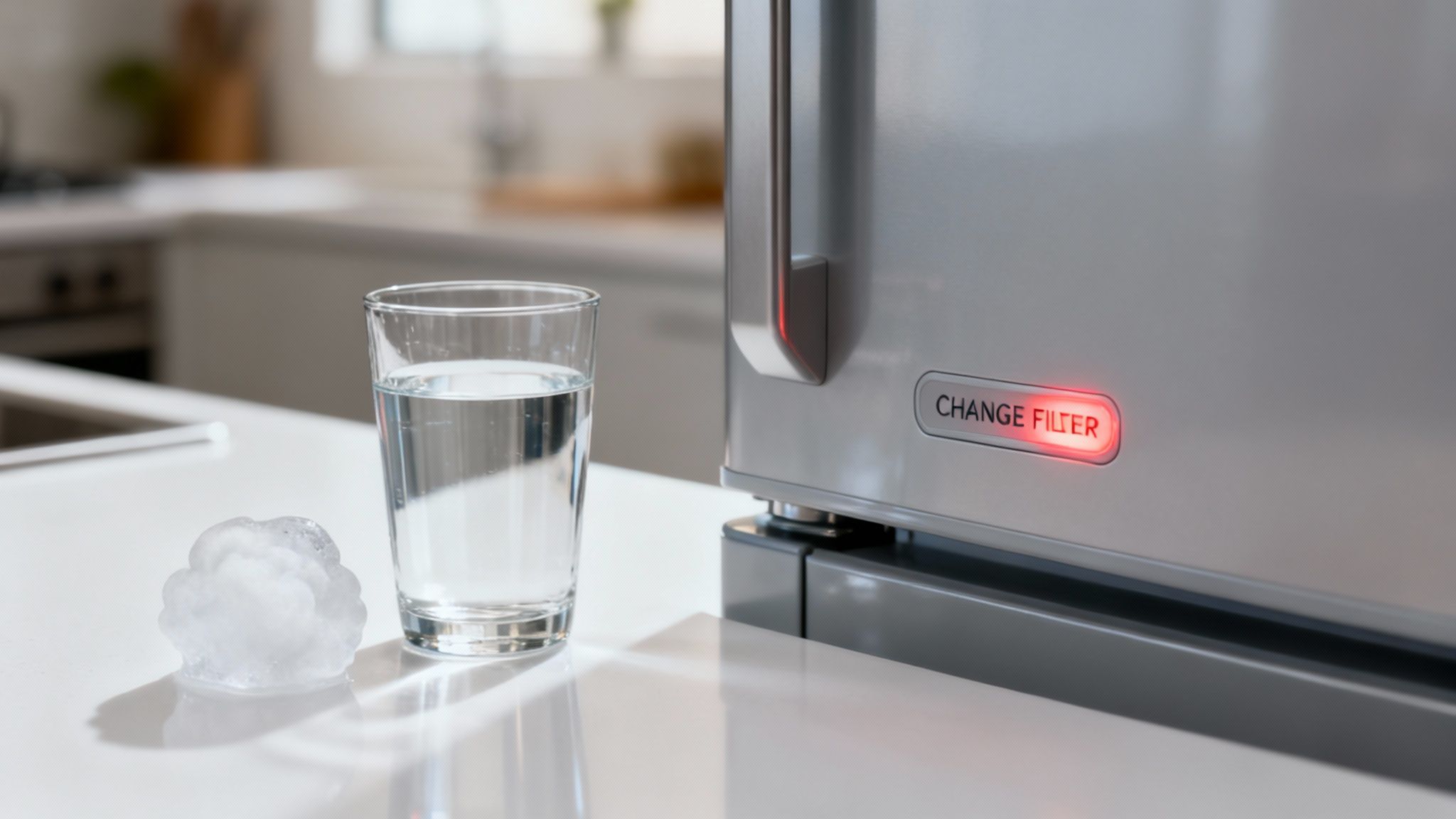
That little 'change filter' light isn't just a suggestion—it's your fridge's way of telling you it's time for some crucial upkeep. For six months, that filter is a workhorse, grabbing all sorts of impurities from your water. Once it's full, its ability to do its job drops off a cliff.
At first, the signs are subtle. Maybe your water tastes a little "off" or your ice cubes look cloudy and have a weird smell. That’s the first clue that the filter is maxed out and can no longer trap minerals, chlorine, and other contaminants effectively.
What Happens When You Ignore the Light
Besides affecting the taste and smell, an old filter can cause some real headaches. It eventually gets clogged with sediment, which slows down the water flow. You'll find yourself waiting forever to fill a glass, and worse, it puts a serious strain on your ice maker. This can lead to some expensive repairs down the road.
When the filter is clogged, the whole water system has to work overtime just to push water through. Ignoring this simple task can wear out important components much faster than they should. For more tips on keeping your appliance in top shape, check out our guide on how to make your refrigerator last longer.
Health, Safety, and Peace of Mind
Let's not forget the main reason for the filter: reducing harmful contaminants. Studies back this up. A 2020 report found that homes using genuine Frigidaire filters saw a massive 92% reduction in chlorine taste and a 78% drop in lead levels. The catch? The same study found that almost 20% of people put off changing their filter, often because they didn't realize the risks.
An old water filter doesn't just stop working—it can become a breeding ground for bacteria. Instead of cleaning your water, a saturated filter can actually start adding contaminants back in.
At the end of the day, a timely filter change is a small price to pay for better water quality, a healthier fridge, and your own peace of mind. If you've seen any of these warning signs or you're just not comfortable doing it yourself, give us a call at Advance Appliance Ltd. We offer expert help in Edmonton, Calgary, and Red Deer.
How To Find the Right Frigidaire Filter
Getting the right replacement water filter for your Frigidaire fridge is crucial for clean water and smooth operation. With different filter lines like PureSource and PurePour, it can seem a bit confusing at first, but figuring out which one you need is usually pretty straightforward.
The best place to start is with the filter you’re replacing. Before you even head to the store or browse online, pull out the old filter and give it a close look. The model number, like "ULTRAWF" or "WF3CB," is almost always printed right on the label. That little code is exactly what you need.
Locating Your Filter's Model Number
What if the label is smudged or has worn off completely? No problem. Your refrigerator has a couple of backup spots with the info you need. Check inside the filter housing—that's the little compartment where the cartridge clicks in. Frigidaire often puts a sticker right there with the filter part number.
If that fails, your owner's manual is another go-to resource. It will have a section listing all the compatible filter models for your specific fridge. Can't find the manual? You can still identify the right part by using your fridge's model and serial number. We have a handy tool for that—just request the correct parts by model and serial number here.
To help you out, here's a quick guide to some of the most common filter types and where you’ll typically find them in your Frigidaire refrigerator.
Common Frigidaire Filter Types and Locations
This table should give you a good idea of what you're looking for based on your fridge's layout.
| Filter Type Name | Common Location in Refrigerator | Appearance/Style |
|---|---|---|
| PurePour (PW) | Upper right corner, inside the fresh food compartment | Long, slender push-in cylinder |
| PureSource Ultra (ULTRAWF) | Upper right corner, inside the fresh food compartment | Shorter, thicker push-in cylinder |
| PureSource 3 (WF3CB) | Upper right corner, inside the fresh food compartment | Push-and-twist cylinder |
| PureSource 2 (WF2CB) | Rear of the fresh food compartment, near the top | Slide-in cartridge with a "cassette" look |
| PureAir (PAULTRA) | Small grille in the fresh food compartment | This is an air filter, not a water filter; flat rectangle |
Once you know the model, you can confidently buy the right replacement.
Genuine OEM vs. Aftermarket Filters
When you start shopping, you'll see two types of filters: genuine Original Equipment Manufacturer (OEM) parts from Frigidaire and cheaper aftermarket or generic versions. The lower price tag on a generic filter can be very tempting, but it’s a gamble that often doesn't pay off.
Genuine Frigidaire filters are engineered for a perfect fit, which prevents leaks that can cause serious water damage to your fridge—damage that your warranty likely won't cover if it's caused by an off-brand part.
More importantly, authentic filters are rigorously tested to meet strict safety and performance standards. Data from the Canadian Standards Association (CSA) shows that over 95% of Frigidaire filters sold in Canada are certified to NSF/ANSI Standards 42, 53, and 401, which means they effectively reduce contaminants. The same report found that counterfeit filters, which lack this certification, make up about 7% of the market and can pose real health risks.
Choosing a genuine Frigidaire filter isn't just about compatibility; it's about guaranteeing the quality and safety of your drinking water. Peace of mind is worth the small difference in price.
Ultimately, sticking with a certified OEM filter is the smart move for your appliance and your family. If you're ever in doubt, the team here at Advance Appliance Ltd. can help you track down the exact filter you need.
Installing Your New Filter and Resetting the Light
Alright, you've got the new genuine Frigidaire filter in hand, and you're ready to get this done. The good news is this part is usually quick and satisfying—nothing beats hearing that new filter click perfectly into place. Most Frigidaire fridges use one of two main filter styles: push-to-release or twist-and-lock.
Before you jump in, here’s a pro tip that’ll save you from grabbing a sponge later. Just place a small towel or a couple of paper towels on the shelf right under the filter housing. A few drops of water will almost certainly escape when you pull the old one out. It's completely normal, and this little bit of prep keeps everything clean and tidy.
Removing the Old Filter
For push-to-release filters, which you'll find in a lot of newer French door and side-by-side models, the name says it all. Give the front of the filter a firm press, and it should pop out just enough for you to grab it. From there, just pull it straight out of the housing.
If you have a twist-and-lock filter, you’ll need to give it a solid turn to the left (counter-clockwise). Usually, a quarter-turn is all it takes to unlock it. Once it's loose, you can pull it straight down or out. Sometimes, an old filter can put up a bit of a fight. If it feels stuck, try giving it a gentle wiggle back and forth as you pull. That’s usually enough to break the seal without having to yank on it.
Expert Tip: Whatever you do, don't grab pliers or any other tools to force a stuck filter out. You could easily crack the filter housing, turning a simple job into a complicated and expensive repair. A firm but gentle wiggle almost always does the trick.
This simple infographic is a great visual reminder to make sure you have the right part for the job.
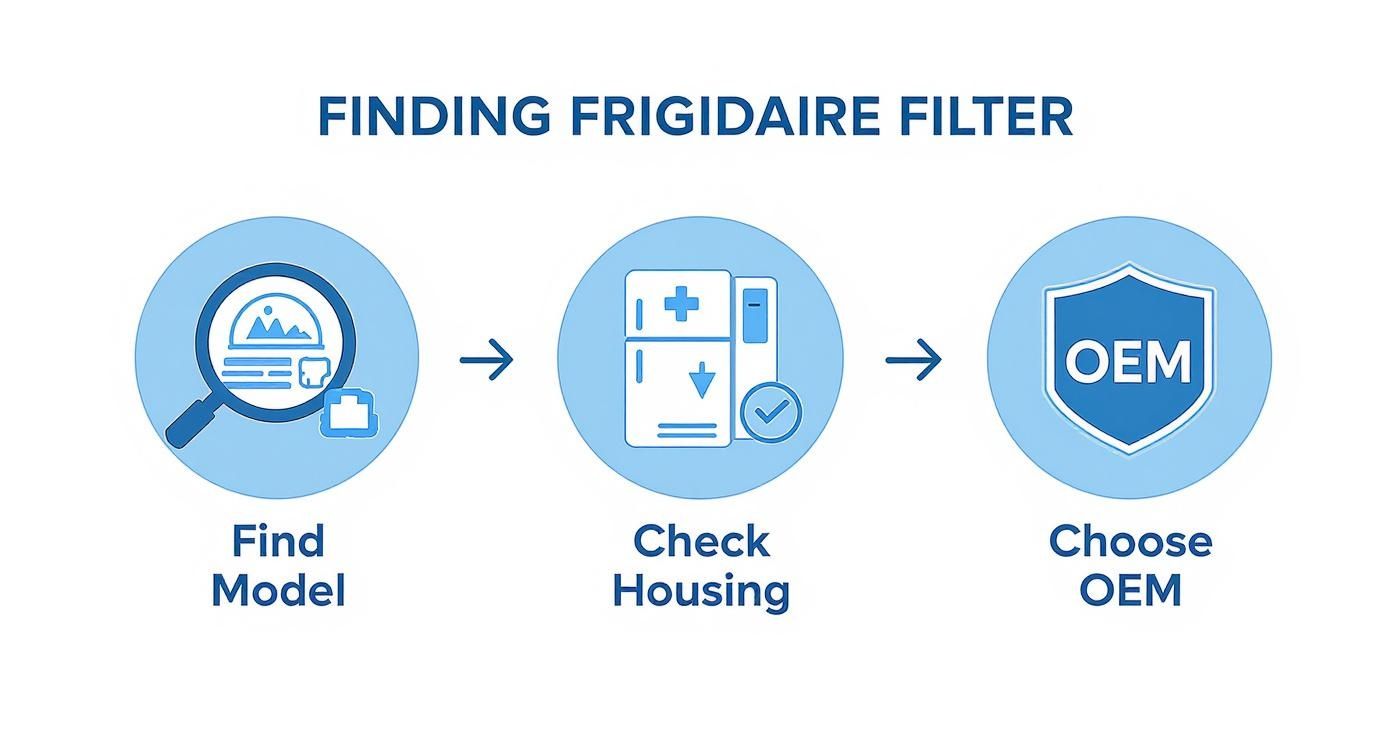
Following these steps—finding your model, checking the housing type, and sticking with an OEM filter—is the key to a successful, leak-free replacement every time.
Putting in the New Filter and Flushing the System
Swapping in the new one is even easier. Start by taking the protective cap off the end of the new filter. Line it up with the housing and slide it in until it stops.
- For a push-to-release model, give it a firm push until you hear and feel it click securely into place.
- For a twist-and-lock style, insert it and turn it to the right (clockwise) until it feels snug and locked in.
With the new filter installed, the next step is crucial: flushing the system. This gets the carbon media inside the filter activated and clears out any harmless carbon dust left over from the manufacturing process. Grab a large pitcher and run about four litres (that’s roughly a gallon) of water through the dispenser. Don't be surprised if the first few seconds of water look a bit grey or cloudy—this is totally normal and will clear up in no time.
Resetting the Filter Indicator Light
The last thing to do is turn off that annoying "Replace Filter" light on your display. How you do this can vary a bit between Frigidaire models. Most have a button that says "Filter Reset" or something similar. Just press and hold it for about three to five seconds until the light goes off or changes colour, usually to green or blue.
If your fridge doesn't have a dedicated reset button, the function is often built into another button, like "Water" or "Light." Pressing and holding one of those for a few seconds is a common alternative. If you're still stuck, your owner's manual will have the exact instructions. While the general idea is the same across different brands, you can find more specific troubleshooting info in our other guides, like this one on how to change a Maytag refrigerator water filter.
If you’ve done all this and are still running into issues, or if you’d just rather have an expert handle it, Advance Appliance Ltd. offers same-day service across Edmonton, Calgary, and Red Deer.
Solving Common Problems After Installation
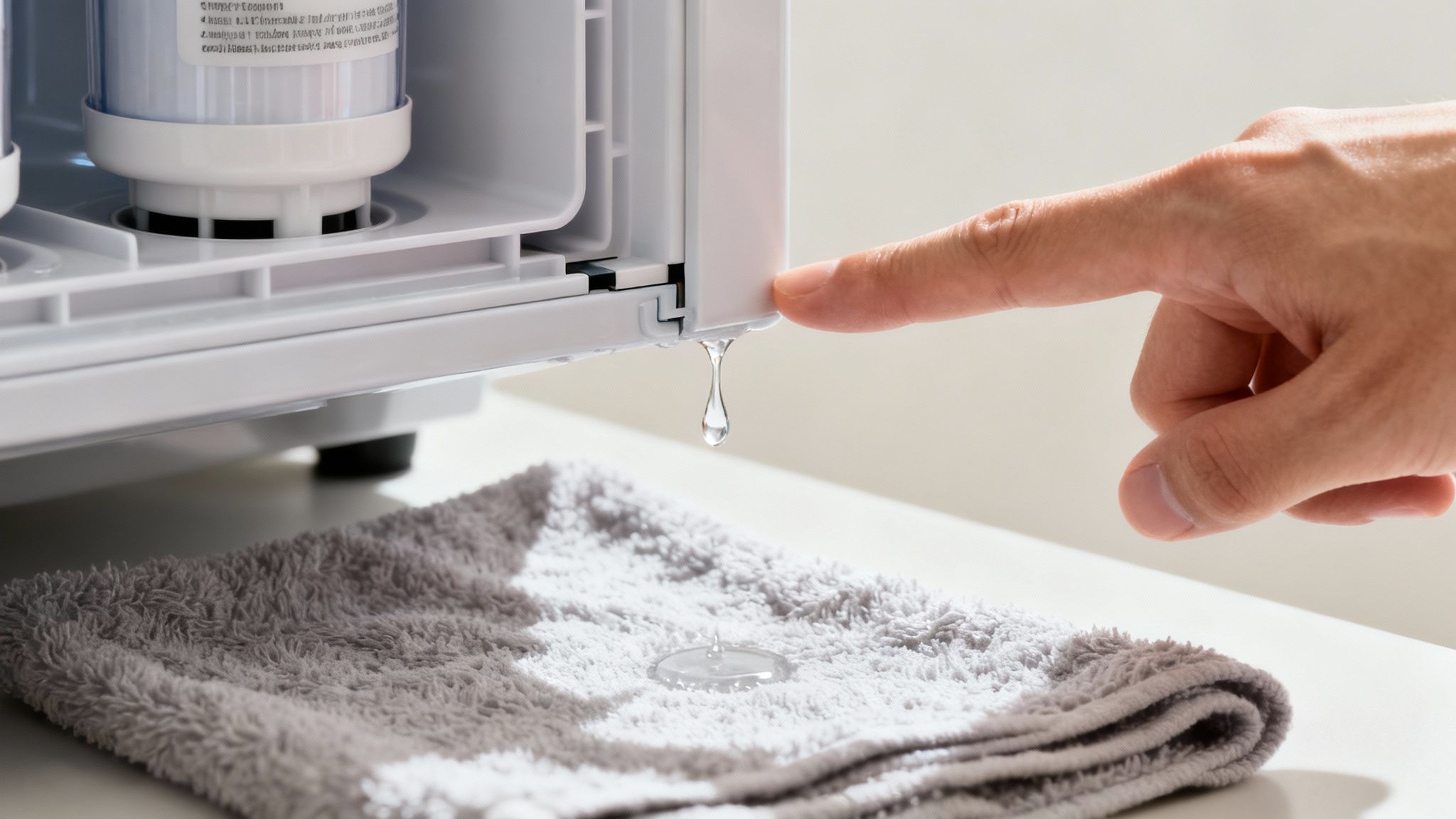
You've just swapped out your old Frigidaire filter for a new one, but something’s not quite right. Maybe the water is sputtering out of the dispenser, or you’ve spotted a small puddle forming underneath. Don't panic—most of these little hiccups are surprisingly common and can usually be fixed in just a few minutes.
Even with a simple job like this, things can get a little quirky. Most of the time, the culprit is just some trapped air in the water lines or a filter that isn't snapped in all the way. Let's go through the most frequent issues I see and get them sorted out.
Addressing Slow or Sputtering Water Flow
One of the first things people notice after a filter change is a slow, noisy, or sputtering stream of water. Nine times out of ten, this is simply air that got trapped in the lines when you took the old filter out.
The fix is easy: flush the system thoroughly. You already ran some water through to activate the carbon, but now you need to keep going to push out those stubborn air pockets. Grab a big pitcher and hold down the dispenser lever for another two to three minutes straight. You should hear the sputtering fade away as the flow becomes smooth and strong.
Air in the lines is completely normal and expected. The key is to be patient and flush the system for a bit longer than you might think is necessary. This step alone solves the vast majority of flow-related issues.
Dealing with Leaks from the Filter Housing
Finding a drip coming from the filter housing is definitely concerning, but it’s often an easy fix. A leak usually means the filter isn't fully seated, which stops the O-rings from creating that perfect, watertight seal.
Your first move should be to remove and reinstall the filter. Give it another try.
- For push-to-release filters, make sure you give it a really firm push. You're listening for a loud, solid "click" that tells you it's locked in. A gentle push often isn't enough.
- For twist-and-lock filters, turn it clockwise until it feels completely snug. It shouldn't be able to turn any further.
If that doesn't stop the leak, pull the filter out again and take a close look at the O-rings on the end. Check that they're clean, sitting flat, and aren't cracked or torn. A tiny piece of debris is all it takes to break the seal.
If you're still seeing drips inside your fridge, our guide on a refrigerator leaking water inside has more detailed steps. For a stubborn leak that just won't quit, it might be time for a professional water leakage repair to rule out a more serious issue.
When the Water Still Tastes Off
It's pretty frustrating when you change the filter to get great-tasting water, but it still has a weird flavour. Assuming you've already flushed it with at least a gallon of water, the problem is likely just some leftover carbon fines. These are tiny, harmless dust-like particles from the filter's carbon media that need to be washed out.
The solution? You guessed it—flush it some more. Dispense another gallon or two to make sure every last bit of that carbon dust is gone, leaving you with nothing but clean, pure-tasting water.
Frigidaire Filter Troubleshooting Quick Fixes
Most post-installation headaches are minor. Here’s a quick table to help you diagnose and solve the most common ones right away.
| Problem | Likely Cause | Solution |
|---|---|---|
| Sputtering/Noisy Dispenser | Air trapped in the water lines | Flush the system by dispensing water for an additional 2–3 minutes continuously. |
| Slow Water Flow | Trapped air or a partially seated filter | Flush the system thoroughly. If that fails, remove and reinstall the filter, ensuring it clicks or twists fully into place. |
| Drips/Leaks at Housing | The filter is not fully locked in place or an O-ring is compromised | Remove and reinstall the filter with firm pressure. If leaking persists, inspect the O-rings for damage or debris. |
| Bad Taste or Odour | Residual carbon fines from the new filter | Flush at least another gallon of water through the system to clear out any remaining particles. |
| "Replace Filter" Light Stays On | The indicator was not reset | Press and hold the reset button for 3–5 seconds until the light goes off or turns green/blue. |
These simple checks resolve nearly every issue that crops up after a filter change.
If the problem continues after you've tried all these fixes, it could point to a more complex issue with your water lines or the refrigerator itself. In that case, don't hesitate to contact Advance Appliance Ltd. for expert service in Edmonton, Calgary, or Red Deer.
Smart Maintenance and When to Call for Help
Staying on top of your Frigidaire’s water and ice system is the secret to getting years of reliable performance. It all starts with the filter. While sticking to a regular schedule is crucial, knowing when to adapt—and when it’s time to call in a pro—is what really makes the difference.
For most families, changing the filter every six months is the sweet spot. This timeline is based on typical water quality and how much an average household uses the dispenser. But your situation might be different, demanding a more frequent swap to keep that water tasting fresh and flowing freely.
Adjusting Your Replacement Schedule
A few common factors can really put your filter through its paces, wearing it out faster than you'd expect. If you live in an area with hard water, for instance, your filter is working overtime trapping all those extra minerals, causing it to clog up sooner. The same goes for large families or anyone who relies heavily on the water and ice dispenser throughout the day.
Your fridge will usually give you a heads-up. Keep an eye out for these tell-tale signs:
- Water pressure from the dispenser has noticeably dropped.
- Your ice cubes are coming out smaller than usual, or the icemaker has stopped completely.
- The water starts to taste or smell a bit off, even if it hasn't been six months yet.
Any of these are clear signals that your filter has done its job and is now saturated. It's time for a change, no matter how long it’s been installed.
Canadians are serious about clean water. A 2021 report showed that 68% of Canadian households with refrigerators use the built-in filtration systems. With roughly 1.2 million Frigidaire filter replacements happening every year, it's clear that following the recommended schedule is a common and effective habit. For more details on your filter's specific capabilities, check out the Frigidaire support page.
Recognizing When You Need a Professional
Changing a filter is usually a quick DIY win, but some problems are symptoms of a deeper issue that needs an expert’s touch. If you run into any of the following, it’s best to put down the tools and pick up the phone.
A persistent leak that doesn't go away after you’ve double-checked the filter installation could mean you have a cracked filter housing or a bad connection in the water line. If you pop in a brand-new filter and get no water at all, the culprit is more likely the water inlet valve. Strange noises like buzzing or grinding coming from the filter area are also big red flags.
These kinds of issues often point to something beyond a simple clogged filter. Trying to fix them yourself can sometimes cause more damage. Our guide on when to call an appliance repair technician breaks it down even further. For a bigger-picture look at keeping your home's water systems healthy, a comprehensive plumbing maintenance checklist is a great resource.
For anyone in Edmonton, Calgary, Red Deer, or the surrounding areas, Advance Appliance Ltd. is here to help. If you're dealing with a problem that a new filter can't solve, give us a call for dependable same-day or next-day service.
Got Questions? We’ve Got Answers
Even with a perfect installation, you might still have a few questions floating around. To help you feel confident about your fridge's water system, we’ve rounded up the most common queries we hear from Frigidaire owners and laid out some straight-up, practical answers.
Let's clear the air on some of those lingering uncertainties.
What Happens if I Don't Change My Filter for a Year?
It’s tempting to let it slide, but putting off your frigidaire refrigerator water filter replacement for a year or more is a bad idea for a few reasons. First off, the filter gets completely clogged with all the gunk it has pulled out of your water. This chokes the water flow, putting a real strain on your dispenser and ice maker.
More importantly, it just stops working. The carbon inside gets saturated and can no longer grab onto impurities like chlorine or lead. The quality of your water takes a nosedive.
But here’s the worst part: an old, soaked filter can turn into a breeding ground for bacteria. Instead of cleaning your water, it could actually start leaking contaminants back into your glass. Sticking to the six-month schedule isn’t just about performance—it’s about your family’s health.
How Do I Reset the Filter Light if There’s No Button?
It’s a head-scratcher when you can't find a dedicated "Reset Filter" button. Don't worry, Frigidaire didn't forget it—on many models, they just built the function into one of the other dispenser controls.
The usual trick is to press and hold either the "Water" or "Light" button for about five seconds. You should see the little indicator light flash a few times before it turns off or changes colour. If that "press-and-hold" method doesn't do the trick, a quick peek at your user manual will give you the specific reset sequence for your fridge.
Should I Use a Generic or Off-Brand Filter?
We get it—the lower price tag on a generic filter looks pretty good. But from our experience, it’s much safer to stick with genuine Frigidaire filters. OEM (Original Equipment Manufacturer) parts are engineered to fit perfectly, which is key to preventing leaks that can cause some serious water damage inside your fridge.
Beyond the perfect fit, authentic filters are certified to meet strict NSF/ANSI standards for reducing specific contaminants. That’s your guarantee of performance and water quality. An off-brand filter might not catch as much, could fit poorly, and might even void your appliance's warranty if it causes a problem. That peace of mind is worth the few extra dollars.
When a new filter doesn't fix the issue, expert help is just around the corner. For reliable, same-day or next-day appliance repair in Edmonton, Calgary, Red Deer, and the surrounding areas, you can trust the certified technicians at Advance Appliance Ltd. Book your service today and let us handle the rest.