Yes, the main board of an appliance can be harmed by a power outage or surge. These electronic parts are the brains of contemporary appliances, and their delicate circuits can be fried by the abrupt voltage spikes that frequently follow power outages. A dead appliance and an expensive repair are frequently the outcome.
This guide explains how power issues damage these critical parts and what you can do to protect your appliances.
Your Appliance’s Brain and Its Greatest Threat
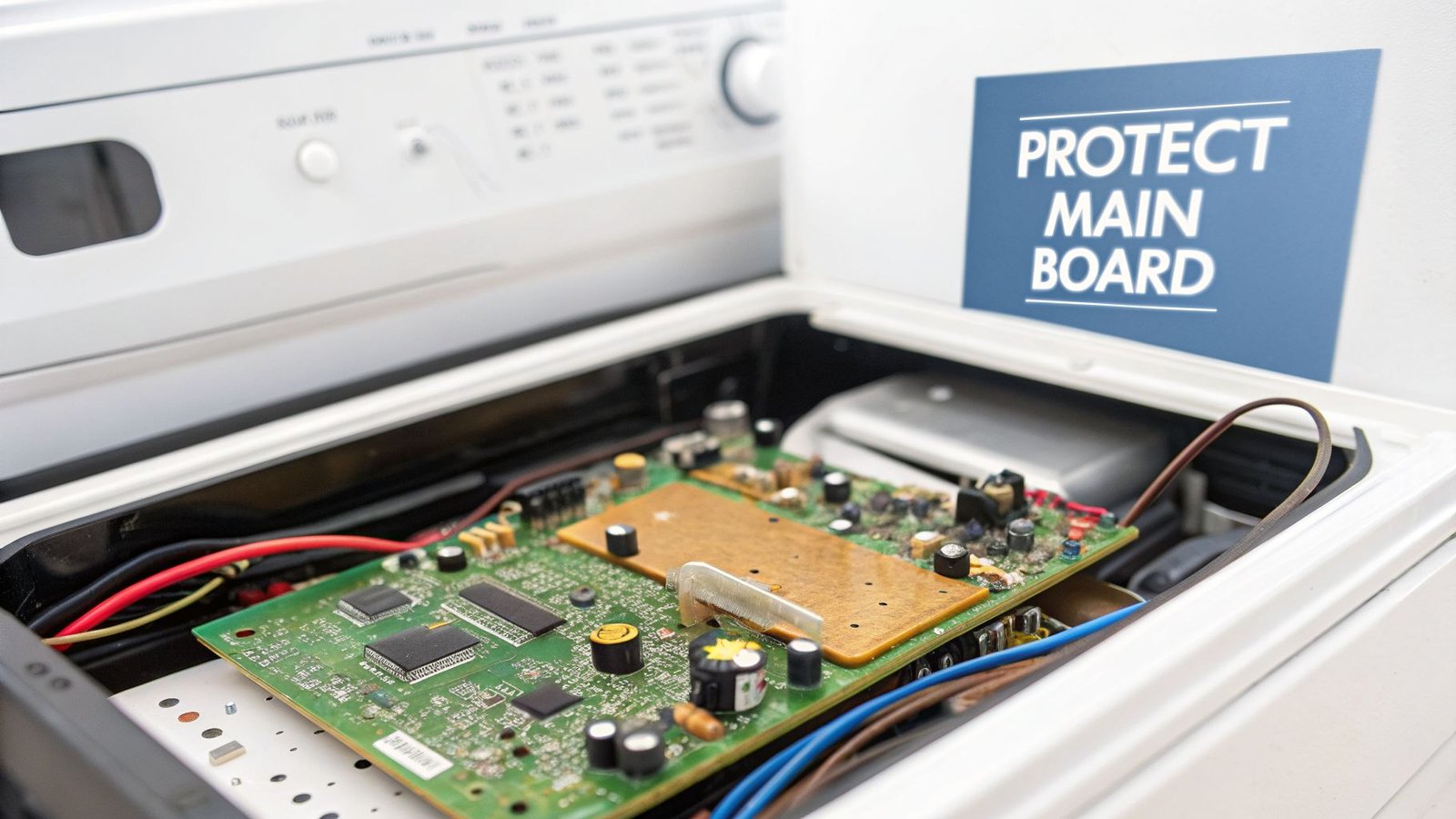
Consider your refrigerator, oven, or washing machine’s primary control board as its central nervous system. It’s a sophisticated circuit board that makes thousands of split-second decisions to control everything from spin cycles to temperature regulation, making sure your appliance functions properly.
These complex routes are designed to provide a consistent, reliable flow of electricity. The complete opposite is a power surge, which is an abrupt, strong spike in voltage. The components of the board are overloaded with this destructive energy, which quickly causes them to overheat, short circuit, and burn out.
The Real Danger Is When Power Returns
Even though a lot of people are concerned about power outages, utility power restoration is frequently the most damaging event. The initial surge of electricity that occurs when the grid comes back online can be quite erratic, rising well over the typical voltage that your home’s equipment are built to withstand.
Each device plugged into your walls receives a strong shock from that post-outage surge. During these few crucial seconds, the main boards in your pricey appliances are very vulnerable.
Understanding how common power issues can damage your appliance’s most vital component is the first step toward protecting your investment. While a power failure or surge can damage appliance main boards, you can take proactive steps to dramatically lower your risk. If you’re already dealing with a dead appliance after a storm, professional appliance control board repair can often be a cost-effective solution.
Understanding the Different Types of Power Events
Although not all power problems are the same, they are all dangerous for your equipment. Appliance main boards can be harmed by power outages or surges, but each incident targets your electronics in a different way.
Think of the electrical supply in your house as water passing through pipes. Electricity flows at a constant, predictable pressure on a typical day. However, your appliances’ delicate main boards become chaotic when that flow is disturbed.
The most frequent electrical incidents and the dangers they pose are broken down below.
Power Events and Their Impact on Appliances
| Type of Electrical Event | Common Causes | Risk to Main Board |
|---|---|---|
| Power Surge | Lightning strikes, power grid restoration after an outage, large appliances cycling on/off. | High. A sudden, high-voltage spike can instantly fry delicate circuits and components. |
| Power Failure (Outage) | Storms, grid overload, accidents, planned utility work. | Indirect. The outage itself is harmless, but the surge when power returns is extremely dangerous. |
| Brownout | High energy demand on the grid (e.g., heatwaves), utility voltage reduction. | Cumulative. Low voltage starves motors and electronics, causing them to work harder, overheat, and suffer long-term strain. |
These events don’t just happen during major storms; they can be a daily reality for your home’s electrical system.
Power Surges: The Sudden Burst
A power surge is a brief but intense spike in voltage. This sudden burst of energy can overload circuits designed for a steady, lower voltage.
The most destructive surges are often caused by external events:
- Lightning Strikes: A nearby strike can send a massive wave of electricity down utility lines and into your home.
- Power Grid Restoration: This is often the most damaging moment. When power comes back after an outage, the re-energized grid can send an uncontrolled jolt that sensitive electronics can’t handle.
Power Failures: The Calm Before the Storm
A complete loss of electricity is known as a blackout or power failure. Your appliances won’t be harmed by an outage per se, but it creates the conditions for a risky return. The surge that frequently occurs when power is restored poses the true threat. Because of this, the most crucial thing you can do to safeguard large appliances during a blackout is to disconnect them.
Brownouts: The Slow Starvation
A decline in voltage from the utility company is known as a brownout. This “starvation” of electricity is equally harmful. of order to compensate, it makes the compressors and motors of air conditioners and refrigerators work harder and draw more electricity, which leads to overheating. Over time, the main board’s components become weaker and finally burn out due to this constant strain.
The Cumulative Effect of Power Events
A lightning strike’s enormous surge can result in an instantaneous, disastrous failure. However, the harm is generally gradual. The minuscule pathways on a main board are worn down by the slow, cumulative stress caused by the continuous onslaught of small, internal surges (from your own huge appliances cycling on and off) and brownouts.
Your appliance may be operating normally one day and dead the next—not due to a single incident, but rather to the cumulative damage caused by thousands of little electrical stressors. Your appliances are at greater risk than ever due to the increasing frequency of weather-related outages. You may find out more about how the weather in Canada affects your home’s energy resilience.
Recognizing the Symptoms of a Damaged Main Board
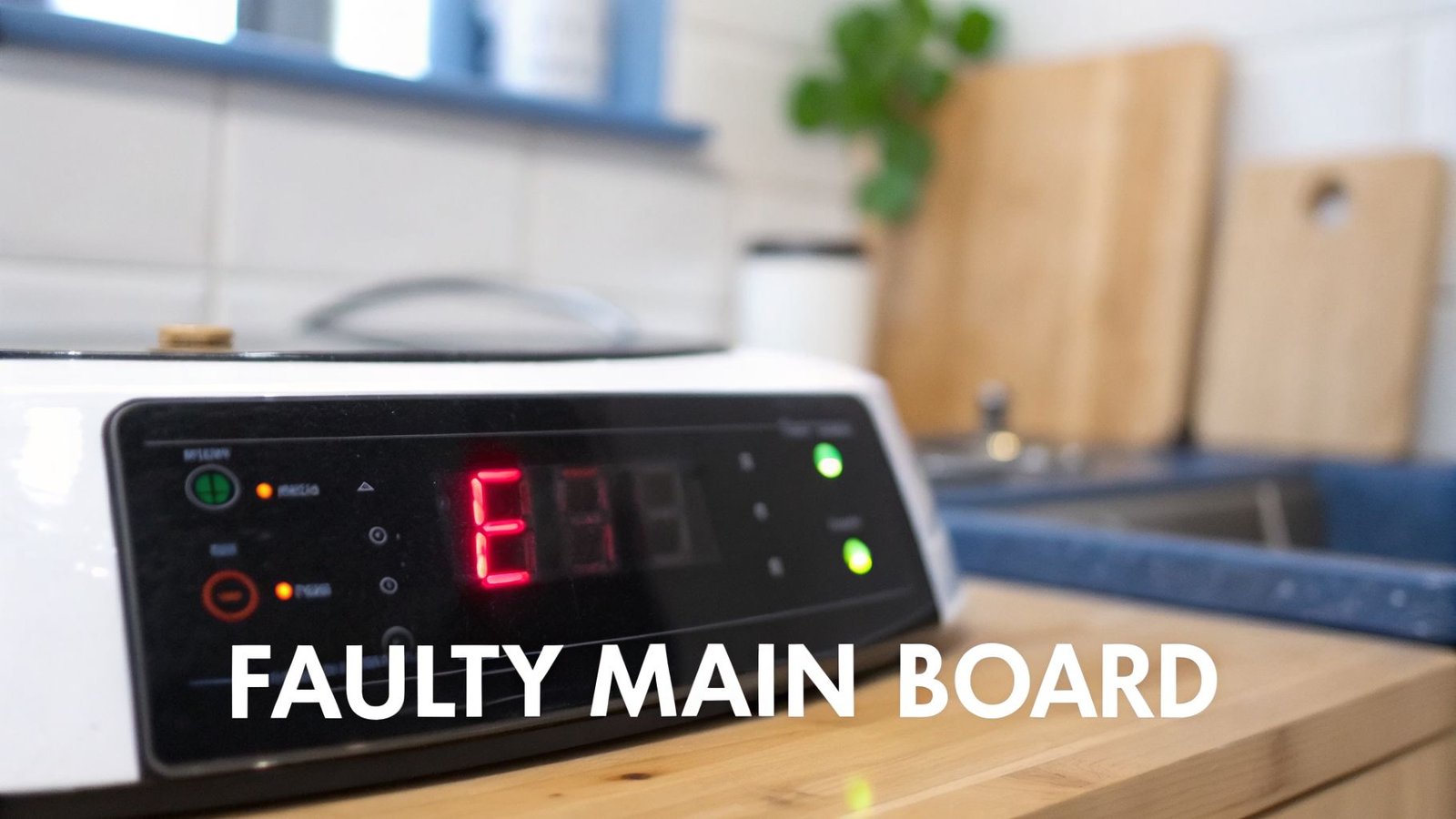
There isn’t always a big bang and a plume of smoke when an appliance main board is damaged by a power outage or surge. Frequently, the symptoms are subtle and perplexing, making you think a simple element has failed while the appliance’s electronic brain is the true culprit.
You can find a potential main board issue by knowing what to check for. Look for these typical signs of a fried board if your equipment has begun to malfunction following a storm or a recent power outage.
Complete Failure to Power On
This is the most obvious sign. You press the power button, turn the knob, and… nothing. The display is dark, no lights come on, and there’s dead silence.
Always start by checking the outlet and the circuit breaker in your house. However, a dead main board is the leading suspect if you have verified that the appliance is receiving power. The board can be totally destroyed by a strong surge, which would prevent it from providing power to any other component of the machine.
Erratic or Malfunctioning Display
The display panel is your appliance’s communication hub, and it gets instructions directly from the main board. When that board gets scrambled by a power event, the display is often the first place you’ll see the chaos.
Watch for these telltale signs:
- Flashing Lights or Error Codes: You might see the display flashing random characters, blinking for no reason, or showing an error code not found in the user manual.
- Unresponsive Buttons: The display might be lit, but some or all of the buttons on the control panel do nothing when pressed.
- Dim or Partial Display: The screen might look unusually dim, or parts of the numbers and letters may be missing.
These are all signs that the main board is sending jumbled or incomplete signals, like a computer trying to run with a corrupted operating system. The mechanical parts of your appliance could be in perfect shape, but they can’t do their job without the right commands.
Functions That Don’t Work Correctly
When an appliance turns on but just doesn’t function properly, it can be the most annoying symptom. As a conductor, the main board instructs motors, heating components, and valves on when to start and stop.
When it’s damaged, you’ll see issues like:
- A washer that stops mid-cycle for no reason.
- An oven that won’t heat to the correct temperature or has wild temperature swings.
- A refrigerator that isn’t cooling, even though you can hear the compressor trying to run.
- A dishwasher that won’t fill with water or refuses to drain at the end of a cycle.
These problems occur because the damaged circuits on the board can no longer manage the complex sequence of operations. Spotting these signs early can save you from frustrating guesswork.
What to Do Immediately After a Power Outage
Your first reaction is probably to see if your appliances are still functional when the lights flicker back on following an outage. Waiting is preferable. The first few minutes after power is restored are frequently the most hazardous for the main board of your appliance.
A restoring power grid is unstable and has the potential to unleash a restoration surge—a huge, uncontrollable wave of electricity—through the wiring in your house. The delicate electronics in your refrigerator, oven, and washing machine could be overloaded and fried by that shock.
The First Crucial Step: Wait
The safest thing to do is to wait. Before you touch a single switch, let the power stabilize.
Resist the urge to turn on the TV or test your microwave. The grid needs a few minutes to balance its load, and secondary surges can occur as the utility company adjusts power flow.
Safety First: If you unplugged your major appliances during the outage, you have already taken the best step. Leave them unplugged for at least 10-15 minutes after the power has been steadily restored. This provides a safe buffer against the initial, most damaging surges.
If you weren’t able to unplug them, it’s still critical to wait before trying to use anything. A little patience is your first line of defence when a power surge can damage appliance main boards.
A Methodical Approach to Testing Your Appliances
Once you’re confident the power has been stable for several minutes, don’t flip everything on at once. A systematic check helps isolate any problems.
Follow this sequence to safely test your devices:
- Start Small: Begin by turning on a single lamp. If it comes on normally without flickering, it’s a good sign the voltage has settled.
- Plug In and Test One by One: Go to your first major appliance, like the refrigerator. Plug it in and listen. Do you hear the familiar, normal hum, or is there any unusual clicking or buzzing? Check if the interior light comes on.
- Observe and Listen: Before moving on, give that first appliance a minute. Watch the display for flickering or error codes. Pay attention to any strange smells, which could signal a burnt wire or a fried component on the control board.
- Repeat the Process: Move to the next appliance—your stove, dishwasher, washer, or dryer—and repeat the process. Plug it in, turn it on, and observe it carefully before starting the next one.
This methodical approach helps you pinpoint exactly which device, if any, was affected. If an appliance fails to turn on or acts erratically, unplug it immediately. This is a strong indicator that the main board is damaged and needs professional attention. If you require immediate assistance, you can find emergency appliance service available in Edmonton and surrounding areas.
Proactive Strategies to Protect Your Appliances
When it comes to power surges, prevention is smarter than repair. Instead of dealing with a fried control board, the best approach is to stop the damage before it happens. A power failure or surge can damage appliance main boards when least expected, so preparing in advance is key.
Think of it as building multiple layers of defense for your appliances. If a big surge gets past the first line of defence, a second or third layer is there to absorb the impact, protecting the delicate electronic “brain” inside your equipment.
But if an outage does strike, your immediate actions matter. The infographic below shows a simple safety protocol to follow to prevent damage when power returns.
Preventing power surges is more prudent than fixing them. The best course of action is to prevent the harm before it occurs rather than coping with a fried control board. Preparing ahead of time is crucial since unexpected power outages or surges can harm appliance main boards.
Consider it as creating several levels of protection for your gadgets. The sensitive electronic “brain” inside your equipment is protected by a second or third layer that is there to absorb the effect if a large surge gets past the first line of defense.
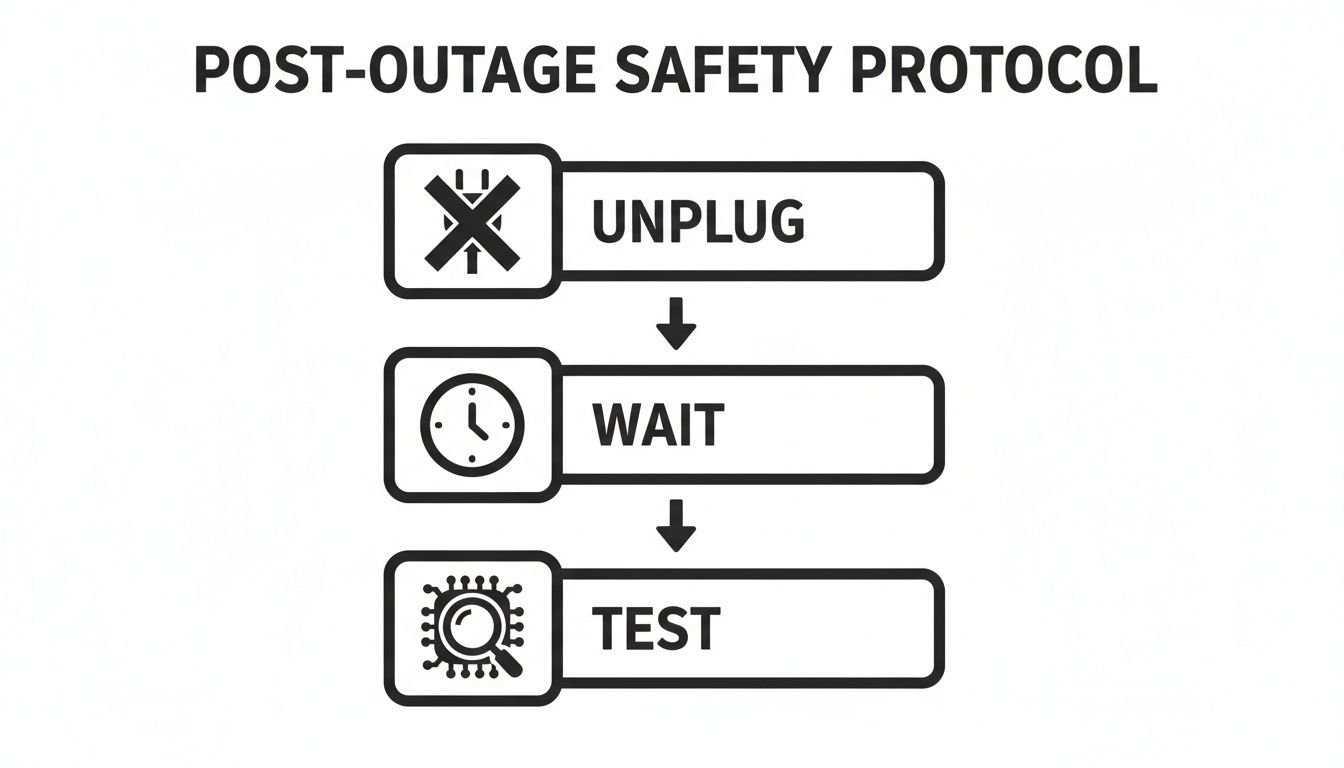
Unplugging your major appliances is the safest first step, followed by waiting before you start testing them one by one.
Start with Point-of-Use Surge Protectors
Your first line of defence is the point-of-use surge protector. These are the power bars and single-outlet adapters you plug your appliances into. Be careful, though—not all power bars offer protection. A basic one is just an extension cord with more outlets.
To protect your gear, you need a true surge protector designed to block and divert excess voltage. When shopping, look for:
- Joule Rating: This measures how much energy it can absorb. For valuable appliances, look for a rating of at least 2000 joules.
- UL Certification: The Underwriters Laboratories (UL) mark means the product meets important safety standards.
- Replacement Indicator: A good surge protector has an indicator light that tells you when its protective parts have worn out and it needs replacement.
Surge protectors are not permanent. They wear down with every surge they absorb. Plan on replacing them every 3 to 5 years, or immediately after a major event like a nearby lightning strike.
Upgrade to Whole-Home Surge Protection
While individual protectors help, they can be overwhelmed by a massive surge, like one from a power grid restoration. For the best protection, a whole-home surge protector is the ideal solution.
This device is installed by a licensed electrician at your main electrical panel. It acts as a gatekeeper, stopping large voltage spikes before they enter your home’s wiring. This is the most effective way to protect hardwired appliances like your HVAC system, oven, and dishwasher.
Add an Uninterruptible Power Supply (UPS) for Critical Devices
For your most sensitive and expensive electronics, like a smart fridge or high-end washer, an Uninterruptible Power Supply (UPS) offers another level of security. A UPS is more than a surge protector; it has an internal battery.
If the power cuts out, a UPS instantly provides battery power, giving the appliance time to shut down properly or ride out a short outage. It also “cleans” the power, protecting the device from both surges and brownouts. For even greater protection, some homeowners install solar panels with battery backup to keep essential appliances running during longer outages.
By layering these tools—point-of-use protectors, a whole-home system, and a UPS for key items—you build a powerful shield against electrical threats.
When You Need to Call a Professional Technician
While some appliance fixes can be DIY projects, a suspected main board failure isn’t one of them. When you suspect a power failure or surge damaged an appliance’s main board, attempting a DIY repair is a risk you shouldn’t take. This is when you need to call a professional.
Working on an appliance’s main control board involves live electrical components and a serious risk of electrical shock if you aren’t properly trained. Beyond safety, one wrong move can easily short out other components, turning a straightforward board replacement into a catastrophic failure that destroys the entire appliance.
The Professional Diagnostic Process
When you call a certified technician, you’re hiring an expert diagnostician. At Advance Appliance Ltd, our process is methodical and precise, designed to find the root cause of the problem without guesswork.
Our Red Seal journeyman technicians follow a strict procedure:
- Safety First: We always begin by safely disconnecting the appliance from its power source to ensure a secure work environment.
- Confirming the Fault: We use specialized multimeters and diagnostic tools to test the flow of electricity to and from the main board. This confirms whether the board is the true point of failure or if the problem lies elsewhere.
- Visual Inspection: We carefully examine the board for classic signs of a power surge, like scorch marks, burnt spots, or swollen capacitors.
- Component-Level Testing: We use advanced tools to test individual components on the board, pinpointing the exact microchip or relay that has failed.
This detailed approach ensures we only replace what’s necessary, saving you time and money.
Why Expertise Matters
With complex electronics, professional expertise is crucial. A licensed technician can distinguish between a fried board, a simple blown fuse, a faulty sensor, or a wiring issue that presents similar symptoms. This accuracy prevents you from paying for unnecessary repairs and ensures the fix is durable.
For example, a refrigerator that isn’t cooling might seem like a main board failure. A trained technician, however, might discover it’s just a faulty start relay on the compressor—a much simpler and cheaper fix. Without the right diagnostic tools, it’s almost impossible to know the difference.
If you’re ever unsure about tackling a repair, it’s always better to understand when to call an appliance repair technician to avoid causing more damage. Our team is ready to get your appliance running again safely and efficiently.
FAQs About Surge Damage
Homeowners often ask practical questions about protecting their appliances. Since a power failure or surge can damage appliance main boards, knowing the facts can save you from frustrating and expensive problems. Here are clear answers to the most common questions.
Are power bar surge protectors enough to protect my large appliances?
In short, no. While a power bar with surge protection is better than plugging your appliance directly into the wall, it’s not enough to stop a major electrical event. It is a final line of defense, best for small power fluctuations. A large surge from a lightning strike or grid restoration can easily overwhelm it. For major appliances like your fridge, oven, or washer, a layered strategy is best: a whole-home surge protector installed at your electrical panel, supplemented by point-of-use protectors for individual appliances.
Will my home insurance cover surge damage?
Often, the answer is “no” with a standard policy. Most basic home insurance policies specifically exclude damage from electrical surges. Coverage for this type of event is typically an optional add-on or a special “rider” you must add to your policy. It’s crucial to review your policy documents or call your insurance agent to confirm what you’re covered for. If you suspect surge damage, document everything and call a professional technician for a formal diagnosis and written repair estimate, as you will need this paperwork for any potential claim.
Is it better to repair or replace an appliance with a damaged main board?
This depends on the appliance’s age, its overall condition, and how the repair cost compares to buying a new one. For newer or high-end premium appliances, replacing the main board is almost always the smarter financial move. A main board repair might cost a few hundred dollars, whereas a brand-new luxury appliance can cost thousands. An honest technician will provide a transparent, upfront estimate that lays out your options so you can make a confident decision.
Can a damaged main board be repaired?
Yes, in many cases, a main board can be professionally repaired instead of being completely replaced. This process, sometimes called control board restoration, involves a technician identifying and replacing the specific failed components on the circuit board, such as burnt-out capacitors, relays, or processors. This is an excellent and cost-effective option, especially for older appliances where a new replacement board is unavailable or very expensive.
If you’re dealing with appliance headaches after a power outage or surge, don’t guess—get an expert diagnosis. The licensed, Red Seal technicians at Advance Appliance Ltd have the right tools and experience to pinpoint and fix main board failures, protecting your investment and getting your home back on track.
Book your service online or call us today for fast, reliable repairs.