
Before you start troubleshooting a Bosch dishwasher, it helps to understand what makes them tick. Most problems you'll run into, like a clogged filter or a fussy sensor, are directly linked to their high-efficiency design. If you know to check the filter system, look for a kinked drain hose, or clear out the spray arms first, you’re already halfway to solving the issue.
Why Choose a Bosch Dishwasher?
When your Bosch dishwasher acts up, remember you're not dealing with just any appliance. These machines are famous for their quiet operation, water efficiency, and clever German engineering, and that's not just marketing fluff. It’s a core design philosophy that changes how you should approach any repair.
Take their near-silent performance, for example. Many Bosch models run below 44 decibels, which is quieter than a library. They achieve this with layers of insulation and a solid base that absorbs vibration. While that’s great for peace and quiet, it means you can't always rely on your ears to diagnose a problem. A motor might be struggling, but you won't hear it until things get serious. This commitment to quality and innovation is a key reason many homeowners prefer the Bosch brand for its reliability and advanced features.
Precision Engineering and Common Issues
At the heart of every Bosch is a precision water delivery and filtration system. Instead of just blasting your dishes with water, Bosch uses carefully designed spray arms and a multi-stage filter to save water and energy. This is what makes them a high-efficiency appliance.
This smart design has a few practical implications you should know about:
- Stainless Steel Tubs: You'll find stainless steel tubs in almost every Bosch. They’re fantastic for durability and drying, but they show hard water stains and mineral buildup easily. Sometimes, what looks like a cleaning problem is just mineral residue.
- Advanced Filtration: That complex filter system is a double-edged sword. It’s brilliant at catching food bits to protect the pump, but it must be cleaned regularly. A clogged filter is hands-down the #1 reason for bad smells, draining problems, and dishes that just don't get clean.
- Sensor-Based Washes: Many cycles use sensors to figure out how dirty your dishes are, adjusting the wash time and water use on the fly. If these sensors get covered in grime or limescale, the dishwasher might run for hours, end too early, or leave food behind.
Common Parts That Fail on a Bosch
Even with their solid build quality, some parts on a Bosch dishwasher just see more action than others. Knowing which components are most likely to fail can shave a ton of time off your diagnosis.
The usual suspects include the drain pump, which can easily get jammed with a stray piece of glass or a popcorn kernel, and the water inlet valve, which controls how much water enters the tub. Less often, the heating element or the main control board can give out, but those issues are usually best left to a professional. Getting familiar with these key parts is the first real step toward fixing it yourself.
How to Decode Bosch Dishwasher Error Codes
That strange code flashing on your Bosch dishwasher display isn't a sign of defeat. Think of it as the machine's way of telling you exactly where it hurts. Learning to speak its language is the first real step in any Bosch dishwasher troubleshooting, taking you straight to the source of the problem and skipping all the guesswork.
Instead of just running through a long list of codes, let's focus on the common ones you're most likely to see. Understanding what they mean and what to do next will help you figure out if you've got a quick fix on your hands or if it's time to call in the pros.
The Dreaded E15 Error: Water in the Base
The E15 error is probably the most common alert Bosch owners run into. It means the AquaStop feature—the anti-flood system—has kicked in. Simply put, water has found its way into the sealed base pan underneath the dishwasher tub.
When this happens, the dishwasher immediately stops taking in water to prevent a flood in your kitchen. Your first move? Unplug the unit. Carefully tilt it forward about 45 degrees and have a towel ready on the floor. This lets the trapped water drain out of the base. After setting it upright for a few minutes, plug it back in. If the code is gone, you've solved the immediate problem, but the leak is still there.
Common reasons for an E15 error include:
- A loose drain hose connection.
- A cracked or worn-out door gasket letting water seep out.
- Using the wrong kind of detergent (or way too much), causing an over-sudsing mess.
Tackling the E24 Error: Drainage Fault
Another familiar code is E24, which points right to a drainage issue. Your dishwasher is trying to pump out water but can't, so the cycle stops dead in its tracks. Don't panic—this is often just a simple blockage you can clear out in minutes.
Start with the easiest thing to check: the filter. You'll find it at the bottom of the tub. It's designed to catch food bits, and if it gets clogged, water has nowhere to go. Just twist it out, give it a good rinse under warm water, and use a soft brush to scrub off any gunk before putting it back.
If the filter looks clean, move on to the drain hose. You may need to pull the dishwasher out a bit to see the hose connected to the back. Look for any sharp kinks or bends that could be blocking the flow. Sometimes, just straightening it out is all it takes to clear the E24 error. If there are no kinks, you might have to disconnect the hose (keep a bucket handy!) to check for a clog inside.
This kind of smart, reliable engineering is why people choose Bosch, but even the best machines need a little help sometimes.
When Error Codes Point to Deeper Issues
While E15 and E24 are the heavy hitters, a few other codes can signal more specific problems. An E09 error, for instance, often points to a problem with the heating circuit, meaning the water isn't getting hot. This could be a bad heating element or an issue with the main control board.
An E22 error also suggests a blockage, but specifically in the sump area or filters, which directly impacts how well your dishes get cleaned. Cleaning the filters is simple enough, but getting into the sump pump is a bit more involved.
If you've checked all the basics and a code just won't go away, it's a good sign it's time to let a professional take a look. For a broader look at common dishwasher problems, our guide on troubleshooting a dishwasher that's not working has some extra tips.
Bosch Dishwasher Error Code Quick Reference
Think of this table as your quick-start guide. While there are many codes, these are the ones you're most likely to see. Starting here will often solve the problem without needing to dig any deeper.
| Error Code | What It Means | Your First DIY Check |
|---|---|---|
| E15 | Water detected in the base pan (leak). | Tilt the dishwasher 45 degrees forward to drain the base. |
| E24 | Water is not draining properly. | Clean the filter at the bottom of the dishwasher tub. |
| E22 | Blockage in the sump pump or filter area. | Clean the main filter and check the sump for debris. |
| E09 | Problem with the heating circuit. | Reset the dishwasher by turning it off at the circuit breaker for 5 minutes. |
| E25 | Drain pump is blocked. | Check for obstructions in the drain pump impeller area. |
After trying these initial checks, if the code returns, it likely points to a part that needs a professional diagnosis.
Always remember to disconnect the power before you start inspecting anything. If you’ve worked through these steps and are still stuck with an error code, it’s a strong hint that a component like a drain pump or water inlet valve might be failing. That's when calling a certified technician is your safest and quickest bet.
Solving Leaks and Drainage Nightmares
Few things cause a homeowner's heart to sink faster than seeing a puddle of water spreading across the kitchen floor. When your Bosch dishwasher is the culprit, the problem usually boils down to two things: a leak somewhere on the unit or a clog that’s stopping it from draining.
Both are messy, but don't panic. With a bit of methodical troubleshooting, you can often find the source of the problem yourself. Let's walk through how to diagnose and fix these water woes, so you can get your kitchen dry and your dishwasher back in action.
Uncovering the Source of a Leak
A leaking dishwasher might look like a total disaster, but the cause is often a simple, easy-to-replace part. Before you assume the worst, it’s best to work through the usual suspects, starting with the easiest ones to check.
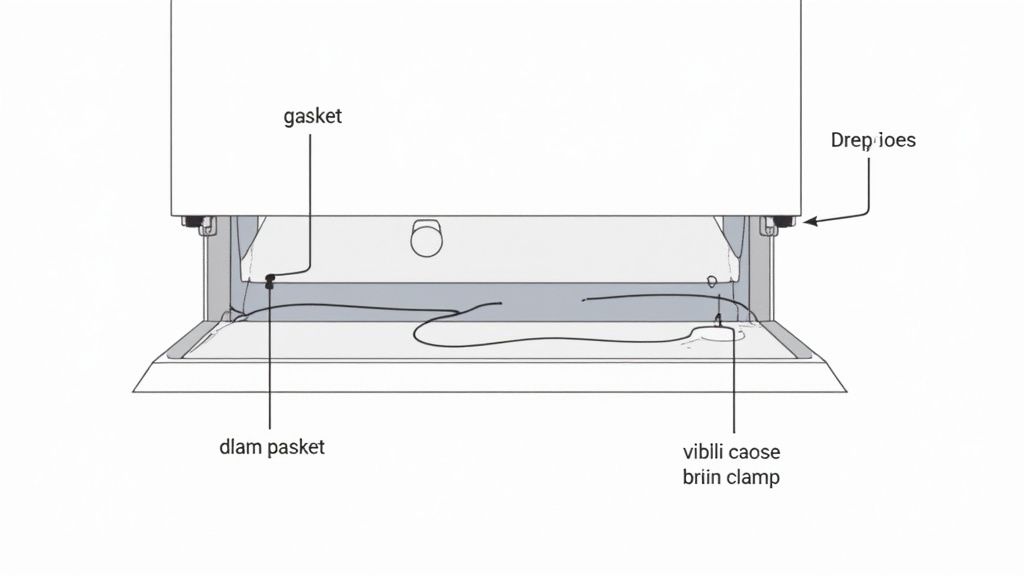
The door gasket is always the first place I look. Over the years, this rubber seal can get brittle, crack, or just get caked with food debris, creating tiny gaps for water to sneak through. Run your fingers along the entire seal. Do you feel any tears, stiff sections, or gunk? Sometimes a good wipe-down with a damp cloth is all it needs, but if it's damaged, swapping it for a new one is a fairly simple job.
Gasket looks okay? The next step is to check the hose connections. You'll need to carefully pull the dishwasher out from under the counter to get a good look at the water inlet and drain hoses. A clamp that has worked its way loose or a deteriorating connection is a classic reason for those slow drips that eventually become a major puddle.
Pro Tip: To find a sneaky leak, slide a large, dry piece of cardboard under the dishwasher before running a short cycle. Even the smallest drip will show up immediately on the cardboard, pointing you right to the source of the trouble without any guesswork.
Another part people often miss is the spray arms. If a spray arm gets a crack or split, it can shoot a jet of water at the wrong angle, hitting the bottom of the door seal with enough force to cause a leak. Just pull out the racks and give the spray arms a spin by hand, inspecting them closely for any damage.
When Your Bosch Dishwasher Won't Drain
Finding a pool of murky water at the bottom of your dishwasher is a sure sign of a drainage problem. This issue is often tied to the E24 error code we covered earlier, but the fix can involve more than just cleaning out the filter.
Start by cleaning the filter assembly at the bottom of the tub—that's always step one. If the water still won't go down, your next target is the drain pump. It’s surprising what can get past the filter; I've found everything from glass shards and olive pits to popcorn kernels jamming the pump's impeller. You’ll usually need to remove the front kickplate to get to the pump and clear out any debris.
Also, take a look at the check valve. This is a small rubber flap that stops dirty water from flowing back into the dishwasher. If it gets stuck open with food particles, grey water from your sink can easily back up into the tub.
Finally, the drain hose setup is absolutely critical for Bosch dishwashers. The hose must have a "high loop" that goes up at least 50 cm (20 inches) above the floor before it connects to your sink's plumbing. This simple loop uses gravity to prevent backflow and is one of the most common reasons for drainage problems, especially right after a new dishwasher is installed.
If you have to empty the water manually to get at these parts, our guide on how to drain a Bosch dishwasher shows you how to do it safely.
Common Parts to Inspect for Water Issues
When you're chasing down leaks or drainage clogs, a few specific parts are almost always the problem. Knowing what they are will make your troubleshooting much faster.
- Door Gasket: This is your main line of defence against leaks. It usually fails from old age, physical wear, or a simple lack of cleaning.
- Drain Pump: This is what actively pushes the dirty water out. It can get jammed by debris or the motor can simply burn out.
- Water Inlet Valve: This valve lets fresh water into the dishwasher. If it gets stuck open, it'll overfill the tub and cause a leak.
- Drain Hose: This can get clogged with gunk, kinked behind the machine, or installed improperly without the crucial high loop.
By checking these components one by one, you can often solve the issue yourself. But if you've gone through this list and the problem is still there, you might be looking at a more complex issue with the sump assembly or the main control board.
Getting Your Dishes Sparkling Clean Again
It’s incredibly frustrating when you open the dishwasher after a full cycle, only to find grimy, streaky dishes staring back at you. You've just wasted time, water, and hydro. This is one of the most common complaints we hear, but the good news is that the fix is usually pretty simple.
Poor cleaning is rarely a sign of a major breakdown. More often than not, it’s a simple issue with water flow, detergent, or some basic maintenance that’s been overlooked. Before you start worrying about a big repair bill, let's walk through the usual suspects behind cloudy glasses and food-crusted plates.
Check the Spray Arms for Blockages
The spray arms are the real workhorses in your dishwasher. They spin around, shooting jets of hot water to blast food off your dishes. If their little nozzles get clogged up with hard water minerals or tiny bits of food, the water pressure drops, and some dishes just won't get clean.
- Take a quick look: Gently remove the upper and lower spray arms. They usually just twist or clip off without much fuss.
- Clear out the gunk: Hold them up to the light to see if any holes are blocked. Use a toothpick or a paperclip to poke out any debris you find.
- Rinse and reinstall: Give them a good rinse under the tap to flush everything out, then pop them securely back into place.
Seriously, this simple five-minute task can make a world of difference, making sure water can actually reach every corner of the dishwasher.
Master Your Loading Technique
How you load your dishwasher is a bigger deal than you might think, especially with a high-efficiency machine like a Bosch. They’re engineered for perfect water circulation, and if you block that flow, you’ll get poor results every time.
Overcrowding is the number one enemy of clean dishes. When plates are jammed together, they act like shields, blocking the water spray. Make sure there’s a bit of space between items. Also, check that no tall baking sheets or stray utensils are blocking the spray arms from spinning freely. A quick manual spin before you hit "start" is a great habit to get into.
Hard water is a major contributor to poor cleaning performance, leaving behind a white, chalky film on glassware and cutlery. This mineral buildup can also clog your dishwasher's internal components over time, reducing its overall effectiveness.
The Role of Detergent and Rinse Aid
Using the right amount of the right detergent is key. Too little, and your dishes stay dirty. Too much, and you're left with a soapy film. Always stick with a high-quality detergent made for automatic dishwashers and follow the instructions on the box.
And rinse aid? It's not optional, especially if you have hard water in areas like ours. It works by breaking the surface tension of water, so it sheets off your dishes instead of leaving droplets that cause spots. If your glasses are coming out cloudy, the first thing to check is the rinse aid dispenser. Make sure it's topped up and adjusted correctly for your water hardness.
For a total refresh, our guide on how to clean your dishwasher has some excellent tips to get your machine back in top shape.
Revitalize with a Deep Cleaning Cycle
Over time, grease, tiny food particles, and mineral scale build up inside your dishwasher. This gunk doesn't just affect cleaning performance—it can start to smell, too. The best fix is to run a maintenance cycle.
Many Bosch models have a dedicated "Machine Care" cycle. If yours doesn't, just run the machine empty on the hottest, longest setting available. You can use a dedicated dishwasher cleaning tablet or, in a pinch, place a dishwasher-safe cup full of white vinegar on the top rack. This breaks down all that nasty buildup.
Doing this every month or two will keep your dishwasher running like new and your dishes looking spotless.
Diagnosing Common Failing Bosch Parts
Even the best-engineered machines like Bosch dishwashers have parts that will eventually wear out. It’s just a fact of life. When your dishwasher starts acting up, knowing which components are the usual suspects can save you a ton of time and frustration. It turns a confusing problem into a more straightforward diagnosis.
This isn’t about random guessing. We’re going to connect the symptoms you’re seeing to the parts that do the heaviest lifting day in and day out.
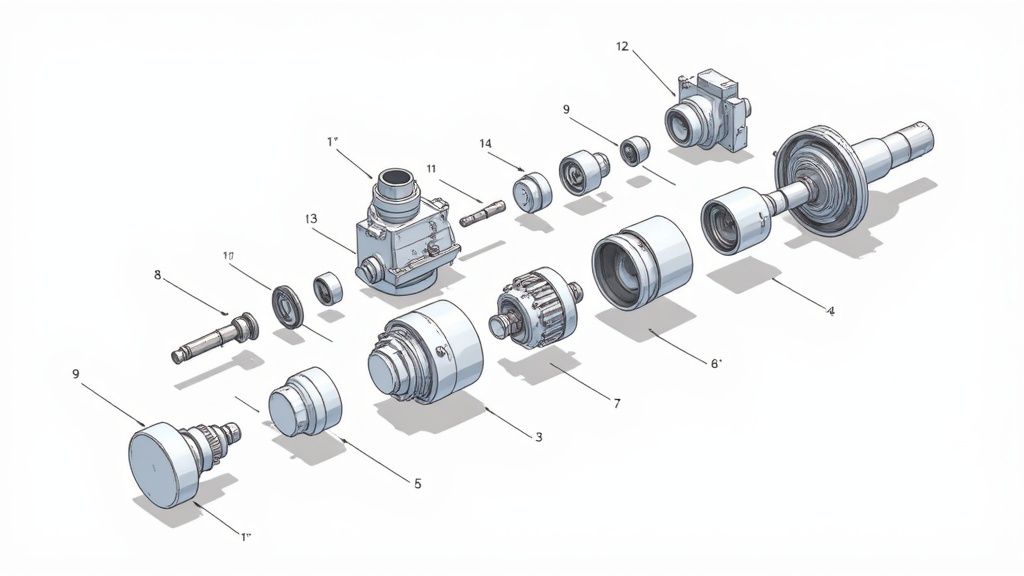
Let's pinpoint these common culprits so you can figure out if you've got a simple DIY fix on your hands or if it’s time to call in a pro.
The Hardworking Drain Pump
If you hear a humming or buzzing sound but find a puddle of gross, dirty water at the bottom after a cycle, your drain pump should be the first thing you check. This little motor has the tough job of forcing all the wastewater out, but it’s surprisingly easy to block.
Small, hard bits of debris—think tiny shards of glass, olive pits, or even a stray popcorn kernel—can sneak past the main filter and jam the pump's impeller. We see this all the time. To get a look at it, you’ll need to unplug the dishwasher, take off the bottom kickplate, and access the pump assembly to see if anything is stuck in there.
The Water Inlet Valve
The water inlet valve acts as the gatekeeper, controlling when fresh water enters your dishwasher. If this valve gives up, it can create two very different problems. If it gets stuck closed, no water can get into the tub, and your wash cycle won't even start properly.
On the other hand, if it fails to close all the way, water will constantly trickle in. This can lead to overfilling and, you guessed it, a potential leak on your kitchen floor. A faulty inlet valve often makes a distinct "hammering" or buzzing noise as it struggles to open or close. You can usually find it right where the main water line connects to the appliance.
A Note on DIY vs. Professional Repairs: While clearing a clogged drain pump or looking at a valve is definitely manageable for many homeowners, replacing these parts is a bigger job. You're dealing with water lines and electrical connections. If you're not 100% comfortable, it’s always safer to call a technician. A small mistake here can easily turn into a big, expensive leak.
The Heating Element and High-Limit Thermostat
Is your dishwasher running a full cycle, but the dishes come out soaking wet and not as clean as they should be? The issue could be the heating element. This component heats the water to the perfect temperature needed to activate your detergent and get everything sparkling. It's also critical for the drying cycle.
Sometimes, a quick visual inspection will reveal a burn mark or a clear break in the element coil. Working alongside it is the high-limit thermostat, a safety device that shuts the element off to prevent overheating. If this thermostat fails, it will cut power to the element, even if the element itself is perfectly fine.
The Main Control Board
Think of the control board as your dishwasher's brain. It's the command centre, sending signals to every single part, from the drain pump to the soap dispenser. While a control board failure is less common, it can cause some truly strange and confusing symptoms:
- The dishwasher is completely dead, with no lights on the panel.
- It flashes error codes that make no sense for the actual problem.
- Cycles start normally but then stop halfway through for no apparent reason.
Diagnosing a bad control board is tough because its failure can look a lot like other problems. It’s usually the last thing to check after you've ruled everything else out. Replacing one is a complex job best left to a certified technician. This is especially true as modern, high-tech appliances require specialized troubleshooting expertise. You can learn more about the evolving appliance market and its trends to see why.
And a final word of advice: always use genuine manufacturer parts for any replacement. They're designed for a perfect fit and will perform to the exact specs, making sure your repair actually lasts.
Knowing When to Call a Repair Technician
Diving into a DIY appliance repair can be incredibly satisfying. It's a great way to save a bit of cash and get to know your machine better. But there's a fine line between a successful fix and a mistake that ends up costing you more. The most important skill in troubleshooting your Bosch dishwasher is knowing when to put the tools down.
Some problems are immediate red flags. They're the kind of issues that should have you reaching for the phone, not a screwdriver.
For instance, if your dishwasher keeps tripping the circuit breaker, that's a serious sign. It points to an electrical fault that could be a genuine safety hazard. This isn't something you can just reset and ignore; it's a clear signal of a short circuit or a major component on its way out.
When the Risk Outweighs the Reward
Trying to fix certain parts without proper training can quickly turn a small issue into a massive headache. The main control board—the dishwasher's brain—is a perfect example. I've seen homeowners guess that the board is faulty, only to replace the expensive part and find out the real problem was a simple, cheap sensor.
Here are a few situations where calling a certified technician is absolutely the right call:
- Persistent Electrical Issues: Anything involving your home's circuit breaker is a job for an expert. Full stop.
- Suspected Control Board Failure: Diagnosing these boards requires specialized tools. A wrong guess is a costly one.
- Deep Internal Leaks: You've checked the door gasket and all the visible hoses, but water is still pooling. The leak could be coming from the sump assembly, and that's a complex repair.
- Motor or Major Component Replacement: Swapping out a circulation motor or a heating element involves tricky wiring and plumbing. It's easy to get it wrong.
A professional technician can often pinpoint the root cause in minutes with diagnostic equipment the average person doesn't own. That speed and accuracy can save you hours of frustration and stop you from buying parts you don't even need.
At the end of the day, a technician’s expertise guarantees the repair is done safely and correctly, preventing potential water damage or electrical hazards down the road. For a more detailed breakdown, check out our guide on when to call an appliance repair technician for more insights.
Got Questions About Your Bosch Dishwasher?
When your dishwasher acts up, you need answers, and you need them now. We get calls about Bosch dishwashers all the time, so we’ve put together a few of the most common issues we hear about—and the quick fixes you can try yourself.
Why Won’t My Bosch Dishwasher Start?
It’s frustrating when you press "Start" and get nothing. No lights, no sounds, just silence. Before you panic, let's run through the usual suspects.
First, give the door a good, firm push. Bosch dishwashers have a very solid latching mechanism, and it needs to click shut properly to start the cycle. It’s an easy thing to overlook.
Next, take a quick trip to your home’s circuit breaker panel. It’s not uncommon for a high-power appliance to trip a breaker, so find the one labelled for your dishwasher and make sure it’s switched on.
Still nothing? Check for the child lock. A small lock or key symbol on the display means it’s active. Just press and hold the button it’s pointing to (often the "Rinse" button) for about three to five seconds. You should hear a beep, and the machine will be ready to go.
Why Are My Dishes Still Soaking Wet?
Pulling out damp dishes at the end of a cycle is a classic dishwasher complaint, but it's rarely a sign of a broken machine. Nine times out of ten, the culprit is an empty rinse aid dispenser.
Rinse aid is a must-have, especially for Bosch models that use condensation drying instead of an old-school heating element. It helps water slide right off your dishes, which is the key to getting them spotless and dry.
Also, take a look at the cycle you’re using. If you've chosen a "Quick" or "Eco" setting, the dishwasher is probably skipping or shortening the drying phase to save time and energy. For the best results, stick to a full cycle and keep that rinse aid topped up.
What’s That Awful Smell Coming from My Dishwasher?
A smelly dishwasher is almost always the result of old food bits and grease building up where you can't see them. The first place you should always check is the filter system. You’ll find it at the bottom of the tub.
Twist it out, take it apart (most have two or three pieces), and give it a thorough scrub under hot, soapy water. You’ll probably be surprised by what you find in there.
If cleaning the filter doesn't completely solve the problem, it's time for a deep clean. Place a dishwasher-safe bowl filled with a cup of white vinegar on the top rack and run the machine empty on its hottest cycle. The vinegar will cut through any remaining grease and give the inside a much-needed refresh.
Tried everything and your Bosch is still on the fritz? Sometimes a problem needs a professional eye. For expert service in Edmonton, Calgary, Red Deer, and the surrounding communities, you can count on the certified technicians at Advance Appliance Ltd. We offer same-day or next-day appointments to get your kitchen back to normal. Book your repair online today.