When a flood hits your home, the immediate actions you take are critical for your safety and salvaging your property. Before assessing any damage, immediately shut off the main power at the breaker box and the main water supply to your house. This is the single most important step. Do not touch or attempt to use any appliance that has come into contact with water; the risk of severe electrical shock is extremely high. Your priority is to secure the area and ensure your own safety. For homeowners in Edmonton, Calgary, and Red Deer facing this stressful situation, this guide provides the expert steps to navigate the aftermath safely.
What the Problem Means
Flood damage to an appliance is far more severe than simply getting it wet. The issue stems from the contaminants within the floodwater, silt, sewage, chemicals, and conductive minerals, that infiltrate every internal component. This destructive mixture begins corroding sensitive electronics, shorting out circuits, and seizing mechanical parts from the inside out. Even after an appliance appears dry, this hidden damage continues to progress, creating a significant safety hazard.
Homeowners will notice symptoms that point to catastrophic failure, even if they can't see the internal damage. These signs include:
An appliance that is completely dead with no signs of power.
A distinct burning smell coming from the unit, indicating fried wiring.
Loud humming or buzzing noises without the appliance functioning, suggesting a seized motor.
Error codes flashing on a digital display.
Visible rust or corrosion on terminals and connections.
The silent, progressive nature of corrosion is what makes flood-damaged appliances so treacherous. A machine might seem to work for a short time after drying, only to fail catastrophically , and dangerously weeks later.
Common Causes of Appliance Failure After a Flood
The damage from floodwater is multifaceted, attacking an appliance's electrical, mechanical, and structural integrity simultaneously. The table below details the most common failure points, explaining why a professional assessment is non-negotiable.
| Cause | Description | Difficulty | Risk |
|---|---|---|---|
| Electrical Short Circuits | Contaminated water creates unintended electrical paths, instantly destroying control boards, wiring, and power supplies. | High | Extreme. Poses an immediate risk of electrocution or fire the moment power is restored. |
| Component Corrosion | Lingering moisture and acidic residues from floodwater eat away at metal contacts, solder joints, and electronic components over time. | High | High. This is a silent killer, leading to delayed failure and creating a significant fire hazard as wiring degrades. |
| Motor & Bearing Seizure | Silt, sand, and other fine debris from the water infiltrate motors and bearings, acting like sandpaper and causing them to grind to a halt. | Medium | Medium. Results in permanent motor failure and can cause overheating, which is a secondary fire risk. |
| Insulation Breakdown | Water soaks into the insulation materials surrounding motors, compressors, and internal wiring, compromising its protective properties. | High | High. Leads to hidden electrical shorts and potential fires. In refrigerators and freezers, it ruins thermal efficiency. |
| Sensor & Switch Failure | Delicate sensors for temperature, water level, and safety switches are easily fouled or shorted by dirty water, leading to erratic operation. | Medium | Medium. Can cause appliances to overflow, overheat, or run improperly, posing both water damage and fire risks. |
Safe Troubleshooting Steps for Homeowners
After a flood, your ability to "troubleshoot" is extremely limited and must focus entirely on safety and assessment, not repair. Do not attempt to power on or operate any flood-damaged appliance.
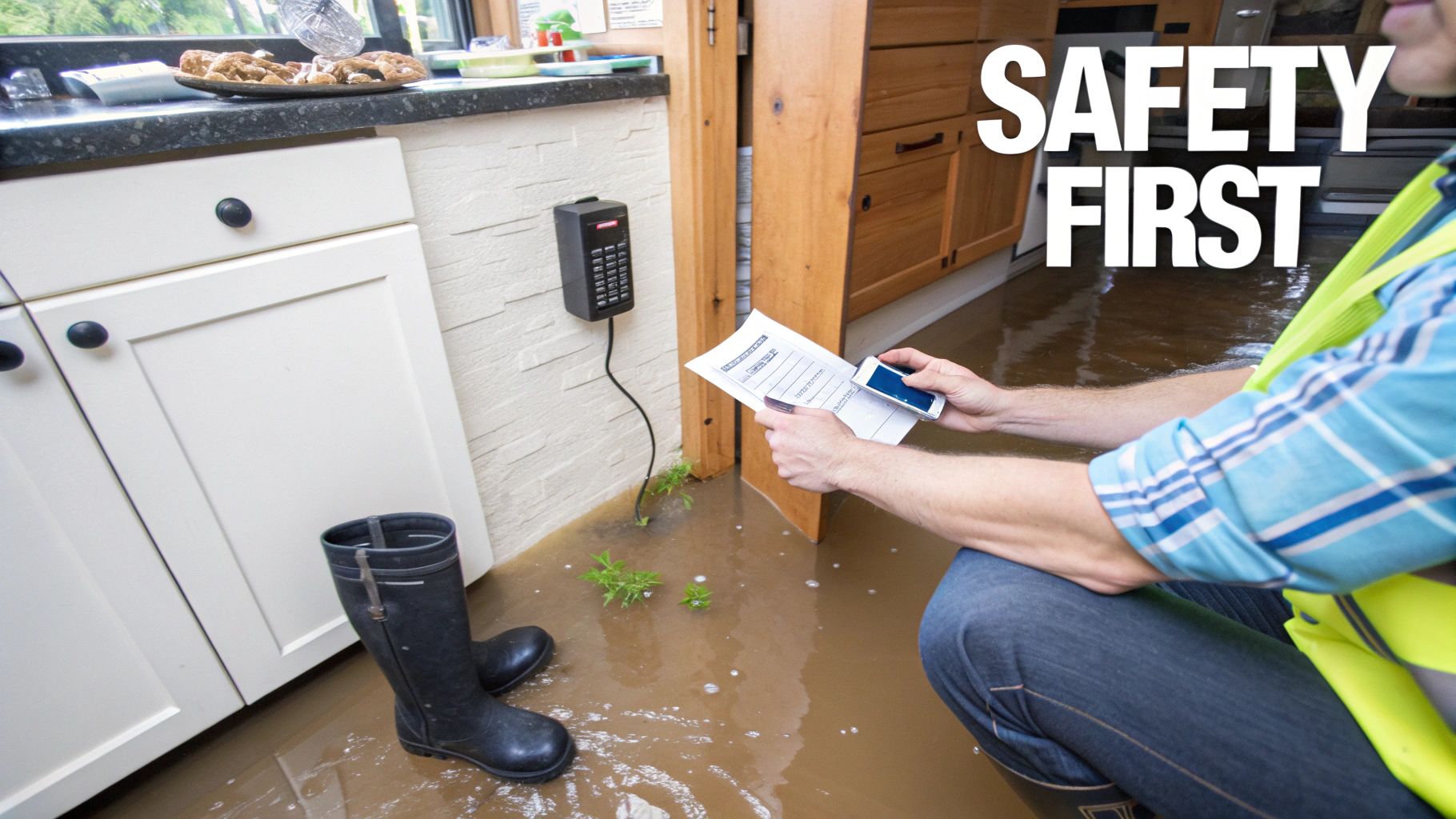
SAFETY WARNING: Never plug in or attempt to turn on any appliance that has been exposed to floodwater. The risk of life-threatening electrical shock or fire is severe. These steps are for safe assessment and documentation only. Always wear protective gear, including rubber boots and waterproof gloves.
Ensure Power is Off: Before approaching any appliance, double-check that the main power to your home is disconnected at the circuit breaker. Confirm there is no standing water around the appliance or your feet.
Document Everything: This is your most critical step. Take clear photos and videos of the flooded area and each affected appliance. Capture the water line on the appliance if visible. Get close-up shots of the model and serial number tags for insurance purposes. Your goal is to create a comprehensive visual record of the damage. For more information, you can learn how to navigate flood damage insurance claims effectively.
Perform a Visual Inspection (No Touching): From a safe distance, look for obvious signs of damage. Note any visible silt or debris in vents, around motors, or on control panels. Look for any physical damage from floating debris.
Check for Lingering Moisture: If the area is dry and safe to enter, open the appliance door (e.g., washer, dryer, oven). Is there still water pooled inside? Is there a strong musty or mildew odour? This indicates deep water saturation.
Do Not Attempt to Clean Internals: Resist the urge to hose down or wipe the internal components of an appliance. This can push silt and moisture deeper into sensitive electronics and motors, making a professional assessment more difficult and potentially causing more damage.
Stop and Call a Professional: This is the most important step. Once you have documented the damage, do not proceed further. The internal condition of the appliance is unknown and dangerous. Contact a certified appliance technician to perform a professional diagnosis. They have the tools and training to safely determine if the appliance is salvageable.
Appliance Flood Damage Repair Cost Breakdown
For residents in Edmonton, Calgary, and Red Deer, understanding the potential costs is crucial for making an informed decision. Repairing a flood-damaged appliance often involves replacing multiple core components, and costs can escalate quickly.
| Repair Type | Typical Cost (Alberta) | Notes |
|---|---|---|
| Diagnostic Fee | $120–$150 | This fee covers the technician's time to safely assess the damage. It is typically waived if you proceed with the recommended repair. |
| Common Parts Replacement | $150–$650+ | This includes parts like motors, control boards, or pumps. Prices vary significantly based on the appliance brand and model. |
| Labour Rate | $150–$260/hr | The rate depends on the complexity of the repair. Flood damage repairs are often intricate and time-consuming. |
Note: All prices are estimates and do not include GST. Costs may vary based on your specific location within the Edmonton, Calgary, or Red Deer areas and the exact appliance model.
Failure Rate & Repair Cost Chart
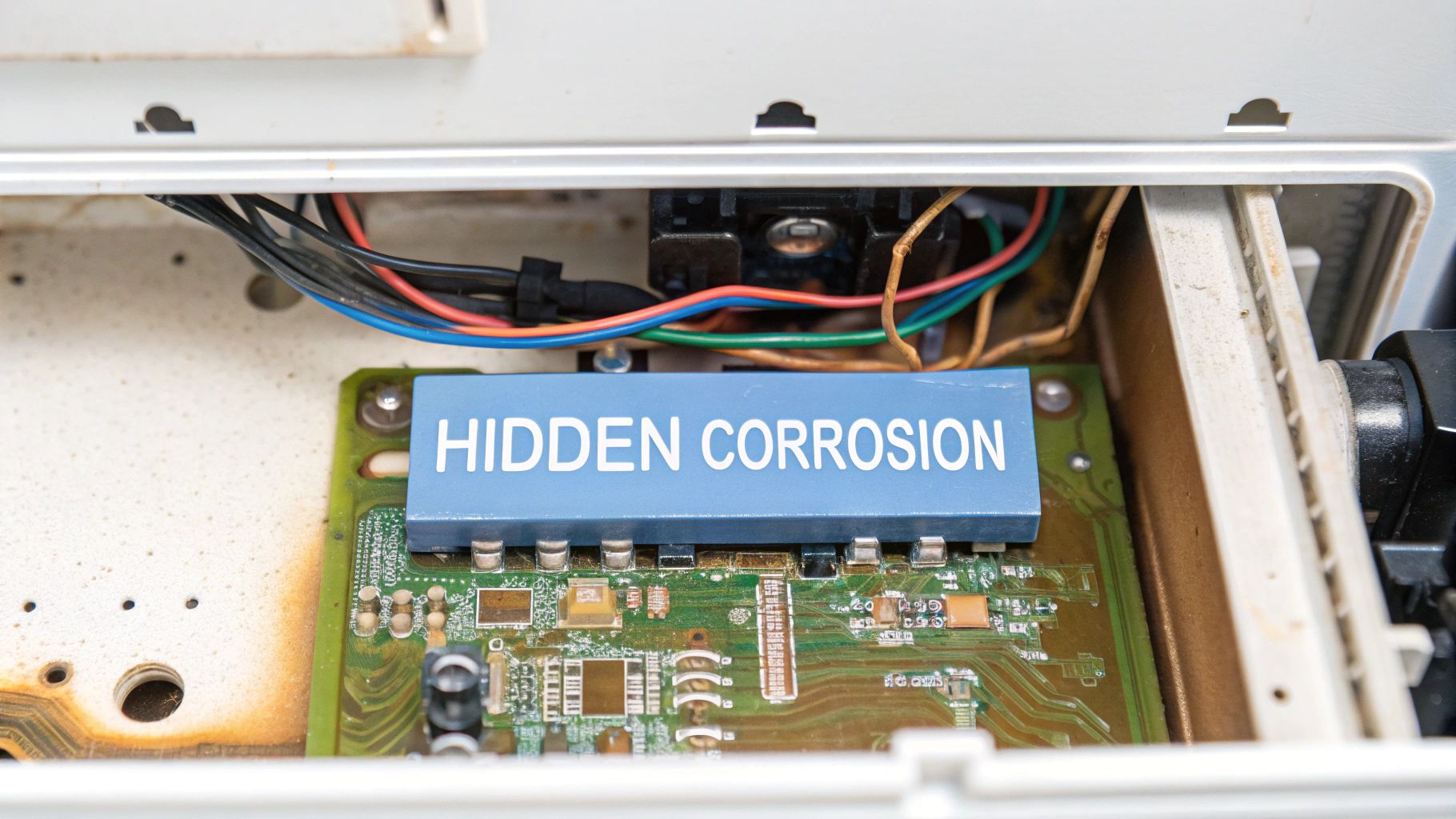
Chart Description: A bar chart compares component failure rates and average repair costs for the current year versus last year. Gray bars represent last year's data, while light blue bars show the current year's data. The chart illustrates that after regional flooding events, there is a sharp increase in the failure rate of control boards and motors (light blue bars are significantly taller), with a corresponding spike in the average repair cost for these components.
This data highlights a critical trend: post-flood scenarios lead to a dramatic rise in failures of expensive electronic and mechanical parts. The average repair cost often approaches the threshold where replacement becomes the more logical financial choice.
Repair vs. Replace: Making the Right Call
The decision to repair or replace a flood-damaged appliance requires a pragmatic financial assessment. The lingering threat of hidden corrosion and future failure means that repair is often a high-risk gamble.
Use these guidelines to make a clear decision:
Apply the 50% Rule: If the total estimated repair cost (parts + labour) exceeds 50% of the price of a new, comparable appliance, replacement is the financially sound option.
Consider Appliance Age: If the appliance is more than 75% through its expected lifespan (e.g., an 8-year-old washer with a 10-12 year lifespan), investing in a major repair is not recommended. The risk of another component failing soon is too high.
Factor in Brand and Technology:
Sub-Zero, Wolf: High-end, built-in appliances have a much higher replacement cost, so a more expensive repair can sometimes be justified if key components are undamaged.
Whirlpool, LG, Samsung: For these popular mid-range brands, the 50% rule is an excellent guide. Their sophisticated electronics are very vulnerable to water and can be costly to replace, often tilting the decision toward a new unit.
Ultimately, safety and reliability are paramount. A repaired flood-damaged appliance will never be as reliable as a new one. For a more detailed breakdown, review our cost analysis on repairing vs. replacing appliances.
Preventive Maintenance Tips
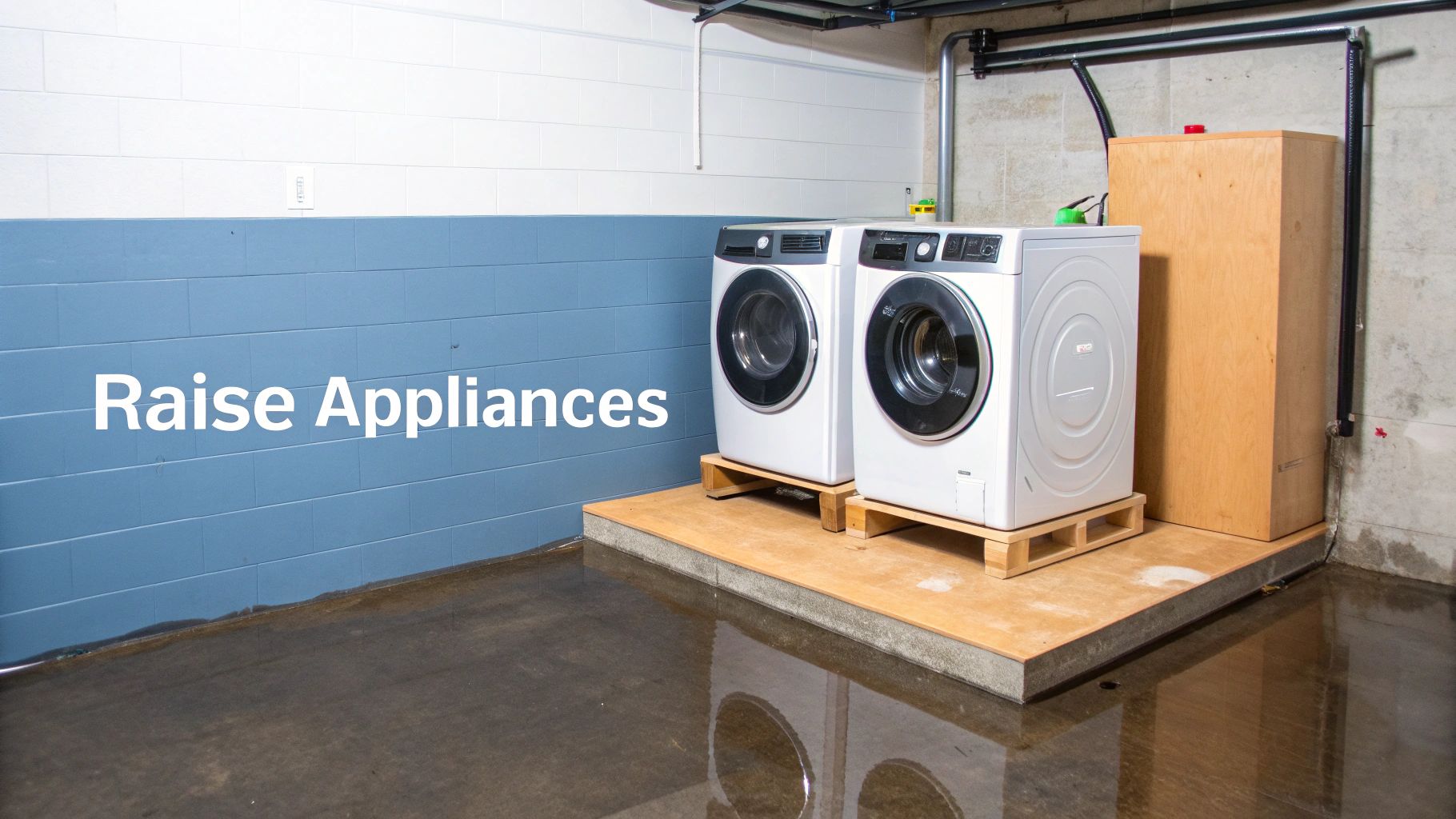
While you can't prevent every flood, you can take steps to mitigate the damage. Proactive measures can save you thousands of dollars and immense stress.
Elevate Your Appliances: If your appliances are in a basement or flood-prone area, raise them on a sturdy, waterproof platform made of concrete blocks or pressure-treated wood. An elevation of 12 inches can make a huge difference.
Install Water Leak Detectors: Place inexpensive, battery-operated water alarms near washing machines, dishwashers, refrigerators, and hot water tanks. They emit a loud alarm at the first sign of moisture.
Use Steel-Braided Hoses: Replace standard rubber supply hoses on your washing machine and dishwasher with durable steel-braided ones. They are far more resistant to bursting.
Know Your Shut-Offs: Ensure every member of your household knows the location of the main water shut-off valve and how to operate it.
Maintain Gutters and Downspouts: Ensure rainwater is directed well away from your home's foundation to prevent water from seeping into your basement.
Consider a Sump Pump: If you have a basement, a functional sump pump with a battery backup is your best defense against groundwater flooding.
Schedule Annual Professional Inspections: Have a certified technician inspect your appliances annually. They can spot potential issues before they become catastrophic failures. Explore our tips on 6 ways to keep your appliances working their best.
Brand-Specific Notes on Flood Damage
While all appliances are vulnerable to flood damage, certain brands have characteristics that affect their repairability and parts availability.
Samsung
Known Issues: Samsung appliances are packed with sensitive electronics. Their control boards and digital displays are highly susceptible to moisture and are often the first components to fail.
Parts Availability: Generally good, but specific electronic components can sometimes have long lead times.
Difficulty Level: High. Repairing water-damaged Samsung electronics requires specialized diagnostic tools.
LG
Known Issues: Similar to Samsung, LG appliances rely heavily on complex circuit boards and sensors. Direct Drive motors in washers can seize if infiltrated by silt.
Parts Availability: Very good for common models across Alberta.
Difficulty Level: High. The integrated nature of LG's electronics makes component-level repair challenging after a flood.
Whirlpool
Known Issues: Whirlpool appliances are known for their mechanical durability, but their electronic control units are still a major weak point in a flood.
Parts Availability: Excellent. Parts are widely available in Edmonton, Calgary, and Red Deer.
Difficulty Level: Medium to High. While mechanically simpler than some brands, diagnosing electrical faults post-flood is still complex.
GE
Known Issues: Water damage often affects the main control board and user interface panels. Wiring harnesses can corrode quickly if not addressed.
Parts Availability: Good, with a strong distribution network.
Difficulty Level: Medium. GE appliances are generally straightforward for experienced technicians to diagnose.
Bosch
Known Issues: Bosch dishwashers and laundry units have highly compact and sealed designs, but once water gets in, it can be trapped, accelerating corrosion. The control modules are particularly vulnerable.
Parts Availability: Good, though some specialized parts may need to be special-ordered.
Difficulty Level: High. The precision engineering of Bosch appliances requires expert knowledge for safe disassembly and assessment.
Maytag
Known Issues: Known for being robust, but like its sister brand Whirlpool, Maytag's electronics are the primary point of failure in a flood. Motors and transmissions are tough but not impervious to silt.
Parts Availability: Excellent.
Difficulty Level: Medium. Their durable build can sometimes make accessing internal components for assessment more time-consuming.
Frequently Asked Questions (FAQ)
Is it safe to plug in an appliance to see if it still works after a flood?
Absolutely not. This is extremely dangerous. A flood-damaged appliance poses a severe risk of electrical shock or fire, even if it appears dry. Internal wiring and safety components are compromised. Never apply power to a wet appliance.
Can I just let my appliance air dry and use it again?
No. This is a common and dangerous misconception. While the exterior may dry, moisture and corrosive contaminants remain trapped inside, slowly destroying electronics and wiring. This creates a ticking time bomb for a future electrical fire.
Will my homeowner's insurance cover my flooded appliances?
It depends on your policy. Standard policies often cover damage from internal sources like a burst pipe, but overland flooding from a storm or river usually requires a separate flood insurance policy. Document everything with photos and contact your insurance agent immediately.
What are the health risks of using a flood-damaged appliance?
Floodwater contains bacteria, sewage, and chemicals. These contaminants get trapped inside your appliance, creating a breeding ground for harmful mould and mildew. Using the appliance could circulate these hazardous particles throughout your home. We discuss similar risks in our article on why washer door gasket mold is harmful.
Why is replacing usually better than repairing a flooded appliance?
Safety and reliability. A repair can't guarantee that all hidden corrosion has been eliminated. The risk of a future failure or fire remains. Given that the cost of replacing multiple core components often exceeds 50% of a new unit's price, replacement is the safer and more cost-effective long-term solution.
How soon should I call a technician after a flood?
As soon as it is safe to re-enter your property. The sooner a professional can assess the damage, the faster you can start your insurance claim and make a decision about repair or replacement. A technician can provide the expert report you'll need for your insurer. Be sure to review these things you should do before getting your appliance repaired to streamline the process.
Final Summary
Navigating the aftermath of a flood is incredibly challenging. When it comes to your appliances, your first priority must always be safety—never attempt to operate a device that has been exposed to water. The internal damage caused by corrosive floodwater is often severe and hidden, making professional assessment non-negotiable. In most cases, the combination of high repair costs, compromised safety, and the risk of future failure makes replacement the most sensible and secure option. A certified technician can provide a definitive diagnosis, giving you the clarity needed to file your insurance claim and restore your home safely.
Need a Professional Assessment? We're Here to Help.
Edmonton Customers
Don’t risk your safety. Let our certified technicians provide a thorough and safe assessment of your flood-damaged appliances.
📅 Book Online: https://advanceappliance.ca/scheduler/
📞 Call Us: 587-882-3225
Calgary Customers
Our expert team is ready to help you navigate this difficult time with a professional and reliable diagnosis.
📅 Book Online: https://advanceappliance.ca/scheduler/
📞 Call Us: 587-997-3019
Same-day or next-day appointments available. Certified technicians. Warranty on parts and labour.