Gas Oven Igniter (Glow Bar) Guide: How It Works, Why It Glows but Won’t Light, Symptoms & Cost
If your gas oven igniter is glowing but not lighting, you’re usually dealing with a weak igniter (low amp draw) or a related gas-valve / wiring issue. This guide explains how glow bars work, what failures look like, typical replacement cost ranges (CAD), and when it’s safer to call a professional. For service, visit our stove & oven repair page, or book online using our service scheduler.
Helpful Pages You Can Use Right Now
These internal resources are useful if you’re diagnosing heat issues, planning service, or checking basics before a visit:
- Appliance repair overview (what to expect, booking flow)
- All services (home, business, and specialty support)
- Appliance repair checklist (great before you call)
- User manuals (model-specific info)
- Contact us (questions before booking)
If you suspect a broader issue (power, controls, or recurring faults), our common issues & repairs page can help you narrow it down quickly.
Service Coverage (Edmonton • Calgary • Red Deer)
We service gas oven igniter issues across Alberta. Use the right local page for faster scheduling details:
For urgent heat or gas concerns, see emergency appliance repair.
What Is a Gas Oven Glow Bar Igniter?
A glow bar igniter is a ceramic heating element near the burner. When you turn on bake or broil:
- The control sends power to the igniter.
- The igniter heats up and glows bright orange.
- As it heats, it must draw a specific current (amps).
- Once amp draw is high enough, the gas safety valve opens.
- The hot igniter lights the gas and the burner flame starts.
The glow bar is both the ignition source and part of the safety proofing system. A weak igniter can glow, but still fail to open the valve.
Common Glow Bar Types & Safety Notes
- Flat-style igniter – common for bake/broil burners.
- Round / cartridge igniter – found on older or specific designs.
- Both are fragile; over-tightening or bumping can crack them.
If you also suspect electronic issues (random shutdowns, error codes, no power to igniter circuit), our control board repair page explains what technicians typically test.
Pros and Cons of Glow Bar Igniter Systems
Most modern gas ovens use hot-surface (glow bar) igniters instead of standing pilot lights. Here’s the practical trade-off.
Pros of Glow Bar Igniters
- No standing pilot – less constant gas usage.
- Automatic ignition – lights as needed during temperature cycling.
- Built-in safety – valve opens only when igniter is hot enough (amp draw verified).
- Stable baking when healthy, with consistent temperature control.
- Parts are commonly available for many brands.
Cons of Glow Bar Igniters
- Wear item – weakens over time (even if it still glows).
- Fragile ceramic – can crack from impact or overtightening.
- Slow ignition – requires heat-up time.
- Higher electrical load than spark systems (amps per cycle).
- Weak igniters cause slow preheat, uneven heat, or no ignition.
Cost to Replace a Gas Oven Glow Bar Igniter (CAD)
Pricing depends on brand, model, access, and local rates. Here’s a realistic range many homeowners see in Canada.
| Scenario | Parts Estimate (CAD) | Labor Estimate (CAD) | Typical Total (CAD) | Notes |
|---|---|---|---|---|
| Standard brand – DIY parts only | $70 – $150 | $0 | $70 – $150 | Part only; no workmanship coverage; risk if misdiagnosed. |
| Standard brand – professional replacement | $90 – $180 | $150 – $280 | $240 – $460+ | Includes diagnosis, safe install, and functional testing. |
| Premium / luxury models | $150 – $280 | $200 – $350 | $350 – $630+ | Often requires OEM parts and longer disassembly time. |
| Igniter + additional issues (wiring, valve) | $150 – $350 | $250 – $450 | $400 – $800+ | Long-term weak igniters can stress valves and connectors. |
The best value is a proper diagnosis (not a guess). If your oven is also inconsistent, it’s worth checking how to test oven temperature or using our oven temperature pro calculator to understand what “normal” drift looks like.
Why the Igniter Glows but the Burner Still Won’t Light
The classic complaint is: “It glows, but there’s no flame.” Most of the time that points to a weak igniter, but technicians also confirm valve response, wiring integrity, and stable power delivery.
1) Weak Igniter (Low Amp Draw)
As igniters age, their electrical characteristics change. They can still glow orange but fail to pull enough current to open the valve.
- Igniter glows for a long time with no flame.
- Oven heats very slowly or not at all.
- Often no gas smell because the valve never opens.
A technician measures the igniter’s amp draw with an ammeter and compares it to manufacturer specs before replacing parts.
2) Failed Gas Safety Valve
Less common, but possible. The valve can fail to open even when the igniter is healthy.
- Igniter glows normally.
- Correct electrical readings, but valve does not open.
- No gas flow at the burner; no ignition.
3) Wiring, Connectors, or Control Issues
- Loose, burnt, or oxidized connectors between igniter/valve/control.
- Damaged harness from heat, spills, or past overheating.
- Electronic control not supplying stable power to the igniter circuit.
4) Gas Supply Problems
- Shut-off valve partly closed after cleaning or moving the range.
- Regulator or pressure issues (especially if multiple burners misbehave).
- Home-wide gas supply concerns.
If you smell raw gas without ignition, turn the oven off immediately, ventilate, and contact a professional. Do not keep trying to light it.
Common Symptoms of a Bad or Weak Oven Igniter
These signs often show an igniter is near end of life:
- Very long preheat times or oven never reaches set temperature.
- Burner lights sometimes, but not consistently on each cycle.
- Igniter glows 30–60+ seconds with no flame.
- Visible cracks, chalky spots, or crumbling on the igniter surface.
- Intermittent heating that gets worse after long baking sessions.
Keeping the oven clean can help airflow and heat stability. If you want a safe approach, see our proper oven cleaning guide. (Avoid harsh scraping around fragile igniters.)
FAQ – Gas Oven Glow Bar Igniters
Is it safe to use my oven if the igniter is slow or weak?
If it eventually lights and there’s no raw gas smell, it’s often a performance issue — but it still should be repaired. Weak igniters can cause unreliable heating and poor temperature control. If you ever smell gas without ignition, turn it off and call a technician immediately.
Can I fix a weak igniter by cleaning it?
Light debris can sometimes be removed carefully, but a weak or cracked igniter can’t be “restored.” If it’s not pulling proper current, replacement is the correct fix.
Should bake and broil igniters be replaced together?
Not always. Many ovens use separate igniters. If only one tests weak, only that one may need replacement. On older ovens where both are original, some owners replace both proactively.
What if my issue isn’t the igniter?
If testing points to controls or cycling issues, a technician may check control outputs and related components. If you’re seeing other recurring problems across appliances, our appliance common issues page is a good reference.
When Should I Call a Professional?
- You’re not comfortable working around gas or live electrical parts.
- You have repeated “glows but no flame” issues.
- You suspect the gas valve, control board, or wiring may be involved.
- You own a premium / built-in range where access is complex.
A professional visit includes testing, safety checks, and verification after repair. If you need help across multiple appliances, visit Advance Appliance repair services.
Hire an expert from Advance Appliance Ltd for safe diagnosis and glow bar igniter replacement. You can also review our service options and book online anytime.
Oven Preventive Maintenance Before the Holiday Season
Holiday cooking places the heaviest workload on your oven all year. A quick preventive check before hosting can prevent slow preheating, ignition failures, temperature drops, and last-minute breakdowns. If you already suspect an issue, consider a full oven and stove repair service before the holiday rush.
Essential Holiday Oven Maintenance Checklist
- Verify igniter performance – slow or weak glow bars cause long preheat times or no flame during heavy use.
- Check oven temperature accuracy – older units run 15–40°F off without calibration.
- Inspect door gasket – damaged seals leak heat and extend cooking time.
- Clean sensor probe – residue affects temperature readings.
- Run a short test bake – confirm proper ignition, stable flame, and cycle consistency.
- Check gas smell or unusual clicks – could indicate ignition delay or weak igniter.
- Test broil function – high heat cycles often reveal weak igniters early.
These quick checks prevent a large portion of the “oven not heating” calls we receive during Thanksgiving and Christmas week. For deeper cleaning tips, see our proper oven cleaning guide.
Common Oven Problems Right Before the Holidays
- Oven takes too long to preheat – often a weak igniter or temperature sensor issue.
- Burner lights intermittently – igniter amperage dropping below safe valve threshold.
- Oven shuts off early – dirty sensor or failing control board.
- Uneven baking – failing fan motor or obstructed airflow.
- Broil not working – broil igniter failure, common in older ranges.
- Error codes when oven gets hot under heavy load.
If your oven shows any of these symptoms, service it before the holiday rush—not the day before your family arrives.
Book a professional diagnostic with Advance Appliance Ltd. We service Edmonton, Calgary, Red Deer, and surrounding areas with fast response times during peak season. For full-home coverage, explore our appliance repair services in Edmonton and area.
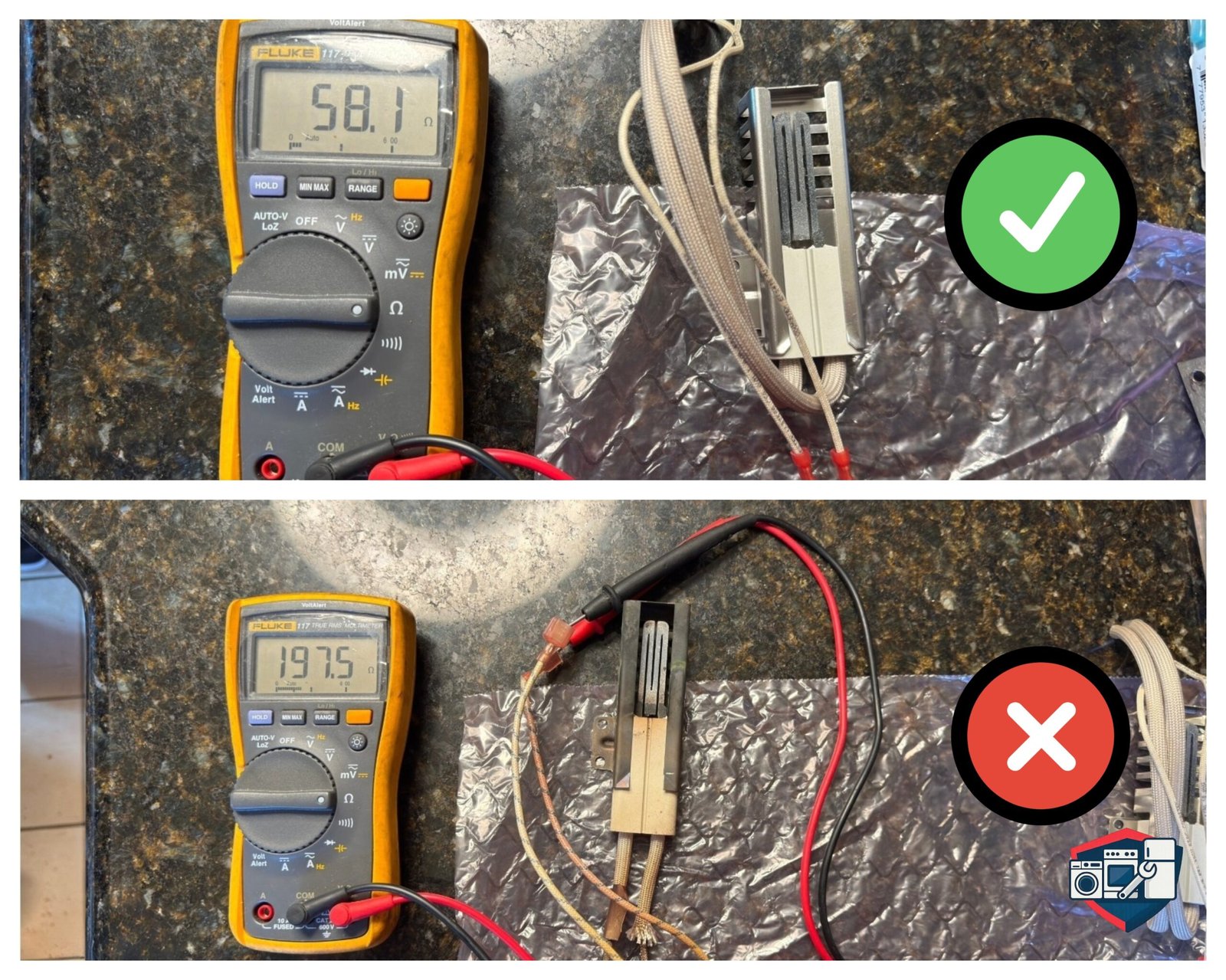
Gas Oven Igniter Resistance Test: Good vs Bad Reading
This section explains how to test a gas oven glow-bar igniter using a multimeter (Ω) and how to interpret results. Key point: an igniter can glow and still be too weak to open the gas valve if resistance is high.
How to Test a Gas Oven Igniter Using a Multimeter
Use resistance testing as a quick screening method. For best accuracy, technicians often confirm with amp draw, but Ω readings can clearly show a weak igniter when the number is unusually high.
- Turn OFF power to the range (unplug or switch off the breaker).
- Access the bake or broil burner area and locate the igniter connector.
- Disconnect the igniter from the harness (prevents reading through the circuit).
- Set your meter to Ω (ohms).
- Place one probe on each igniter terminal (polarity does not matter for resistance).
- Compare your reading to the “Good vs Bad” examples below.
✅ Good Igniter (Top Image): ~58 Ω
- Reading: approximately 58 Ω
- Meaning: healthy igniter resistance profile
- Performance: can draw sufficient current to open the gas valve
- Expected result: normal ignition and stable preheat
❌ Bad Igniter (Bottom Image): ~197 Ω
- Reading: approximately 197 Ω
- Meaning: weak/failing igniter (high resistance)
- Performance: cannot pull enough amperage to open the gas valve
- Symptoms: no heat, delayed ignition, intermittent heating
| Reading (Ω) | Interpretation | What you’ll notice |
|---|---|---|
| ~58 Ω | Healthy / normal range example | Ignites properly, reaches temperature normally |
| ~197 Ω | High resistance (weak igniter) | Glows but won’t light, delayed ignition, intermittent heat |
Book a technician for accurate diagnosis and safe repair recommendations.