A malfunctioning commercial refrigerator is more than an inconvenience; it's an urgent business crisis that puts your inventory, profits, and reputation at risk. For business owners in Edmonton, Calgary, and Red Deer, getting a fast and accurate diagnosis is critical to prevent product loss and operational disruption. This expert guide provides clear, actionable steps to help you understand the problem and determine the most effective solution.
What the Problem Means

When your commercial refrigerator fails, it’s a direct threat to your business operations and food safety standards. Seemingly minor issues like inconsistent temperatures or unusual noises are often early indicators of a more significant underlying problem that could lead to a complete system failure. Understanding these symptoms allows you to take prompt action to protect your assets.
Common symptoms homeowners and business managers notice include:
- Temperature Fluctuations: The unit cannot maintain a consistent, food-safe temperature, putting perishable inventory at immediate risk.
- Unusual Noises: Grinding, buzzing, or loud clicking sounds indicate mechanical stress on components like the compressor or fan motors.
- Excessive Frost Buildup: A thick layer of ice, particularly in a frost-free model, points to a malfunctioning defrost system or poor airflow.
- Water Leaking: Puddles inside or outside the unit often signal a clogged defrost drain line or a compromised door gasket.
- Unit Runs Constantly: The refrigeration cycle never stops, indicating the system is struggling to reach its set temperature, leading to excessive energy consumption and component wear.
Common Causes of Commercial Refrigerator Failure

Before you can fix a commercial refrigerator, accurately identifying the root cause is essential. Many different electrical and mechanical failures present with similar symptoms, such as inadequate cooling. This table outlines the most common issues we diagnose, their descriptions, and the associated difficulty and safety risks involved in their repair. A correct diagnosis is the first step toward a lasting and cost-effective solution.
| Cause | Description | Difficulty | Risk |
|---|---|---|---|
| Dirty Condenser Coils | A buildup of dust, grease, and debris on the coils restricts heat transfer, forcing the compressor to overwork and eventually fail. | Low | Low |
| Faulty Evaporator Fan Motor | The fan motor fails, preventing cold air from circulating throughout the cabinet. This leads to poor cooling and ice buildup on the coils. | Medium | Medium (Electrical) |
| Compressor Failure | The compressor, the core of the cooling system, stops working. Refrigerant no longer circulates, and all cooling ceases. | High | High (Electrical/Pressure) |
| Refrigerant Leak | A breach in the sealed system allows refrigerant to escape, causing a gradual or total loss of cooling capacity. Requires specialized equipment to locate and repair. | High | High (Chemical/Pressure) |
| Malfunctioning Thermostat | The thermostat provides inaccurate temperature readings, causing the compressor to cycle improperly and leading to unsafe temperature swings. | Medium | Medium (Electrical) |
| Failed Defrost System | The defrost heater, timer, or thermostat fails, causing excessive ice to build up on the evaporator coils and block airflow. | Medium | Medium (Electrical) |
| Worn Door Gaskets | Damaged or brittle door seals allow warm ambient air to enter the unit, forcing it to run constantly to maintain temperature. | Low | Low |
| Clogged Drain Line | Debris or ice blocks the defrost drain tube, causing water to back up and leak, creating slip hazards and potential water damage. | Low | Low |
Safe DIY Troubleshooting Steps
Before calling a professional, there are several safe, basic checks you can perform to rule out simple issues. Many service calls can be avoided by verifying these common culprits. These steps do not require specialized tools and can help you provide valuable information to a technician if a repair is needed.
CRITICAL SAFETY WARNING: Your safety is the top priority. Before performing any inspection, you MUST disconnect the appliance from its power source. Unplug the unit from the wall outlet or turn off the corresponding circuit breaker at your electrical panel. Never attempt any troubleshooting steps on a live appliance.
Verify Power Connection: Ensure the refrigerator is securely plugged into the wall outlet. Check your electrical panel to see if the circuit breaker has tripped. If it has, reset it once. If it trips again immediately, this indicates a serious electrical fault; stop and call a professional technician immediately.
Inspect Door Gaskets: Close the door and carefully run your hand along the seals. If you feel cold air escaping, the gasket is not sealing properly. Clean the gaskets with warm, soapy water to remove any debris and check for cracks, tears, or brittleness that would require replacement.
Check for Proper Airflow: Overloading shelves or blocking internal air vents with product can restrict the circulation of cold air. Ensure there is adequate space between items and that all vents are unobstructed to allow the unit to cool efficiently. This is a common cause of refrigerator temperature problems.
Confirm Thermostat Settings: It is common for thermostat dials to be accidentally adjusted in a busy environment. Verify that the temperature is set to the correct, food-safe level for your inventory.
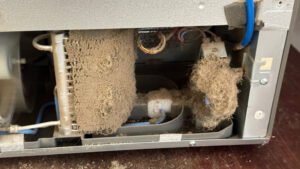
Clean the Condenser Coils: The condenser coils dissipate heat from the refrigerant. Over time, they become coated with dust and grease, severely reducing their efficiency. Carefully clean the coils, typically located at the bottom or back of the unit, using a stiff brush and a vacuum.
Clear the Drain Line: Locate the defrost drain tube inside the unit and ensure it is free of clogs from ice or debris. A simple obstruction can cause water to leak onto the floor.
If these steps do not resolve the issue, it is time to call a professional. Do not attempt to access or repair the compressor, refrigerant lines, or any internal electrical wiring. These tasks require licensed technicians with specialized tools and carry significant safety risks. If you've done these checks and still have issues, our guide on how to fix a refrigerator that is not cooling may provide more insight before you call.
Commercial Refrigerator Repair Cost Breakdown
Understanding the potential costs associated with a professional repair helps you make an informed decision for your business. The following breakdown provides estimated pricing for commercial refrigerator repair services in Alberta.
Please Call to get exact Rates:
Effective starting in 2026, service call fees are no longer waived. The service call fee covers the technician’s travel time, professional appliance diagnosis, and helps support ongoing operational expenses required to deliver reliable, high-quality service. We remain committed to keeping our fees fair, transparent, and aligned with reasonable repairability standards.
Alberta Regional Pricing (Current Year):
- Estimated Service call / diagnostic: $120–$250 (not waived)
- Estimated Parts: $150–$650 (varies by brand and model)
- Estimated Labor: $150–$260 per hour
Important Notes:
- GST is not included in the estimated prices.
- Prices vary by service area, including Edmonton, Calgary, and Red Deer.
- Rates are subject to market and economic changes.
- Additional travel or mileage charges may apply for locations outside our primary service zones.
Component Failure Rate & Average Repair Cost Chart

When analyzing repair trends, data shows a consistent pattern in component failures. Imagine a chart where gray bars represent last year's data and light blue bars represent the current year. This chart would compare the failure rates of key components against their average repair costs.
Consistently, the data would show that compressors and evaporator fan motors have the highest failure rates and also incur the highest repair costs due to expensive parts and intensive labor. Following closely would be electronic control boards and defrost system components. In contrast, parts like door gaskets and thermostats would show a lower failure rate and a significantly lower average repair cost. This trend highlights why a precise diagnosis is crucial; mistaking a simple thermostat issue for a failing compressor can lead to unnecessarily high expenses. Understanding the system's smaller components, like the filter drier in refrigeration systems, is key to grasping the overall health of the unit.
Repair vs. Replace: Making the Right Decision
When faced with a significant repair bill, the critical question is whether to invest in the existing unit or replace it. Making a sound financial decision requires a clear-headed assessment based on three key factors: repair cost, appliance age, and brand quality.
We recommend replacement when:
- The repair cost exceeds 50% of the replacement cost. This is a widely accepted industry guideline. For example, if a repair is quoted at $1,800 and a comparable new unit costs $3,000, replacement is the more financially prudent choice.
- The appliance is past its expected lifespan. Most commercial refrigerators have a lifespan of 10 to 15 years. Investing in major repairs for a unit nearing the end of its service life is often not a wise investment, as other components are likely to fail soon.
- The brand and model have a history of frequent breakdowns. If your unit has required multiple service calls in the past year, it is likely entering a cycle of cascading failures. Replacing it with a more reliable model will save you money and downtime in the long run. Our guide on whether to repair or replace a refrigerator offers a deeper analysis.
Conversely, for high-end brands like Sub-Zero or Viking, which are built for longevity, a significant repair can still be a worthwhile investment even on an older unit.
Preventive Maintenance Tips

Proactive maintenance is the most effective way to prevent costly, unexpected breakdowns and extend the life of your commercial refrigerator. Integrating these simple tasks into your operational routine will improve efficiency, reduce energy costs, and protect your inventory.
- Clean Condenser Coils Monthly: Use a stiff brush and vacuum to remove all dust and grease buildup from the condenser coils.
- Inspect and Clean Door Gaskets Weekly: Wipe gaskets with a damp cloth and mild detergent to ensure a tight seal. Check for any cracks or tears.
- Monitor Temperatures Daily: Verify that the internal temperature is consistently within the food-safe range.
- Ensure Proper Airflow: Keep the area around the refrigeration unit clear of clutter to allow for adequate ventilation and heat dissipation.
- Clear Interior Vents: Do not overstock shelves or block interior vents, which are critical for proper cold air circulation.
- Clean Fan Blades and Housings: Periodically and safely clean fan blades to prevent dust accumulation that can unbalance and damage the motor.
- Check and Clear Drain Lines: Regularly ensure the defrost drain line is clear of debris to prevent water leaks and ice buildup.
- Schedule Annual Professional Inspections: A certified technician can identify and address potential issues like small refrigerant leaks or component wear before they become major failures.
Brand-Specific Notes
Repairing a commercial refrigerator effectively requires brand-specific knowledge. Each manufacturer has unique designs, common failure points, and parts supply chains. Our technicians are trained to service a wide array of brands found in Alberta businesses.
Amana, Maytag, Whirlpool, KitchenAid, JennAir, Roper, Inglis, Caloric, Crosley, Cabrio, Bravos:
- Known Issues: Commonly experience issues with defrost systems, failing evaporator fan motors, and worn-out door gaskets. Control board failures can occur after power fluctuations.
- Parts Availability: Excellent. Parts are widely available across Canada, allowing for quick repairs.
- Repair Difficulty: Low to Medium. Straightforward designs make them relatively easy for experienced technicians to diagnose and service.
Frigidaire, White-Westinghouse, Tappan, Gibson, Kelvinator, Frigidaire Gallery:
- Known Issues: Prone to defrost timer and thermostat failures. Damper control assemblies can also stick or fail, causing temperature inconsistencies.
- Parts Availability: Very good. Widespread distribution network ensures parts are readily accessible.
- Repair Difficulty: Low to Medium.
GE, GE Profile, Café, Monogram, Hotpoint, Moffat:
- Known Issues: Electronic control boards are a common failure point. Water dispenser and ice maker systems can also be problematic.
- Parts Availability: Good, with a reliable supply chain for most common components.
- Repair Difficulty: Medium. Some electronic diagnostics can be complex.
Samsung, LG:
- Known Issues: Notorious for compressor failures, especially with their linear compressor designs. Ice maker systems are also a frequent source of service calls.
- Parts Availability: Can be inconsistent. While common parts are available, specific electronic components or updated compressor models can be difficult to source quickly.
- Repair Difficulty: High. Advanced electronics and proprietary components require specialized knowledge and diagnostic tools.
Bosch, Thermador, Gaggenau:
- Known Issues: Well-built, but can experience issues with clogged drain lines (Bosch) and complex electronic control systems.
- Parts Availability: Good, but often must be ordered from authorized distributors, which can add time to the repair.
- Repair Difficulty: Medium to High. Integrated designs and precise engineering demand a methodical approach.
Sub-Zero, Wolf, Viking:
- Known Issues: These premium units can develop sealed system problems (leaks, compressor failure) after 10-15 years. Viking models can have finicky electronic controls.
- Parts Availability: Good, but parts are expensive and must be sourced through authorized channels.
- Repair Difficulty: High. These systems often feature dual compressors and complex controls, requiring brand-specific expertise.
Miele, Liebherr, Asko:
- Known Issues: Extremely reliable, but when failures occur, they are often complex electronic issues. Integrated designs can make access for repairs challenging.
- Parts Availability: Generally good, though some parts may need to be special-ordered from Europe.
- Repair Difficulty: High. Requires meticulous work due to compact and integrated construction.
Danby, Haier, Hisense, Insignia, Magic Chef, Sharp, Toshiba, Beko, Blomberg:
- Known Issues: As value-oriented brands, they can experience a range of component failures, from thermostats to compressors, often earlier in their lifespan.
- Parts Availability: Varies significantly. Can be challenging to source parts for older or less common models.
- Repair Difficulty: Medium.
Speed Queen, Alliance Laundry:
- Known Issues: Primarily known for laundry, their refrigeration units (less common) are built for durability but can still face standard component failures.
- Parts Availability: Limited due to their focus on laundry equipment.
- Repair Difficulty: Medium.
Dacor, Fisher & Paykel, Thor:
- Known Issues: Unique designs can lead to specific issues, such as with Fisher & Paykel's drawer-based systems or Dacor's advanced electronic features.
- Parts Availability: Generally requires ordering from specialized distributors.
- Repair Difficulty: Medium to High.
Frequently Asked Questions (FAQs)
1. When should I stop troubleshooting and call a technician?
Stop immediately and call a professional if the unit won't power on after a breaker reset, you hear loud mechanical grinding, smell chemical odors (potential refrigerant leak), or see any damaged wiring.
2. What is the average cost to fix a commercial refrigerator in Alberta?
Costs vary, but you can typically expect a service call/diagnostic fee of $120–$250, parts ranging from $150–$650, and labor at $150–$260 per hour. The total depends on the specific failure and brand.
3. Is it safe for me to handle a refrigerant leak?
No, absolutely not. Refrigerant is a controlled, hazardous substance. Handling it without proper certification and specialized equipment is illegal and dangerous. Always call a licensed technician for any sealed system repairs.
4. How long should my commercial refrigerator last?
With regular preventive maintenance, a quality commercial refrigerator should provide 10 to 15 years of service. High-end brands may last even longer.
5. Does my appliance's warranty cover this repair?
Manufacturer warranties typically cover parts and labor for defects within the first year, with longer coverage (5+ years) often limited to the sealed system. Always check your warranty documents, as extended or third-party warranties may have different terms.
6. How quickly can I get a technician to my business?
For emergencies like a failed commercial refrigerator, we prioritize service and offer same-day or next-day appointments throughout Edmonton, Calgary, and Red Deer to minimize your downtime.
Final Summary
Successfully managing a commercial refrigerator failure requires understanding its symptoms, performing safe initial checks, and knowing when to call for expert help. While routine cleaning and maintenance can prevent many common issues, complex mechanical and electrical problems demand professional attention. Attempting to fix a commercial refrigerator beyond basic troubleshooting can lead to more extensive damage, safety hazards, and prolonged business disruption. The most effective and safest solution is to secure a prompt diagnosis from a certified technician who can ensure the repair is done correctly, protecting your inventory and your investment.
Reviewed by certified appliance technicians at Advance Appliance Ltd serving Alberta homeowners.
Book a Service Appointment
Call: 587-882-3225
Book Online: https://advanceappliance.ca/scheduler/
Same-day or next-day appointments available. Certified technicians. Warranty on parts and labor.