Opening your dishwasher to find a cloudy film on glasses or food residue on plates is a frustrating, common problem. When a dishwasher fails to rinse properly, it turns a convenient appliance into a source of extra work. At Advance Appliance Ltd, we frequently address this issue for homeowners across Edmonton, Calgary, and Red Deer, providing clear solutions to restore your machine’s performance.

What the Problem Means
A dishwasher not rinsing properly means that dirty, soapy water is being left on your dishes at the end of a cycle instead of being thoroughly washed away with fresh, clean water. This failure can stem from mechanical blockages, component malfunctions, or even improper usage. The result is dishes that are unsanitary and require re-washing by hand.
Common symptoms homeowners notice include:
- A white, cloudy film or streaks on glassware.
- Gritty, sand-like residue on plates and bowls.
- Visible food particles stuck to utensils and cookware.
- A soapy or chalky feel on the surface of the dishes.
- Puddles of dirty water left at the bottom of the dishwasher tub after the cycle finishes.
Understanding these signs is the first step in diagnosing the root cause. For a broader look at cleaning issues, see our guide if your dishwasher is not cleaning.
Common Causes of Poor Rinsing
Several issues can prevent your dishwasher from rinsing correctly. The table below outlines the most common causes, their difficulty to diagnose, and the associated risks. Our internal data shows that clogged spray arms and hard water mineral buildup account for over 35% of rinsing-related service calls in Alberta.
| Cause | Description | Difficulty | Risk |
|---|---|---|---|
| Clogged Spray Arms | Food debris, mineral deposits (limescale), or other small particles block the nozzles on the spray arms, preventing water from reaching all dishes. | Low | Low. No safety risk to the homeowner, but can lead to poor cleaning and potential damage to the circulation pump if left unaddressed. |
| Dirty or Clogged Filter | The filter at the bottom of the tub is designed to trap food particles. When it becomes clogged, dirty water is recirculated onto the dishes. | Low | Low. A dirty filter poses no safety risk but is a primary cause of poor rinsing and can lead to foul odors. |
| Improper Loading | Overcrowding the dishwasher or placing large items in a way that blocks the spray arms' rotation prevents water from reaching every surface. | Low | Low. No safety risk, but consistently improper loading leads to poor performance and wasted water and energy. |
| Rinse Aid Dispenser Malfunction | The dispenser may be empty, clogged, or broken, preventing it from releasing the rinse aid needed to help water sheet off dishes effectively. | Low-Medium | Low. A faulty dispenser doesn't pose a safety risk but directly causes spotting and poor drying. |
| Low Water Pressure | Insufficient water pressure from your home's plumbing means the dishwasher can't fill properly or spray forcefully enough to rinse dishes clean. | Medium | Medium. Diagnosing this may require checking plumbing valves. Incorrectly handling water lines can lead to leaks and water damage. See low water pressure. |
| Faulty Water Inlet Valve | This valve controls the flow of fresh water into the dishwasher. If it's clogged or fails, the machine won't get enough clean water for rinsing. | High | High. This is an electrical and plumbing component. Attempting a DIY repair risks electric shock and significant water leaks. |
| Clogged Drain Line or Air Gap | A blockage in the drain hose or air gap prevents dirty water from being fully pumped out, causing it to mix with the final rinse water. | High | High. Involves disconnecting plumbing lines. Mistakes can lead to flooding, water damage, and sewer gas backflow. Consult resources on fixing a clogged dishwasher drain. |
| Failed Circulation Pump | The pump is the heart of the dishwasher, responsible for spraying water. If it's failing, water won't circulate with enough force to rinse properly. | High | High. The pump is a major electrical component. A DIY replacement is complex and carries a risk of electric shock and improper installation. |
Troubleshooting Steps
Before scheduling a repair, there are several safe, simple steps you can take to resolve common rinsing issues. These checks do not require special tools and often fix the problem without the need for a technician.
Safety Warning: Always disconnect the dishwasher from its power source before performing any inspection or cleaning. Unplug the appliance from the wall outlet or turn off the corresponding breaker at your main electrical panel to eliminate the risk of electric shock.
- Clean the Dishwasher Filter: Locate the filter at the bottom of the dishwasher tub. Twist to unlock it, then remove it along with the mesh screen. Wash both parts thoroughly with warm, soapy water and a soft brush to remove all food debris and grease. Rinse completely before securely reinstalling it.
- Inspect and Unclog the Spray Arms: Check the small holes on the upper and lower spray arms for blockages. Use a toothpick, pin, or piece of wire to carefully clear out any visible food particles or mineral deposits. After cleaning, give the arms a gentle spin by hand to ensure they rotate freely and are not obstructed by dishes or racks.
- Check the Rinse Aid Dispenser: Open the rinse aid compartment and check if it is full. If it's empty, refill it with a high-quality rinse aid. If it's full but dishes are still spotted, check the dispenser's setting—most have an adjustable dial to control the amount released.
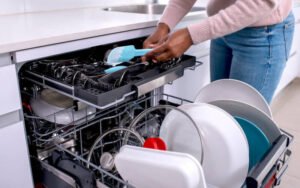
- Review Your Loading Technique: Ensure you are not overcrowding the dishwasher. Leave adequate space between dishes for water to circulate. Make sure large pots, pans, or utensils are not blocking the path of the spray arms.
- Run a Hot Water Pre-Rinse at the Sink: Before starting a cycle, run the hot water tap at your kitchen sink until the water is hot. This ensures the dishwasher begins its cycle with hot water immediately, which is crucial for dissolving detergent and cleaning effectively.
- Perform a Vinegar Cleaning Cycle: To remove mineral buildup caused by Alberta's hard water, place a dishwasher-safe bowl containing one cup of white vinegar on the top rack of the empty dishwasher. Run a full, hot water cycle. This helps dissolve limescale and deodorize the machine. For a more detailed guide, see how to clean your dishwasher.
When to Stop: If you have completed all of these steps and your dishwasher is still not rinsing properly, the problem is likely a malfunctioning component like the water inlet valve, circulation pump, or a clogged drain line. Do not attempt to diagnose or repair these parts yourself. Stop and call a professional technician to avoid the risk of water damage or electrical injury.
Repair Cost Breakdown
Understanding potential repair costs helps homeowners in Edmonton, Calgary, and Red Deer make informed decisions. We believe in complete transparency, so here is a breakdown of what to expect for a professional dishwasher repair. The process begins with a service call for an accurate diagnosis, which is essential to identify the root cause.
Please Call to get exact Rates:
Effective starting in 2026, service call fees are no longer waived. The service call fee covers the technician’s travel time, professional appliance diagnosis, and helps support ongoing operational expenses required to deliver reliable, high-quality service. We remain committed to keeping our fees fair, transparent, and aligned with reasonable repairability standards.
- Estimated Service call / diagnostic: $120–$250 (not waived)
- Estimated Parts: $150–$650 (varies by brand and model)
- Estimated Labor: $150–$260 per hour
- Additional travel or mileage charges may apply
Important Notes:
- GST is not included in these estimates.
- Prices vary by Edmonton, Calgary, and Red Deer.
- Rates are subject to market and economic changes.
For a comprehensive overview of service expenses, see our average appliance repair cost breakdown.
Failure Rate & Repair Cost Chart
In the appliance repair industry, tracking component failure rates and costs helps us identify trends and provide better advice to homeowners. A chart comparing this data year-over-year would show gray bars for last year and light blue bars for the current year. For dishwashers, you would typically see that common, low-cost parts like spray arms have a relatively stable failure rate. However, more complex components like circulation pumps and electronic control boards might show a slight increase in failure rates in the current year due to supply chain factors affecting component quality. The average repair cost for these major parts would also reflect this trend, with a noticeable rise in the light blue bars compared to the gray ones, driven by increased part prices and labor complexity. This data reinforces the importance of knowing when to call an appliance repair technician for an accurate diagnosis.
Repair vs Replace
Deciding whether to repair or replace a faulty dishwasher is a common dilemma for homeowners in Edmonton, Calgary, and Red Deer. A practical guideline we recommend is the 50% rule: if the estimated repair cost exceeds 50% of the cost of a comparable new dishwasher, replacement is generally the more financially sound option.
The appliance's age is another critical factor. Most dishwashers have an expected lifespan of 9 to 12 years. If your machine is approaching or has surpassed this range, investing in a significant repair may not be wise, as other components are likely to fail soon.
Brand differences also play a role. Premium brands like Miele, Bosch, or Thermador are built with higher-quality components and have a longer expected lifespan. Repairing these units, even when they are older, often makes economic sense. In contrast, for a budget-friendly model that has provided several years of service, replacement is often the better choice when faced with a costly repair. For more guidance, explore our analysis of appliances that are worth repairing vs replacing.
Preventive Maintenance Tips

Proactive maintenance is the most effective way to prevent rinsing problems and extend the life of your dishwasher. Integrating these simple habits into your routine can save you from inconvenient breakdowns and expensive repairs.
- Clean the Filter Weekly: Remove and rinse the filter at the bottom of the tub under hot water to prevent food buildup that causes poor rinsing and odors.
- Scrape, Don't Pre-Rinse: Scrape large food scraps off plates before loading, but avoid extensive pre-rinsing. Modern dishwasher detergents are designed to work on food soils.
- Inspect Spray Arms Monthly: Use a toothpick to clear any debris from the spray arm nozzles to ensure an unobstructed, powerful spray.
- Use High-Quality Detergent: Choose a premium detergent formulated to combat mineral deposits from Alberta's hard water.
- Keep Rinse Aid Full: Always use a rinse aid to help water sheet off dishes, preventing spots and improving drying performance.
- Run a Monthly Cleaning Cycle: Use a commercial dishwasher cleaner or run an empty, hot cycle with a cup of white vinegar to dissolve grease and limescale.
- Check the Door Gasket: Wipe down the rubber gasket around the door to prevent mold and ensure a tight seal.
- Load Dishes Properly: Avoid overcrowding and ensure nothing blocks the spray arms from rotating freely.
- Schedule Annual Professional Inspection: An annual tune-up by a certified technician from Advance Appliance Ltd can identify and address potential issues like a failing water valve or a worn pump seal before they cause a major failure.
Brand-Specific Notes
Different dishwasher brands have unique characteristics regarding common issues, parts availability, and repair complexity. Here is a brief overview for various brands available in Alberta.
Amana, Bravos, Cabrio, Caloric, Crosley, Gibson, Goldstar, Insignia, Kelvinator, Magic Chef, Roper, Tappan, White-Westinghouse
- Known issues: Generally simpler designs, prone to issues with wash arms, door latches, and filters.
- Parts availability: Excellent, as many parts are interchangeable with Whirlpool and Frigidaire models.
- Repair difficulty level: Low to Medium. Straightforward for experienced technicians.
Bosch, Gaggenau, Miele, Siemens, Thermador
- Known issues: Advanced engineering means issues are often sensor or control board-related. Prone to drain pump and flow sensor errors if not maintained.
- Parts availability: Good, but parts are often brand-specific and can be expensive.
- Repair difficulty level: High. Requires specialized knowledge and diagnostic tools.
Frigidaire, Electrolux, Frigidaire Gallery, IKEA
- Known issues: Common issues include circulation pump failures, heating element problems, and control board glitches.
- Parts availability: Very good. Parts are widely available across Alberta.
- Repair difficulty level: Medium. Modular designs make many repairs straightforward for a professional.
GE, GE Profile, Café, Monogram
- Known issues: Known for wash pump motor failures, faulty water inlet valves, and electronic control issues on higher-end models.
- Parts availability: Excellent. A robust parts distribution network ensures quick access.
- Repair difficulty level: Medium to High. Varies significantly between standard and high-end models.
LG, Samsung, Kenmore
- Known issues: Often experience issues with drain pumps, chopper assemblies, and complex electronic error codes. Water leakage from door gaskets can also be a problem.
- Parts availability: Good, but can sometimes have delays for specific electronic components.
- Repair difficulty level: High. Advanced electronics and compact designs require expert handling.
Maytag, JennAir, KitchenAid, Whirlpool
- Known issues: Durable but can have issues with thermal fuses, control panels, and upper rack adjusters. Chopper assemblies can also become clogged.
- Parts availability: Excellent. Parts are widely stocked and readily accessible.
- Repair difficulty level: Medium. Well-documented service procedures make repairs efficient.
Asko, Beko, Blomberg, Fisher & Paykel, Liebherr, Sharp, Speed Queen, Sub-Zero, Viking, Wolf
- Known issues: These premium or specialized brands often have unique issues, such as integrated water softeners in Asko models or the dual-drawer system in Fisher & Paykel units.
- Parts availability: Varies. Can be limited and require special orders, leading to longer repair times.
- Repair difficulty level: High. Technicians require brand-specific training to diagnose and repair effectively.
Danby, Haier, Hisense, Hitachi, Panasonic, Thor, Toshiba
- Known issues: Tend to have issues with simpler components like door seals, rack rollers, and basic pump failures.
- Parts availability: Fair to poor. Sourcing specific parts can be challenging.
- Repair difficulty level: Medium. While mechanically simple, lack of parts and service information can complicate repairs.
FAQs
Here are answers to some of the most common questions we receive from homeowners in Edmonton, Calgary, and Red Deer about dishwasher rinsing problems.
Why are my dishes still soapy after a cycle?
This is typically caused by using too much detergent for your water hardness, a clogged filter preventing proper drainage, or a malfunctioning rinse aid dispenser that isn't releasing correctly.
Is it safe to try and fix this myself?
Cleaning the filter, unclogging spray arms, and running a vinegar cycle are safe and effective DIY steps. However, do not attempt to repair electrical components like the water inlet valve or circulation pump yourself, as this poses a serious risk of electric shock and water damage.
How much will a professional repair cost in Alberta?
A diagnostic service call in Alberta typically ranges from $120 to $250. The total repair cost will depend on the parts and labor required, which a technician will quote after diagnosing the specific issue.
When should I absolutely call a technician?
Call a professional if basic troubleshooting doesn't solve the problem, if you hear unusual grinding or humming noises, if the dishwasher is leaking, or if an error code is displayed on the control panel.
Could hard water be the only cause of the white film?
Yes, Alberta's hard water is a primary cause of white, chalky film on dishes. Using a high-quality rinse aid and occasionally running a cleaning cycle with vinegar or a citric acid-based cleaner is essential to combat mineral buildup.
What is the average lifespan of a dishwasher?
The average dishwasher has a lifespan of 9 to 12 years. If your appliance is nearing or past this age and requires a costly repair, replacement is often the more economical choice.
Final Summary
When your dishwasher stops rinsing properly, the cause often lies with simple issues like a clogged filter, blocked spray arms, or improper loading, which can be safely addressed at home. However, if these basic steps don't resolve the problem, the fault likely involves a more complex component such as the water inlet valve, drain line, or circulation pump. For your safety and to prevent further damage, these issues require expert attention. The most effective and reliable solution is to schedule a professional diagnosis to accurately identify the root cause and perform a safe, warranted repair.
Reviewed by certified appliance technicians at Advance Appliance Ltd serving Alberta homeowners.
Book Your Dishwasher Repair in Edmonton
Call: 587-882-3225
Book Online: https://advanceappliance.ca/scheduler/
Same-day or next-day appointments available. Certified technicians. Warranty on parts and labor.