A broken appliance disrupts your daily routine, causing immediate stress and inconvenience. Whether it’s a non-cooling refrigerator in Calgary, a leaking dishwasher in Edmonton, or a dryer that won't heat in Red Deer, you need a fast and reliable solution. This guide provides Alberta homeowners with clear, expert information to navigate household appliance repair, from initial troubleshooting to understanding professional service costs.
What the Problem Means
An unusual noise, leak, or failure to operate is your appliance signaling an internal component has failed or is about to fail. Ignoring these symptoms can lead to more significant damage, higher utility bills, and potential safety hazards like electrical faults or water damage. Understanding these signs is the first step in effective household appliance repair.
- Refrigerators & Freezers: Symptoms include inconsistent cooling, food spoilage, loud buzzing or clicking sounds from the compressor, or water pooling on the floor, which often indicates a clogged defrost drain.
- Washers & Dryers: Loud banging during the spin cycle suggests an unbalanced drum or failing bearings. A dryer that runs but leaves clothes damp points to a burnt-out heating element or a clogged vent, which is a serious fire risk.
- Dishwashers: Dishes remaining dirty or cloudy after a cycle can mean clogged spray arms or a faulty water inlet valve. Water on the floor beneath the unit signals a critical leak requiring immediate attention.
- Ovens & Stoves: A gas stove that clicks but won't ignite often has a faulty igniter. An electric oven that doesn’t heat correctly or displays error codes typically has a failed temperature sensor or heating element.
Common Causes of Appliance Breakdowns
Appliance failures are typically caused by worn-out components, electrical faults, or a lack of routine maintenance. The following table identifies common causes, their descriptions, and the associated difficulty and safety risks of repair to help homeowners understand the complexity involved.
| Cause | Description | Difficulty | Risk |
|---|---|---|---|
| Electrical Failure | The main control board, a fuse, or internal wiring has shorted out or failed, making the appliance unresponsive or causing erratic behavior. | High | High |
| Worn Motor or Bearings | The motor or bearings that spin the drum in a washer or dryer have worn out from years of use, causing loud grinding, squealing, or seizing noises. | High | Medium |
| Faulty Heating Element | The component responsible for heat in an oven, dryer, or dishwasher has burned out. The appliance may run, but it will not produce heat. | Medium | High |
| Clogged Drains or Vents | A buildup of lint, food debris, or mineral deposits has blocked a critical pathway, preventing a washer from draining or a dryer from venting properly. | Low / Medium | Low |
| Failed Gaskets or Seals | The rubber seals around a refrigerator, oven, or dishwasher door have become cracked, warped, or brittle, causing air or water leaks and energy waste. | Low | Low |
| Defective Sensors | A critical sensor (e.g., temperature, door latch, water level) has failed, sending incorrect information to the control board and causing operational issues. | Medium | Medium |
| Water Inlet Valve Failure | The valve controlling water flow into a washer or dishwasher is stuck closed (no water) or open (constant leaking or overflow). | Medium | Medium |
| Broken Belts or Pulleys | The belt that spins the drum in a washer or dryer has snapped or slipped off its pulley. The motor may run, but the drum will not turn. | Medium | Low |
Troubleshooting Steps
Before scheduling a service call, homeowners can perform a few safe diagnostic checks. These steps can sometimes resolve simple issues without the need for professional intervention.
Safety Warning: Always unplug the appliance from the power outlet before performing any inspection or cleaning. Water and electricity are a dangerous combination.
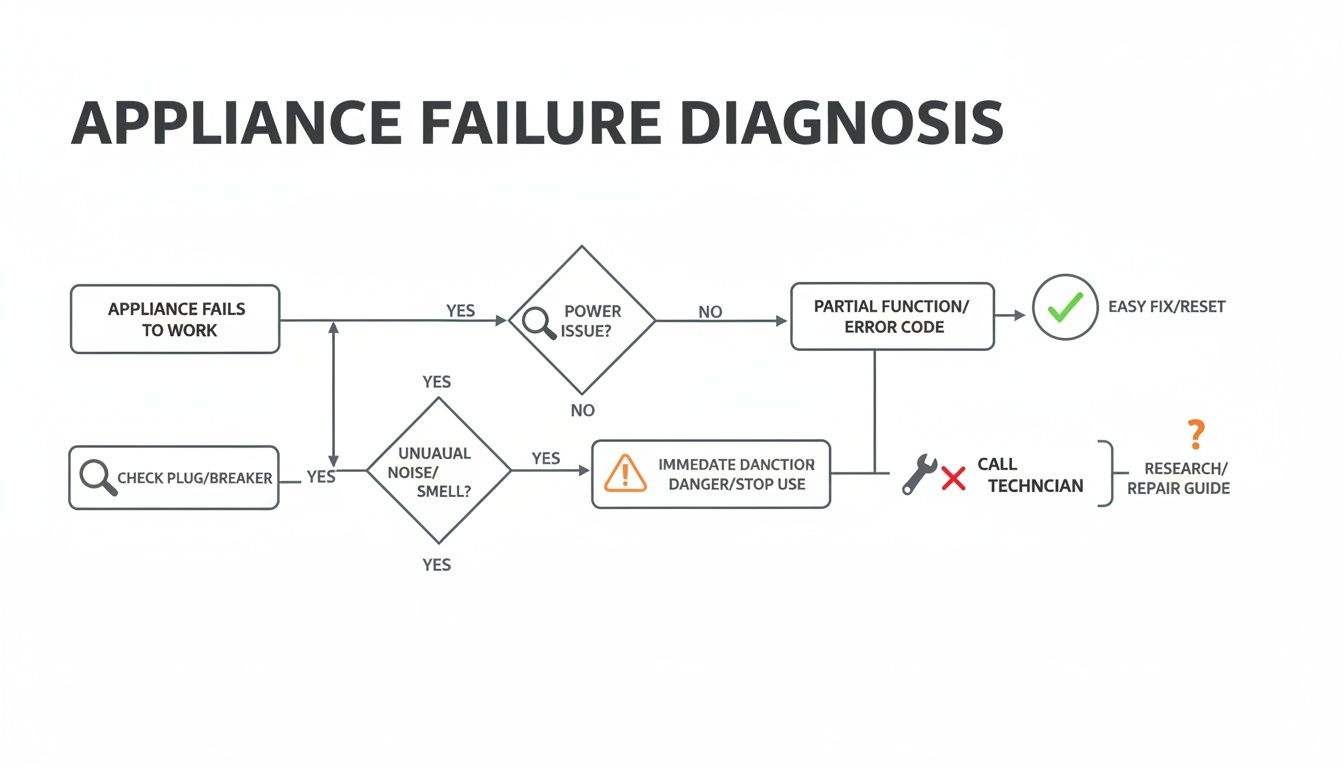
- Verify Power: Ensure the appliance is plugged in securely. Check your home’s circuit breaker panel and reset any tripped breakers.
- Inspect Filters and Vents: Clean the lint trap in your dryer after every use. Check and clean the filter at the bottom of your dishwasher. Ensure refrigerator condenser coils are free of dust and debris.
- Check Settings: Confirm that the appliance controls are set to the correct cycle and settings. Accidental bumps can change selections.
- Look for Obstructions: Check for blockages in your dishwasher’s spray arms or kinks in your washing machine’s drain hose. Knowing simple fixes like clearing a clogged garbage disposal can be useful.
- Listen for Unusual Noises: Pay attention to new grinding, squealing, or banging sounds, as they often indicate a specific mechanical failure.
- Know When to Stop: If these steps do not resolve the issue, it is time to call a professional. Do not attempt to remove panels or access internal wiring. Understanding the safety risks of DIY appliance repair is crucial for your protection.
Repair Cost Breakdown
Please Call to get exact Rates:
Effective starting in 2026, service call fees are no longer waived. The service call fee covers the technician’s travel time, professional appliance diagnosis, and helps support ongoing operational expenses required to deliver reliable, high-quality service. We remain committed to keeping our fees fair, transparent, and aligned with reasonable repairability standards.
For Alberta homeowners, repair costs are based on several factors. Below is an estimated breakdown for the current year.
- Estimated Service call / diagnostic: $120–$250 (not waived)
- Estimated Parts: $150–$650 (varies by brand and model)
- Estimated Labor: $150–$260 per hour
- Additional travel or mileage charges may apply
Note:
- GST is not included in these estimates.
- Prices vary by service area, including Edmonton, Calgary, and Red Deer.
- Rates are subject to market and economic changes.
For more information, see our guide on the average appliance repair cost breakdown.
Failure Rate & Repair Cost Chart
To provide insight into appliance reliability trends, consider a chart comparing component failure rates and average repair costs year-over-year. In this conceptual chart, gray bars would represent data from last year, while light blue bars would represent the current year. Such a chart would illustrate how failure rates for parts like control boards, motors, and heating elements have changed. It would also show the corresponding shift in average repair costs, reflecting inflation, parts availability, and labor market dynamics in Alberta. This data-driven view helps homeowners understand the economic factors influencing their household appliance repair decisions.
Repair vs Replace
Deciding whether to repair or replace a faulty appliance involves balancing cost, age, and future reliability. A practical guideline is the 50% Rule: if the total repair cost exceeds 50% of the price of a new, comparable appliance, replacement is often the more economical choice.
The appliance's age is another critical factor. Investing in a major repair for a unit nearing the end of its expected lifespan may not be wise, as other components could fail soon. Brand also matters; some high-end brands are built to last and are worth repairing, while budget models may be cheaper to replace. A professional diagnosis from a certified technician provides the necessary information to help you decide whether to repair or replace an appliance. For a local perspective, our cost analysis on appliances worth repairing versus replacing offers detailed guidance for Alberta homeowners.
Preventive Maintenance Tips
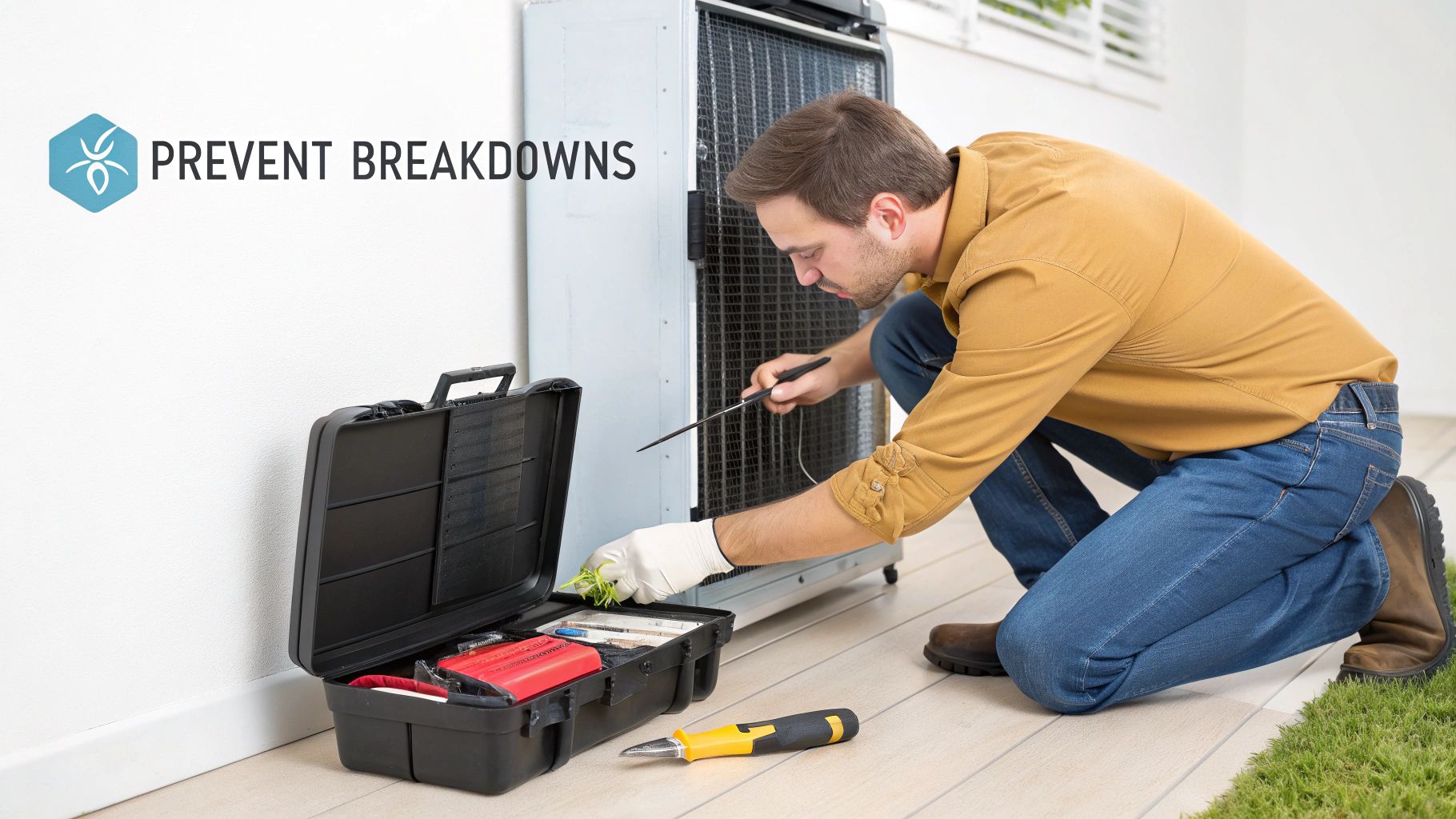
Proactive maintenance is the most effective way to extend the life of your appliances and avoid unexpected breakdowns. Most of these tasks are simple and can be performed by any homeowner.
- Clean Refrigerator Coils: Every six months, vacuum the condenser coils at the back or bottom of your refrigerator to improve efficiency and reduce strain on the compressor.
- Clean Dryer Lint Filter: Clean the lint trap after every single load to ensure proper airflow and prevent a fire hazard.
- Inspect Dryer Vent Hose: Annually, disconnect and clean the entire length of your dryer's exhaust vent to remove lint buildup.
- Clean Dishwasher Filter: Monthly, remove and rinse the filter at the bottom of your dishwasher to prevent clogs and odors.
- Do Not Overload: Avoid overloading your washer, dryer, or dishwasher, as this puts excessive strain on motors, belts, and bearings.
- Use Proper Detergent: Use only high-efficiency (HE) detergent in HE washing machines to prevent residue buildup and sensor issues.
- Check Gaskets: Regularly inspect the door seals on your refrigerator, freezer, and oven for cracks or brittleness and wipe them clean.
- Ensure Leveling: Make sure your appliances, especially washers and refrigerators, are perfectly level to ensure proper operation.
- Allow for Ventilation: Leave adequate space around appliances like refrigerators and dryers for proper air circulation to prevent overheating.
- Schedule Professional Inspection: Consider an annual professional check-up to catch potential issues before they become major problems.
Brand-Specific Notes
Repair complexity, parts availability, and common issues vary by brand. Here is a quick reference for brands serviced in Alberta.
- Amana: Known for straightforward design. Common issues include thermal fuse failures in dryers. Parts are widely available. Repair difficulty is generally low to medium.
- Asko: High-end European brand. Known for durable washers and dishwashers but can have complex electronics. Parts can be expensive and may need to be ordered. Repair difficulty is medium to high.
- Alliance Laundry: Commercial-grade durability (includes Speed Queen). Known for robust mechanical components. Parts are readily available. Repair difficulty is low to medium.
- Bosch: German engineering, known for quiet dishwashers. Common issues involve drain pumps and control modules. Parts are generally available but can be pricey. Repair difficulty is medium.
- Bravos: A Maytag washer series. Often face issues with the bearing and tub seal. Parts are available through Whirlpool's network. Repair difficulty is medium to high for tub work.
- Beko: European brand gaining popularity. Known for efficient refrigerators. Can have unique electronic systems. Parts availability is improving. Repair difficulty is medium.
- Blomberg: Another European brand focused on efficiency. Similar to Beko, can have complex electronics. Parts are becoming more common. Repair difficulty is medium.
- Café: GE's premium line. Known for style and features. Shares many components with GE Profile. Parts are widely available. Repair difficulty is medium due to advanced electronics.
- Caloric: An older brand. Parts can be very difficult to find, often requiring generic or refurbished components. Repair difficulty is high due to parts scarcity.
- Cabrio: A Whirlpool washer series. Known for lid lock and actuator failures. Parts are readily available. Repair difficulty is low to medium.
- Crosley: A brand name used by various manufacturers. Repair depends on the original equipment manufacturer (OEM). Parts availability varies. Repair difficulty is variable.
- Dacor: Luxury brand. Known for high-performance ovens and ranges. Can have complex control systems. Parts are expensive and sometimes have lead times. Repair difficulty is high.
- Danby: Specializes in compact appliances. Common issues relate to thermostats in mini-fridges. Parts are generally available. Repair difficulty is low to medium.
- Electrolux: Swedish brand known for innovative features. Common issues include ice maker failures and control board issues. Parts are widely available. Repair difficulty is medium.
- Fisher & Paykel: New Zealand brand known for its DishDrawer™ dishwashers and smart drive washers. Can have unique electronic modules. Parts availability is good but can be expensive. Repair difficulty is medium to high.
- Frigidaire: Popular mid-range brand. Common issues include faulty refrigerator damper controls and oven igniters. Parts are very easy to source. Repair difficulty is low to medium.
- Frigidaire Gallery: An upgraded line from Frigidaire. Shares many core components but has more complex electronics. Parts are also readily available. Repair difficulty is medium.
- GE: General Electric is a household staple. Known for reliable refrigerators and ranges. Common issues are water inlet valves and dryer heating elements. Parts are ubiquitous. Repair difficulty is low to medium.
- GE Profile: GE's line with more features. Electronics are more advanced than standard GE models. Parts are widely available. Repair difficulty is medium.
- Gaggenau: High-end luxury brand. Built with premium materials but has highly complex systems. Parts are expensive and must be special-ordered. Repair difficulty is high.
- Gibson: An older brand, now part of Electrolux. Similar to Frigidaire models. Parts are often interchangeable with other Electrolux brands. Repair difficulty is low to medium.
- Goldstar: An older brand name for LG. Repairs are similar to early LG models, but specific parts can be hard to find. Repair difficulty is medium.
- Haier: Known for compact and affordable appliances. Can have issues with electronic control boards. Parts are becoming more available. Repair difficulty is medium.
- Hisense: Gaining market share with affordable refrigerators and freezers. Parts availability is still growing. Repair difficulty is medium.
- Hitachi: Primarily known in North America for smaller appliances. Parts for major appliances can be difficult to source. Repair difficulty is medium to high due to parts availability.
- IKEA: Appliances are made by Whirlpool or Electrolux. Repairability is based on the OEM. Parts are available through the manufacturer's network. Repair difficulty is low to medium.
- Insignia: Best Buy's house brand, made by various manufacturers like Haier or Midea. Parts availability can be challenging. Repair difficulty is medium.
- JennAir: Luxury brand owned by Whirlpool. Known for downdraft cooktops and built-in refrigerators. Shares some parts with KitchenAid/Whirlpool but has unique components. Repair difficulty is high.
- Kelvinator: A brand under Electrolux, known for basic, durable appliances. Shares parts with Frigidaire. Repair difficulty is low.
- Kenmore: Sears' brand, manufactured by Whirlpool, LG, Electrolux, and others. The first three digits of the model number identify the OEM. Parts are generally available. Repair difficulty is variable.
- KitchenAid: A premium brand by Whirlpool. Known for quality dishwashers and stand mixers. Common issues include control panel failures on dishwashers. Parts are readily available. Repair difficulty is medium.
- LG: South Korean brand known for technology and design. Common issues include compressor failures in refrigerators and drain pump issues in washers. Parts are widely available but can be expensive. Repair difficulty is medium to high.
- Liebherr: German luxury brand specializing in refrigeration. Known for quality but has complex dual-compressor systems. Parts are expensive and often require ordering. Repair difficulty is high.
- Magic Chef: An older brand now associated with budget appliances made by various OEMs. Parts availability is spotty. Repair difficulty is medium.
- Maytag: A Whirlpool-owned brand known for durability. Common issues are washer bearings and dryer thermal fuses. Parts are widely available. Repair difficulty is medium.
- Miele: High-end German brand known for longevity. Dishwashers and washing machines can last 20 years but have proprietary, complex systems. Parts are expensive and must be sourced from Miele. Repair difficulty is high.
- Monogram: GE's ultra-premium luxury line. Known for professional-style ranges and built-in refrigerators. Parts are specific and expensive. Repair difficulty is very high.
- Panasonic: Known for microwaves but less so for major appliances in Canada. Parts can be very difficult to find. Repair difficulty is high.
- Roper: A budget brand by Whirlpool. Features basic, mechanical designs. Parts are cheap and interchangeable with Whirlpool/Amana. Repair difficulty is low.
- Samsung: South Korean brand known for feature-rich appliances. Common issues include refrigerator ice maker freezing and drain line issues. Parts are available but electronics can be complex. Repair difficulty is medium to high.
- Sharp: Primarily known for microwaves and some specialized appliances. Parts for major appliances are not common. Repair difficulty is medium to high.
- Speed Queen: Known for commercial-grade washers and dryers with exceptional durability. Failures are rare but parts are available. Repair difficulty is low to medium due to simple design.
- Sub-Zero: Luxury refrigeration brand. Known for dual compressors and longevity. Repairs require specialized knowledge. Parts are expensive. Repair difficulty is very high.
- Tappan: A brand within the Electrolux family. Similar to Frigidaire and Gibson models. Parts are easy to source. Repair difficulty is low to medium.
- Thermador: A high-end brand owned by Bosch. Known for professional-style cooking appliances. Parts are expensive and repairs require brand-specific expertise. Repair difficulty is high.
- Thor: Specializes in pro-style ranges at a more affordable price point. Parts availability can be inconsistent. Repair difficulty is medium.
- Toshiba: Better known for electronics, but makes some major appliances. Parts availability in Canada is limited. Repair difficulty is medium.
- Viking: Luxury brand known for powerful ranges. Early models had reliability issues. Parts are very expensive and require expert installation. Repair difficulty is very high.
- Whirlpool: One of the largest and most common brands. Known for reliable and easy-to-service appliances. Parts are inexpensive and widely available. Repair difficulty is low to medium.
- White-Westinghouse: An Electrolux brand. Very similar to Frigidaire models. Parts are readily available and affordable. Repair difficulty is low.
- Wolf: The cooking appliance partner to Sub-Zero. Known for high-performance ranges and ovens. Requires specialized technicians. Parts are expensive. Repair difficulty is very high.
FAQs
Here are answers to common questions we receive from homeowners in Edmonton, Calgary, and Red Deer.
- Is it safe to do my own appliance repair?
Simple tasks like cleaning filters or checking power cords are safe. However, any repair involving electrical wiring, gas lines, or sealed refrigerant systems should only be performed by a certified technician to avoid risk of injury or further damage. - How much will my repair cost?
The final cost depends on the service call fee, the price of the necessary parts, and the labor required. A precise quote can only be given after a professional diagnosis. - What if my appliance is still under warranty?
If your appliance is under warranty, contact the manufacturer or retailer first. Using an unauthorized repair service can void your warranty coverage. - How long should my appliances last?
Typical lifespans are: Refrigerators (10–15 years), Washers/Dryers (10–13 years), Dishwashers (9–12 years), and Ovens/Ranges (13–15 years). Age is a key factor in the repair vs. replace decision. - Can you fix my appliance on the first visit?
Our service vehicles are stocked with common parts to maximize the chance of a first-visit repair. However, rare or brand-specific parts may need to be ordered. - When is it time to call a professional?
Call a professional if basic troubleshooting fails, you smell gas or burning plastic, the repair requires specialized tools, or you are not 100% confident in your ability to perform the repair safely.
Final Summary
When dealing with a broken appliance, a structured approach is best. Start with safe, simple troubleshooting to rule out minor issues, but recognize when the problem requires professional expertise. Understanding the potential causes, repair costs, and brand-specific considerations helps you make an informed decision. For the safety of your home and family, always leave complex electrical, gas, or mechanical repairs to a trained professional. A professional diagnosis is the safest and most effective solution to get your household running smoothly again.
Reviewed by certified appliance technicians at Advance Appliance Ltd serving Alberta homeowners.
Book Your Appliance Repair
Call: 587-882-3225
Book Online: https://advanceappliance.ca/scheduler/
Same-day or next-day appointments available. Certified technicians. Warranty on parts and labor.