
When your Samsung refrigerator stops working, it's more than an inconvenience, it's a major disruption to your daily life. Whether the fridge isn't cooling or the ice maker is on strike, a Samsung refrigerator repair often comes down to a few common issues. This guide will walk you through the symptoms, causes, and solutions, helping you understand what's gone wrong and what to do next.
Identifying Your Samsung Refrigerator Problem
From our years of experience as technicians in Edmonton and Calgary, we've seen it all. Samsung refrigerator problems almost always fall into a few predictable categories. Pinpointing the exact symptom is the first step toward a solution, and it’s often simpler than you think.
This visual guide breaks down the issues we see most often in the field—cooling failures, stubborn ice makers, and weird noises—into a simple flowchart you can follow.
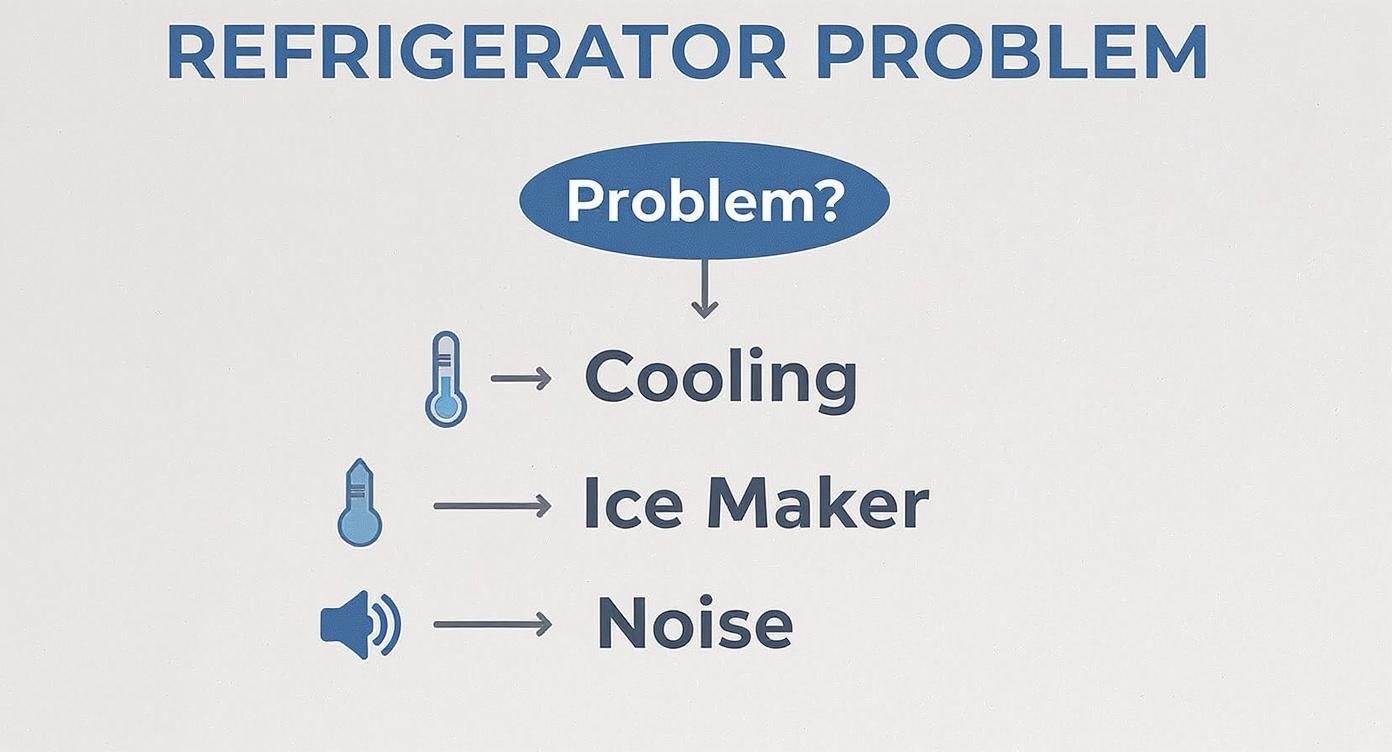
Use the chart to trace your fridge's symptoms back to a likely cause. It’s designed to steer you toward the right troubleshooting steps and help you understand what's happening inside your appliance.
Quick Samsung Refrigerator Diagnostic Checklist
Use this table to match your refrigerator's symptoms to common causes and practical next steps.
| Symptom | Common Cause | First Step |
|---|---|---|
| Fridge/Freezer Not Cooling | Dirty condenser coils, faulty fan motor, or defrost system failure. | Check and clean the coils at the back. Listen for the fans running. |
| Ice Maker Not Working | Jammed ice, frozen fill tube, or faulty sensor. | Gently clear any visible ice jams. Check if the water line is frozen. |
| Leaking Water on Floor | Clogged defrost drain or cracked water line. | Unclog the defrost drain tube inside the freezer compartment. |
| Excessive Frost Buildup | Faulty door seal or a failing defrost system component. | Inspect the door gaskets for any tears or gaps. |
| Loud or Unusual Noises | Worn-out fan motor bearings or a struggling compressor. | Try to pinpoint the noise source (inside freezer vs. behind the unit). |
This checklist gives you a solid starting point, helping you identify the problem without having to guess.
Common Failure Points
Out in the field, we see the same parts failing over and over again on Samsung models. Knowing what these weak spots are can save you a ton of time and stress.
Here are the usual suspects we encounter on almost a daily basis:
-
Ice Maker Assembly: This is, without a doubt, the most frequent point of failure. The design is prone to frost buildup, which jams the mechanism or completely blocks the sensors.
-
Defrost System Components: When a defrost sensor, heater, or thermostat goes bad, ice builds up on the evaporator coils. This buildup blocks airflow and is a primary reason your fridge stops cooling.
-
Fan Motors: Your fridge has two key fans: the evaporator fan (inside the freezer) and the condenser fan (by the compressor). When either one fails, you'll get cooling problems and often hear some strange new noises.
-
Main Control Board: It’s less common, but a glitchy control board can cause all sorts of bizarre behaviour, from wild temperature swings to a completely dead appliance.
Understanding these patterns helps you move from guesswork to an educated assessment, so you can tell if you're dealing with a simple DIY fix or something that needs a professional's touch.
Troubleshooting Cooling and Temperature Problems
When your Samsung refrigerator stops cooling, it's a problem you just can't ignore. From our experience on the ground here in Edmonton and Calgary, this kind of critical failure usually points to a handful of specific parts. Before you jump to the worst conclusion, there's a straightforward diagnostic process you can follow.
The idea is to start with the simplest, most common culprits first. A lot of cooling issues are actually caused by poor airflow or a small, failed component—not a catastrophic compressor failure. This step-by-step approach can help you zero in on the issue, often without needing any specialized tools.
Checking for Airflow Obstructions
Your refrigerator's entire job is to move cold air around. If something gets in the way, the unit simply can't cool. In the field, the very first thing our technicians check is airflow.
-
Dirty Condenser Coils: These coils, usually found on the back or bottom of the fridge, release heat. When they get caked in dust and pet hair, they can't do their job, forcing the compressor to work overtime and eventually leading to a cooling failure.
-
Blocked Interior Vents: It sounds almost too simple, but we frequently find the vents inside the fridge and freezer completely blocked by food containers. You have to make sure air can move freely between all the shelves and compartments.
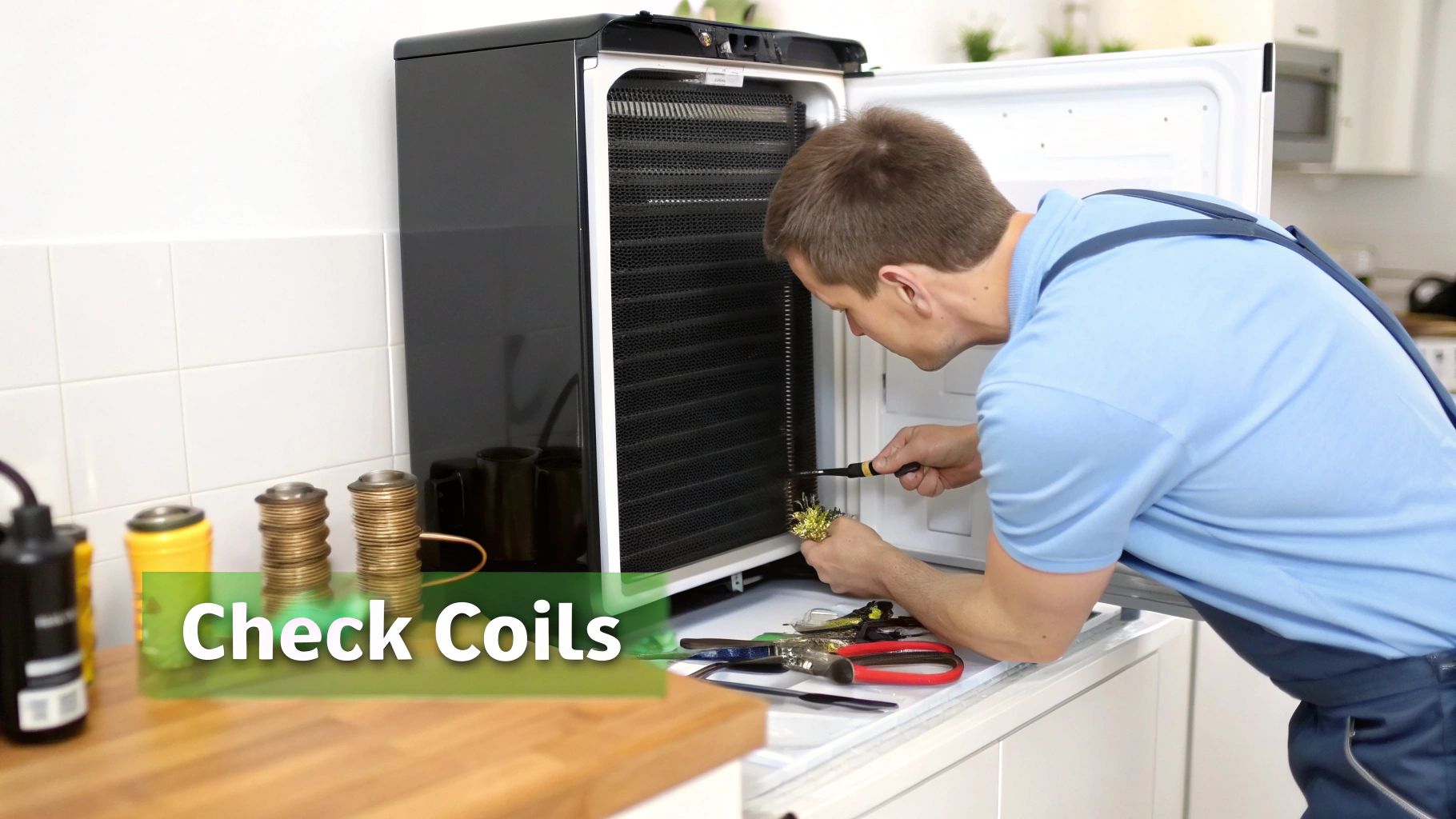
Technician's Insight: A surprising number of our Samsung refrig repair calls for cooling problems are fixed just by cleaning the condenser coils. It's a five-minute job that can easily save you a service call fee and prevent a much more expensive repair down the road.
Inspecting Key Cooling Components
If airflow is clear, the problem most likely lies with one of three key parts. These are the most common points of failure we see on Samsung models.
The Evaporator Fan
This fan sits behind a panel inside your freezer. Its job is to push cold air from the evaporator coils out into the rest of the fridge and freezer. If this fan dies or gets jammed by ice, all that cold air gets trapped, and your fridge starts to warm up.
The Thermistor (Temperature Sensor)
The thermistor is a tiny sensor that reports the internal temperature back to the main control board. When it fails, it might send the wrong signals, causing the cooling system to either shut off too soon or run nonstop. A faulty thermistor is a common and relatively inexpensive fix.
The Defrost System
Samsung refrigerators are notorious for issues with their defrost systems. A buildup of frost on the evaporator coils can choke off airflow completely. The system, which includes a heater and a sensor, is supposed to melt this ice regularly. When it fails, the ice just takes over.
While any handy homeowner can safely check coils and vents, diagnosing a faulty thermistor or defrost system involves dealing with electrical components. For a more detailed walkthrough, you can check out our guide on how to fix a refrigerator that is not cooling. Safety becomes critical here; anything beyond a basic visual check is best left to a certified technician.
Tackling Those Stubborn Ice Maker and Water Issues
Here in Edmonton, Calgary, and Red Deer, a huge number of our Samsung refrig repair calls are for ice makers that have just given up. It's a notoriously tricky feature, often leaving homeowners with either a solid block of ice where cubes should be or nothing at all.
The heart of the issue usually comes down to the design. It can let moist air creep into the ice maker compartment, which then freezes and builds up. Before you know it, the whole mechanism is jammed, the sensors are blocked, or the chute is clogged solid.
How to Figure Out Why Your Ice Maker Failed
When your Samsung ice maker goes on strike, it's almost always one of three things: it's frozen solid, it isn't getting any water, or one of its parts has failed. A quick visual check is the best place to start.
-
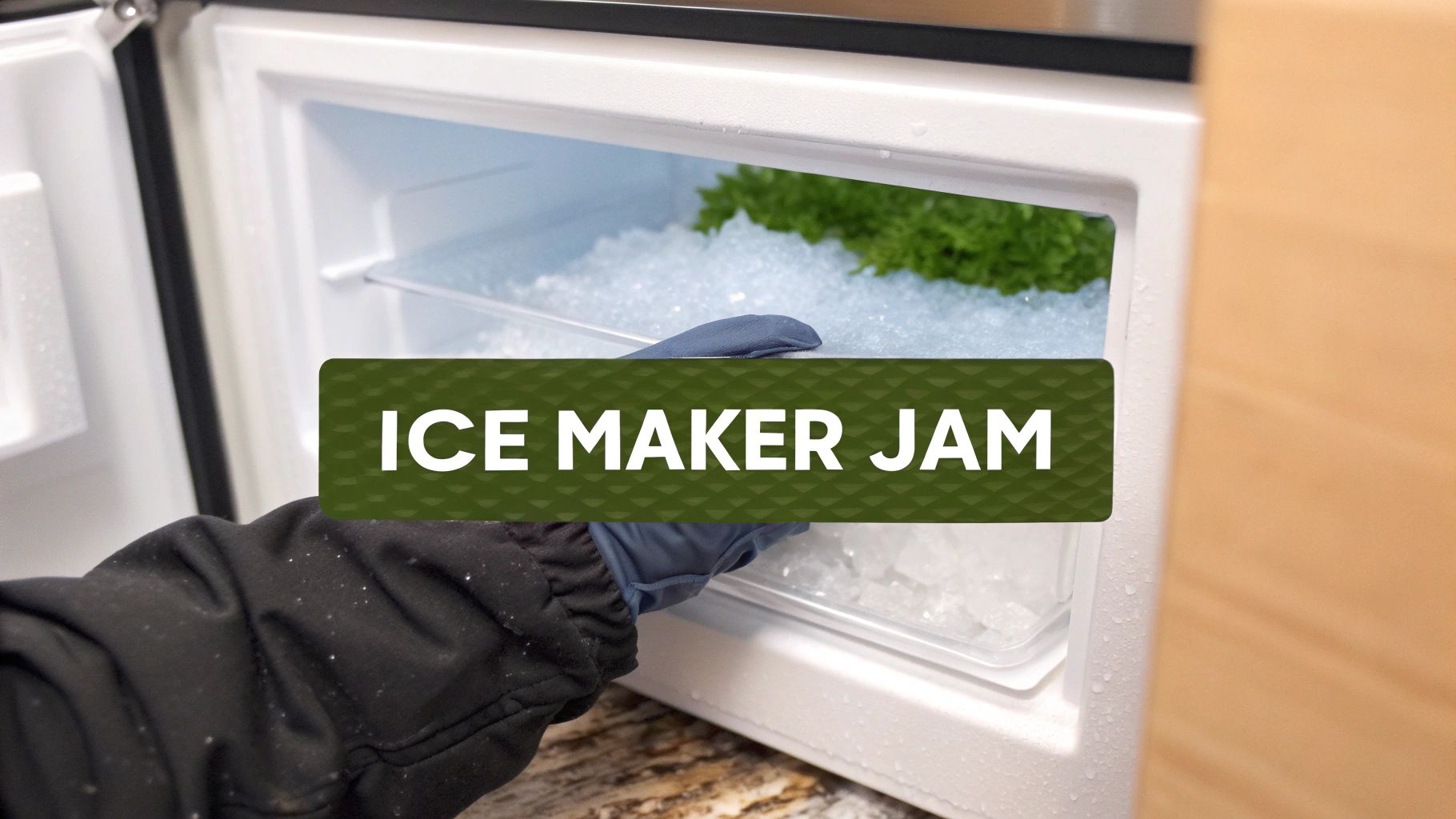
Look for Frost and Ice Buildup: Pop open the ice maker compartment. Do you see a massive chunk of ice swallowing the tray and motor? That means it's seized up, which is easily the most common problem we see in the field.
-
Check the Water Fill Tube: Find the small tube that feeds water into the ice tray. These things freeze over all the time, completely stopping water from getting where it needs to go.
-
Glance at the Display for Error Codes: Some Samsung models are helpful enough to flash an error code right on the main panel, pointing you directly to the ice maker fault.
If the whole unit is encased in ice, your next step is a forced defrost.
Safety First: Always unplug your refrigerator from the wall before you start poking around. Water and live electricity are a combination you want no part of.
How to Safely Defrost a Jammed Ice Maker
A completely frozen-over ice maker needs to be defrosted by hand. Grab a hairdryer and use it on a low heat setting to gently melt the ice. This takes patience—don't get tempted to use a screwdriver or knife to chip away at the ice. You can easily puncture a plastic part or wreck a sensor.
Once you’ve cleared the ice, you can keep this from happening again with some routine maintenance. Our guide on how to clean your ice maker has some great tips that can make a world of difference.
What to Do When the Water Dispenser Acts Up
If your water dispenser is on the fritz too, the problems are probably linked. The water line running through the freezer door is prone to freezing, especially if your freezer temperature is set a bit too low.
The other usual suspect is the water filter. If it's clogged or wasn't installed quite right, it can choke off the water flow to both the dispenser and the ice maker. Make sure you're replacing your filter on schedule. If you’ve tried these fixes and are still getting nothing, the problem might be the water inlet valve, and that’s a job best left to a professional.
Decoding Strange Noises, Leaks, and Frost Buildup
When your Samsung fridge starts making strange sounds or leaving puddles on the floor, it's telling you something's wrong. From our experience, these aren't just minor quirks; they're clues pointing to specific problems that need fixing before they escalate into something bigger.
Diagnosing Unusual Refrigerator Noises
First, not every sound is a bad sound. A gentle hum from the compressor or the soft whirring of a fan is completely normal. It’s the new, loud, or persistent noises that should get your attention.
A loud buzzing can often mean the condenser fan motor is struggling, maybe because it's clogged with dust. If you hear a sharp clicking sound coming from the back, that could be the compressor's start relay acting up. Grinding or squealing noises from inside the freezer are classic signs of a failing evaporator fan motor. To get a better sense of what's normal, check out our guide on normal refrigerator sounds and noises.
Technician's Insight: Pay close attention if you hear a loud click, a brief hum that abruptly stops, and then the cycle repeats every few minutes. That's a classic sign the compressor is trying—and failing—to start. This needs immediate professional help to prevent permanent damage to a very expensive component.
Finding the Source of Water Leaks
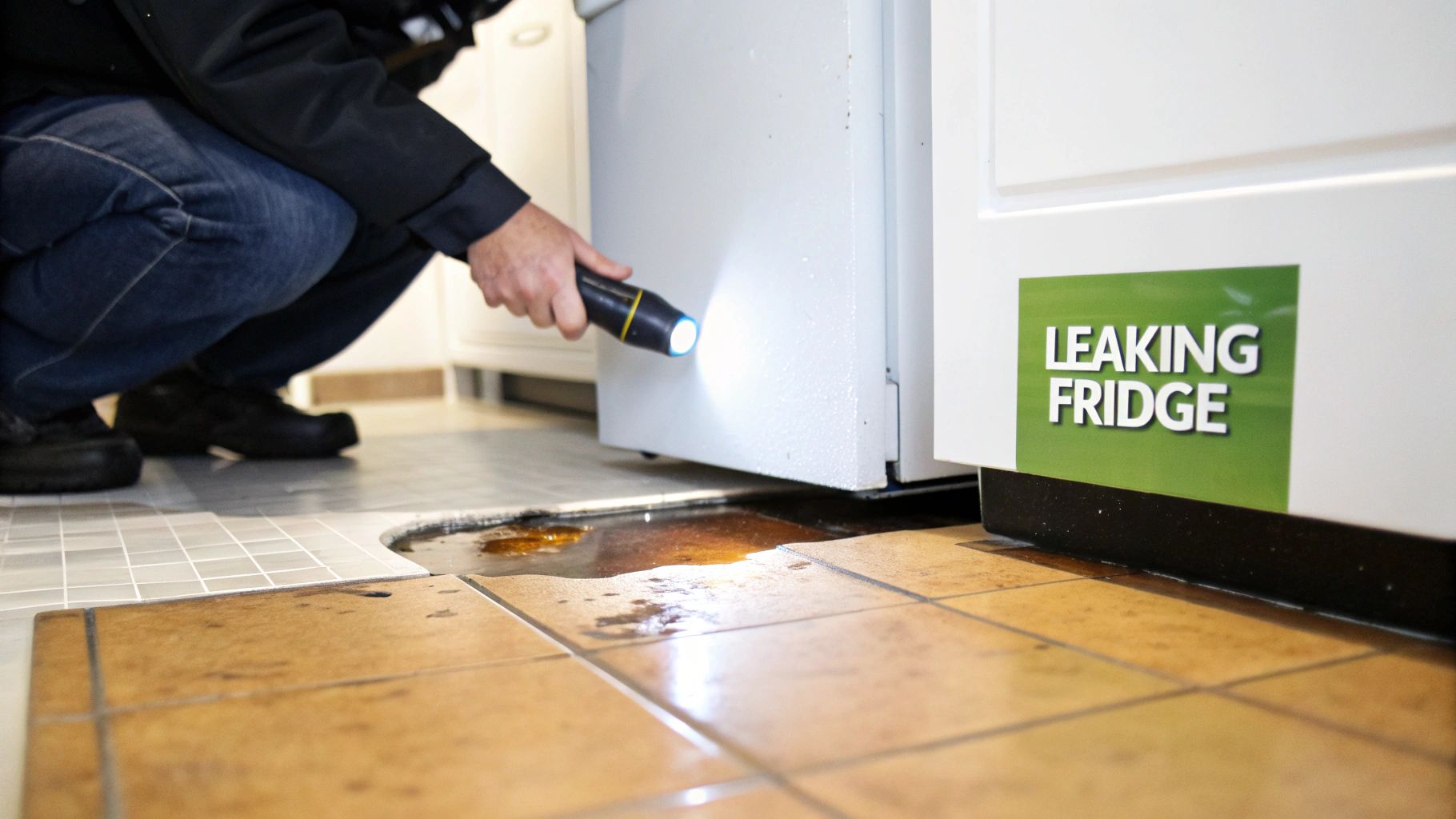
Seeing a puddle of water on your kitchen floor is never a good feeling, but the cause is often a simple clog, not a catastrophic failure. The most common culprit we run into is a blocked defrost drain line.
During a defrost cycle, melted ice is meant to flow down a small tube to an evaporation pan underneath the fridge. But when that tube gets clogged with ice buildup or food particles, the water has nowhere to go but out onto your floor. It's a fixable problem, but it takes a careful hand to clear the line without causing any damage.
Why Is There Frost Inside My Freezer
A little bit of frost is one thing, but if your freezer looks like a winter wonderland with a thick layer of ice crystals, that’s a red flag. This almost always points to one of two issues:
-
A Bad Door Seal: If the rubber gasket around your freezer door is damaged or brittle, it can't create an airtight seal. Warm, moist air from your kitchen seeps in, and as soon as it hits the cold surfaces inside, it freezes, causing that excessive frost.
-
A Faulty Defrost System: Just like with cooling problems, the defrost system can be the source. If the defrost heater, sensor, or timer fails, the freezer can't run its cycle to melt away the ice that naturally builds up on the evaporator coils.
Is It Better to Repair or Replace Your Samsung Fridge?
It's the question every homeowner eventually faces: do you sink more money into a major Samsung refrig repair, or is it time to cut your losses and buy new? We see this dilemma with our clients in Edmonton and Calgary all the time. Honestly, there's no single right answer, but a few key factors—the fridge's age, the specific repair cost, and its track record—can make the decision a lot clearer.
As a rule of thumb, we often use the 50% rule out in the field. If your refrigerator is pushing past eight years old and a repair is going to cost more than half the price of a comparable new model, replacement is almost always the smarter long-term move.
Comparing Repair Costs to Replacement Value
To make a good call, you need a realistic picture of what a major repair actually costs. Little things like a faulty sensor or a noisy fan might only set you back a couple hundred dollars. But when a core component fails, the numbers get serious.
Estimated Samsung Refrigerator Repair Costs
Here’s a quick breakdown of common repair costs to help you weigh your options. This table gives you a ballpark idea of what to expect for some of the more significant failures we see.
| Component Failure | Estimated Repair Cost (Parts & Labour) | When to Consider Repair |
|---|---|---|
| Compressor or Sealed System | $800 – $1,500+ | Rarely. This is often the point where replacement is more cost-effective. |
| Main Control Board | $400 – $750 | If the fridge is under 7 years old and otherwise in good condition. |
| Ice Maker Assembly | $300 – $550 | Usually worth it, as it's a common failure that doesn't affect cooling. |
| Defrost System Failure | $250 – $450 | Definitely worth repairing on a fridge that is under 10 years old. |
Keep in mind that a brand-new refrigerator comes with a fresh warranty and is almost certainly more energy-efficient, which translates to real savings on your utility bills down the road.
Factors Beyond the Initial Cost
The decision isn't just about the numbers on an invoice. Think about your appliance's history. Has it been a reliable workhorse until now, or are you constantly calling for service? If this is your third repair call in two years, it might be time to stop throwing good money after bad. For a much deeper dive into this, check out our guide on whether it's cheaper to repair or replace a refrigerator.
When a Professional Technician Is Your Only Safe Option
While this guide gives you the confidence to tackle many common fridge problems, some repairs are simply not negotiable. These are the jobs that demand a certified professional. Trying to fix certain parts of your Samsung refrigerator without the right training and tools isn't just risky—it's dangerous and can cause damage that can't be undone.
In our line of work, we have a strict set of safety red lines. These are the moments when you absolutely must step back and call for help. The risk of electric shock, serious injury, or causing a costly sealed system breach is just too high to gamble with.
Absolute Red Lines for DIY Repair
Think of these as the hard boundaries for any DIY Samsung refrig repair. If your troubleshooting points to any of these components, your very next move should be picking up the phone to book a service call.
-
Sealed System or Refrigerant Issues: You need a special license and expensive recovery equipment to handle refrigerant. A leak is hazardous to your health, and one wrong move will destroy your compressor for good. Never attempt this.
-
Compressor Replacement: The compressor is the heart of your refrigerator, pumping refrigerant through the system. It's a high-voltage, sealed unit that's incredibly complex and dangerous to work on without professional training.
-
Main Control Board Repair: Swapping a board might look like a simple plug-and-play job, but correctly diagnosing why it failed is the real challenge. A mistake here can instantly fry the brand-new board and damage other parts connected to it.
-
Internal Electrical Wiring: Any repair that involves cutting, splicing, or modifying the fridge's internal wiring is a job exclusively for a licensed technician. The fire and shock hazards are significant.
Your safety is always the number one priority. Trying to save a few dollars is never worth the risk of a serious injury or turning a fixable appliance into scrap metal.
Knowing when to call an appliance repair technician is one of the most important parts of being a responsible homeowner. When you do need to call in the pros, having an effective appliance repair answering service on their end ensures your request is handled quickly so you can get the help you need without delay.
Common Questions About Samsung Refrigerator Repair
After countless service calls for Samsung fridge repairs across Edmonton, Calgary, and Red Deer, our technicians have heard just about every question in the book. We've pulled together the most common ones we get, aiming to give you clear, straightforward answers.
How Long Does a Typical Repair Take?
Most common fixes—things like a busted fan motor, a faulty sensor, or a defrost component—are usually wrapped up in a single visit, taking about one to two hours. Of course, if a specific part needs to be ordered, we'll have to schedule a follow-up visit. Our technicians keep their vans stocked with the most common Samsung parts to give us the best shot at a same-day repair.
Is Repairing a Five-Year-Old Fridge Worth It?
In most cases, absolutely. A five-year-old refrigerator is really only about halfway through its expected 10 to 12-year lifespan. If the repair costs less than 50% of what a new, comparable fridge would run you, it's a sound financial decision. The issues we typically see at this age, like ice maker failures or finicky sensors, are definitely worth fixing to get several more years out of your appliance.
A Technician's Perspective: From what we see out in the field every day, a well-maintained Samsung fridge can easily last over a decade. A timely, professional repair on a middle-aged appliance is almost always a smarter investment than jumping straight to a replacement.
Why Does My Samsung Ice Maker Keep Freezing Up?
This is an extremely common issue, and frankly, it's often a design-related flaw we encounter daily. The problem usually starts with tiny air leaks around the ice maker housing itself. This lets moist, warmer air sneak in, which then freezes and jams the whole mechanism. It can also be triggered by a faulty defrost cycle within the ice maker unit. Our technicians can pinpoint the real root cause—whether it's an air leak or a bad part—and implement a lasting fix.
Key Takeaways and Next Steps
Dealing with a broken Samsung refrigerator can be stressful, but understanding the common failure points empowers you to make an informed decision.
-
Common Symptoms: Most issues are related to cooling failures, ice maker jams, strange noises, or water leaks.
-
Likely Causes: Problems often stem from simple issues like dirty coils or blocked vents, but can also involve failed components like fans, sensors, or the defrost system.
-
Safe DIY vs. Professional Help: Cleaning coils and checking for blockages are safe first steps. However, any work involving electrical components, the compressor, or the sealed refrigerant system requires a certified technician.
-
Repair vs. Replace: For fridges over 8 years old, if a repair costs more than 50% of a new model's price, replacement is often the better choice.
When your DIY efforts aren't enough, it's time to trust the experts. You can hire expert appliance technicians from Advance Appliance Ltd for fast, reliable, and professional repair services in Edmonton, Calgary, Red Deer, and surrounding areas.
Book your service online at https://advanceappliance.ca for a prompt and effective solution.