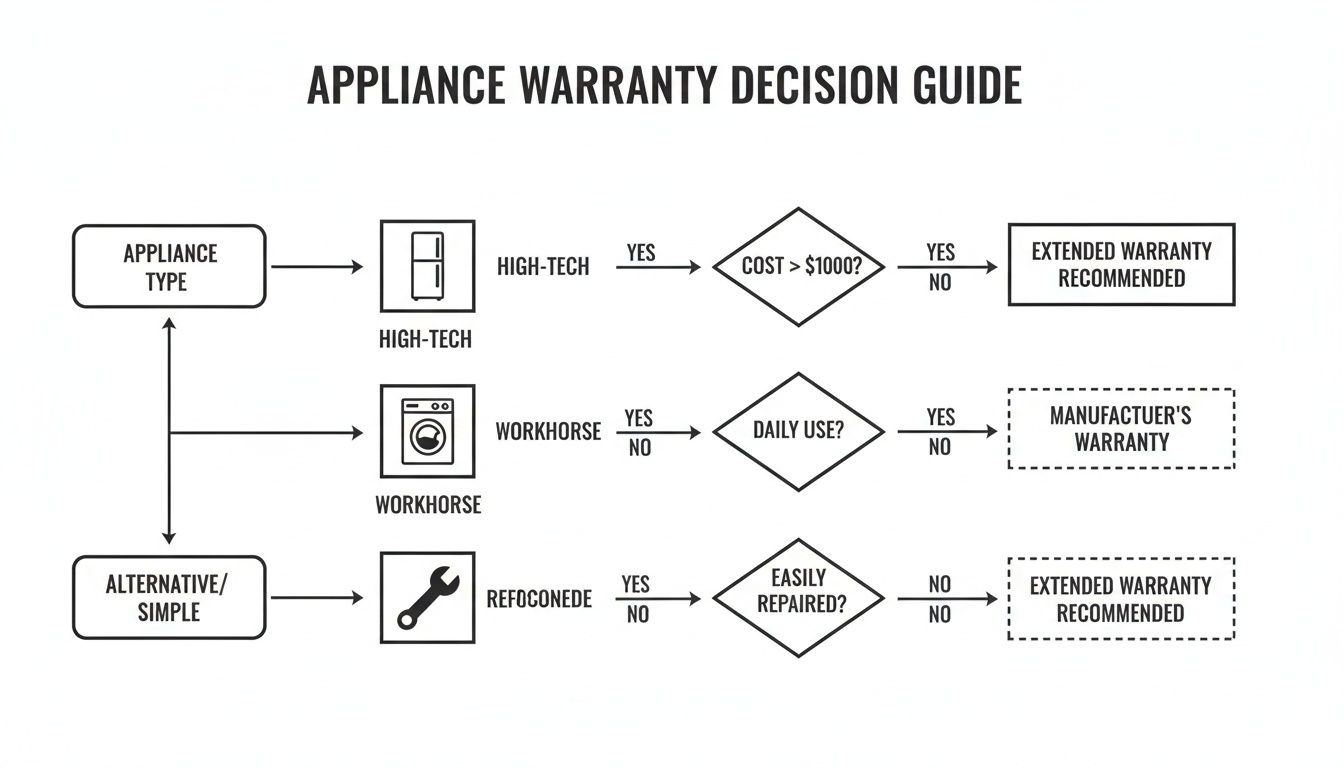
So, what's the quick answer? For most Alberta homeowners, an extended appliance warranty is a gamble. Think of it less as a guaranteed investment and more as an insurance policy for your peace of mind. The real answer always comes down to your appliance's complexity, its age, and honestly, your personal comfort with risk. A fancy smart fridge packed with electronics might justify the cost, but a basic, reliable washing machine probably won't. For homeowners in Edmonton, Calgary, and Red Deer, understanding the real costs versus the promised benefits is key to making a smart financial decision.
What an Extended Warranty Actually Covers and Excludes
Cracking open an extended warranty contract can feel like you’ve been handed a legal document in another language. Let’s cut through the jargon. At its core, an extended warranty is a service plan designed to cover the cost of parts and labour for mechanical and electrical failures that happen during normal, everyday use. Think of it as a safety net for when a key component—like the motor in your washing machine or the compressor in your fridge—decides to pack it in unexpectedly.
Homeowners notice symptoms like:
- A refrigerator that stops cooling.
- A washing machine that won't spin or drain.
- An oven that fails to heat up.
- A dishwasher that leaks or doesn't clean dishes properly.
The real million-dollar question isn't just what's covered. It's what's deliberately left out. The fine print is where you find out what your money is really buying, so understanding the exclusions is the most important step you can take.
Common Reasons for Warranty Claims
Here’s a breakdown of the typical issues that might lead a homeowner to file a warranty claim, and the factors you need to consider.
| Cause | Description | Difficulty | Risk |
|---|---|---|---|
| Compressor Failure | The heart of a refrigerator or freezer fails, causing a total loss of cooling. This is often due to age or electrical issues. | High | Low (to user), High (to food) |
| Control Board Malfunction | The electronic "brain" of a modern appliance shorts out, leading to erratic behavior or complete shutdown. | High | Medium |
| Motor Burnout | The motor in a washer, dryer, or dishwasher stops working due to wear and tear or an internal electrical fault. | High | Medium |
| Heating Element Failure | The element in an oven, dryer, or dishwasher burns out, preventing the appliance from reaching the required temperature. | Medium | Low |
| Drain Pump Clog/Failure | The pump in a dishwasher or washing machine gets blocked or fails, preventing water from draining out. | Medium | Low |
| Leaking Seals/Gaskets | Rubber seals around doors (fridge, washer, dishwasher) degrade over time, causing leaks and efficiency loss. | Low-Medium | Low |
| Igniter Failure (Gas) | The igniter on a gas oven or cooktop fails, preventing the burners from lighting. This is a common wear-and-tear part. | Medium | High |
| Sensor Malfunction | Temperature, moisture, or pressure sensors fail, causing the appliance to operate incorrectly or display error codes. | Medium | Low |
DIY Troubleshooting Steps Before Making a Claim
Before you spend hours on the phone with a warranty company, a few simple checks can sometimes solve the problem or at least confirm you have a genuine failure.
SAFETY WARNING: Always unplug the appliance from its power source before attempting any physical inspection or cleaning. If you smell gas or are unsure about any step, stop immediately and call a professional.
- Check Power Supply: Is the appliance firmly plugged in? Has a circuit breaker tripped? Test the outlet with another small device (like a lamp) to ensure it's working.
- Reset the Appliance: Unplug the unit for 5-10 minutes, then plug it back in. This can reset the main control board and clear minor electronic glitches, which often cause error codes.
- Inspect for Simple Obstructions: For dishwashers and washers, check the drain filter for clogs. For dryers, ensure the lint trap and vent hose are completely clear. For refrigerators, make sure nothing is blocking the vents inside.
- Review the User Manual: Look up any error codes displayed on the appliance. The manual often provides simple solutions for common codes that don't require a technician.
- Confirm Settings: Double-check that the appliance settings are correct. A "Control Lock" feature might be activated, or a delayed start cycle might be engaged.
- Document Everything: If these steps don't work, take photos or a short video of the problem (e.g., the error code, the lack of power, the leaking water). This documentation will be extremely helpful when you file your warranty claim or call for service.
If none of these steps resolve the issue, it’s time to stop and contact either your warranty provider or a trusted local technician.
Repair Cost Breakdown in Alberta
When deciding if a warranty is worth it, you need to know what an out-of-pocket repair costs. Here are typical prices for professional service in the Edmonton, Calgary, and Red Deer areas.
| Repair Type | Typical Cost | Notes |
|---|---|---|
| Diagnostic Fee | $120–$150 | This fee is typically waived if you proceed with the recommended repair. |
| Common Parts | $150–$650 | Price varies significantly by appliance brand, type, and part complexity. |
| Labour | $150–$260/hr | Cost is based on the complexity of the repair and the time required. |
Note: All prices are estimates and do not include GST. Costs can vary between Edmonton, Calgary, and Red Deer based on local factors.
For a closer look at what repairs actually cost around here, check out our guide on the average appliance repair cost breakdown.
Appliance Failure Rate & Repair Cost Chart
Chart Description: A bar chart comparing appliance component failure rates and average repair costs. Gray bars represent data from last year, while light blue bars represent the current year. The x-axis lists major components like Compressors, Control Boards, Motors, and Heating Elements. The y-axis on the left shows failure rate percentage, and the y-axis on the right shows average repair cost in dollars. The chart would visually demonstrate that while failure rates for complex parts like control boards are rising, the repair costs for all components have also increased from last year to this year, making warranty decisions more critical.
Repair vs. Replace: Making the Right Call
As technicians on the ground in Edmonton, Calgary, and Red Deer, we often give homeowners a simple guideline called the 50% Rule.
- Replace if the repair cost exceeds 50% of the price of a new, comparable appliance.
- Replace if the appliance is older than its expected lifespan. Major components failing on an old machine is often a sign that other parts are soon to follow.
Brand also plays a huge role. A high-end Sub-Zero refrigerator is built to last 20+ years, so repairing it at the 12-year mark makes sense. However, a feature-packed Samsung or LG washer with a failed control board at 8 years old may not be worth the expensive repair, as you're approaching the end of its typical lifespan. For a clearer idea, you can check our estimated appliance lifespan tables to see what's typical.

Preventive Maintenance Tips to Avoid Repairs
Honestly, the best way to dodge a massive repair bill is to prevent the problem in the first place. A simple preventative maintenance schedule can add years to the life of your appliances and stop major issues before they even start.
- Clean Refrigerator Coils: Twice a year, vacuum the dust off the condenser coils. When they're clogged, the compressor has to work overtime, leading to burnout.
- Descale Your Dishwasher: Run a cleaning cycle with a descaling agent every 1-2 months to prevent gunk from wrecking the pump and drain lines.
- Clear Dryer Vents: Clean the lint trap after every use and have the entire vent duct cleaned professionally once a year. This is a crucial fire safety measure.
- Replace Water Filters: Change the water filters in your refrigerator and ice maker as recommended by the manufacturer to prevent clogs and ensure clean water.
- Don't Overload: Avoid overloading your washer, dryer, or dishwasher. This puts immense strain on the motor, belts, and bearings, leading to premature failure.
- Use the Right Detergent: Use high-efficiency (HE) detergent in HE washers and the correct soap in your dishwasher to prevent damaging residue buildup.
- Check Gaskets and Seals: Regularly wipe down the rubber gaskets on your fridge, washer, and dishwasher doors to prevent mold and ensure a tight seal.
- Schedule an Annual Inspection: Have a certified technician from Advance Appliance Ltd. perform an annual check-up to catch small issues before they become expensive breakdowns.
Brand-Specific Notes for Alberta Homeowners
Not all appliances are created equal. Here are some quick insights into common brands we service across Calgary, Edmonton, and Red Deer.
Samsung
- Known Issues: Complex electronic control boards, ice maker failures in French door refrigerators.
- Parts Availability: Generally good, but some specialized electronic components can have delays.
- Difficulty: High. Modern Samsung appliances are tech-heavy and require specialized diagnostic tools.
LG
- Known Issues: Linear compressor failures in refrigerators, drain pump issues in front-load washers.
- Parts Availability: Good for common parts, but compressor replacements can sometimes be back-ordered.
- Difficulty: High. Similar to Samsung, LG appliances are electronically complex. See our guide on the LG appliance warranty policy.
Whirlpool
- Known Issues: Generally reliable, but common issues include thermal fuse failures in dryers and actuator problems in washers.
- Parts Availability: Excellent. Parts are widely available and typically affordable.
- Difficulty: Low to Medium. Many Whirlpool repairs are straightforward for a trained technician.
GE
- Known Issues: Water valve failures in washers, igniter issues in gas ranges.
- Parts Availability: Very good. GE has a robust parts distribution network.
- Difficulty: Medium. Fairly standard designs make most repairs accessible.
Bosch
- Known Issues: Known for reliability, especially dishwashers. When issues arise, they are often related to drain pumps or control panels.
- Parts Availability: Good, but parts can be more expensive than North American brands.
- Difficulty: Medium to High. Engineered with precision, requiring careful and knowledgeable service.
Maytag
- Known Issues: As part of Whirlpool, they share many reliable components. Older models are tanks; newer models can have belt or lid switch issues in washers.
- Parts Availability: Excellent, shared with the Whirlpool supply chain.
- Difficulty: Low to Medium. A preferred brand for many technicians due to serviceability.
Frequently Asked Questions (FAQs)
Got questions about extended warranties? You're not alone. Here are some of the most common questions Alberta homeowners ask, with straightforward answers.
Are warranties transferable if I sell my home?
Sometimes, yes, but never assume it's automatic. You'll need to contact the warranty company to formally transfer the policy, and they may charge a fee. Always check the contract terms first, as many plans are non-transferable.
Does an extended warranty cover pre-existing conditions?
No. Extended warranties are designed to cover unexpected breakdowns that occur after coverage begins. If a technician determines the problem was caused by a long-standing issue that existed before you bought the policy, the claim will be denied.
Can I choose my own repair technician?
Almost never. Warranty companies have their own network of approved technicians, and you’re required to use them. This can lead to long wait times and no control over the quality or experience of the technician sent to your home.
How is a manufacturer's warranty different from an extended warranty?
A manufacturer's warranty comes free with a new appliance (usually for one year) and covers defects in materials or workmanship. An extended warranty is a separate insurance plan you purchase that kicks in after the manufacturer's warranty expires to cover failures from normal use.
What happens if my appliance cannot be repaired?
The warranty company will typically offer a replacement or a cash payout. However, the replacement is often a refurbished model, and a cash payout is almost always based on the appliance's depreciated value, meaning you only get a fraction of what it costs to buy a new one.
Is it better to just save money for repairs myself?
For most homeowners, yes. Creating a dedicated "appliance repair fund" gives you complete control. You use the money when you need it, choose your own trusted technician, and if your appliances run smoothly, the money is still yours. This strategy is often called "self-insuring."

Final Summary
So, after laying out all the facts, what’s the final call? The real answer to "is an extended appliance warranty worth it?" depends entirely on your specific appliance and how much risk you’re comfortable with. For a high-end, feature-packed appliance, the fixed cost can provide peace of mind. However, for most homeowners in Edmonton, Calgary, and Red Deer, the math doesn't add up. The most effective and safest solution is to shift your focus to proactive maintenance and build a relationship with a trusted local repair partner. This approach gives you the flexibility to get expert service exactly when you need it, delivering far more long-term value than a generic warranty plan.
Need a Professional Diagnosis in Alberta?
Edmonton Customers
Don't guess what's wrong—get a fast, accurate diagnosis from our certified technicians.
📅 Book Online: https://advanceappliance.ca/scheduler/
📞 Call Us: 587-882-3225
Calgary & Red Deer Customers
Our expert team is ready to help you in the Calgary and Red Deer regions.
📅 Book Online: https://www.advanceapplianceltd.com/
📞 Call Us: 587-882-3225
Same-day or next-day appointments available. Certified technicians. Warranty on parts and labour.