


Your KitchenAid built-in appliances are the seamless backbone of your kitchen, but when one fails, it disrupts your entire routine. A wall oven that won't heat or a fridge that isn't cooling can throw your day off course, and professional KitchenAid built-in appliance repair is the fastest way to restore order. For homeowners in Edmonton, Calgary, and Red Deer, our certified technicians provide expert, same-day service to get your premium kitchen back up and running.
What a Malfunctioning KitchenAid Appliance Means for You
A broken KitchenAid appliance is more than a small inconvenience; it's a major disruption to your daily life. Whether it's a panel-ready dishwasher leaving grime on your plates or a cooktop that refuses to ignite, these problems bring your routine to a halt. You invested in KitchenAid for its premium performance and reliability, so when something goes wrong, it's frustrating. The most common symptoms homeowners notice are:
- Performance Issues: The appliance doesn't cool, heat, or clean as it should.
- Strange Noises: You hear unusual buzzing, grinding, or clicking sounds.
- Error Codes: The digital display shows an error code you don't recognize.
- Complete Failure: The appliance won't turn on at all, despite being connected to power.

Common Causes of KitchenAid Built-in Appliance Failures
Understanding what might be wrong is the first step. While some issues seem complex, they often stem from a single faulty component. This table outlines common failures our technicians see in Edmonton, Calgary, and Red Deer, along with the difficulty and risk involved in a potential repair.
| Cause | Description | Difficulty | Risk |
|---|---|---|---|
| Faulty Bake Element | A key heating component in electric ovens that can burn out, causing uneven heating or no heat at all. | Medium | High – Risk of electric shock if not disconnected from power correctly. |
| Defective Igniter | In gas ovens, a weak or failed igniter prevents the burner from lighting, resulting in no heat. | Medium | High – Involves working with gas lines, posing a risk of gas leaks if not handled by a professional. |
| Failed Defrost System | A combination of a heater, thermostat, and timer that prevents ice buildup in the freezer. Failure leads to excessive frost. | High | Medium – Requires accessing components near live electrical wiring and refrigerant lines. |
| Clogged Drain Pump | Food debris and foreign objects can block or burn out the dishwasher's drain pump, leaving standing water. | Medium | Low – Messy but generally safe if power is disconnected. Risk of water damage if not sealed properly. |
| Failed Control Board | The "brain" of the appliance. A power surge or component failure can render the entire unit unresponsive. | High | High – Involves diagnosing complex electronics and handling sensitive, high-voltage components. |
| Faulty Door Latch | A simple mechanical or electronic switch that confirms the door is securely closed before a cycle can begin. | Low | Low – Typically a straightforward part swap with minimal risk once the power is off. |
| Dirty Condenser Coils | Coils on the back or bottom of a refrigerator become caked with dust, preventing heat dissipation and forcing the compressor to overwork. | Low | Low – A simple cleaning task, but requires care not to damage the coils. |
| Worn Gaskets | The rubber door seals on refrigerators and ovens can crack or lose their seal, allowing cold or hot air to escape and reducing efficiency. | Low | Low – Gaskets are typically easy to replace with the correct part. |
Safe DIY Troubleshooting Steps for Homeowners
Before you book a KitchenAid built-in appliance repair, there are a few safe checks you can perform. Sometimes, a simple fix is all that's needed to get your appliance working again.
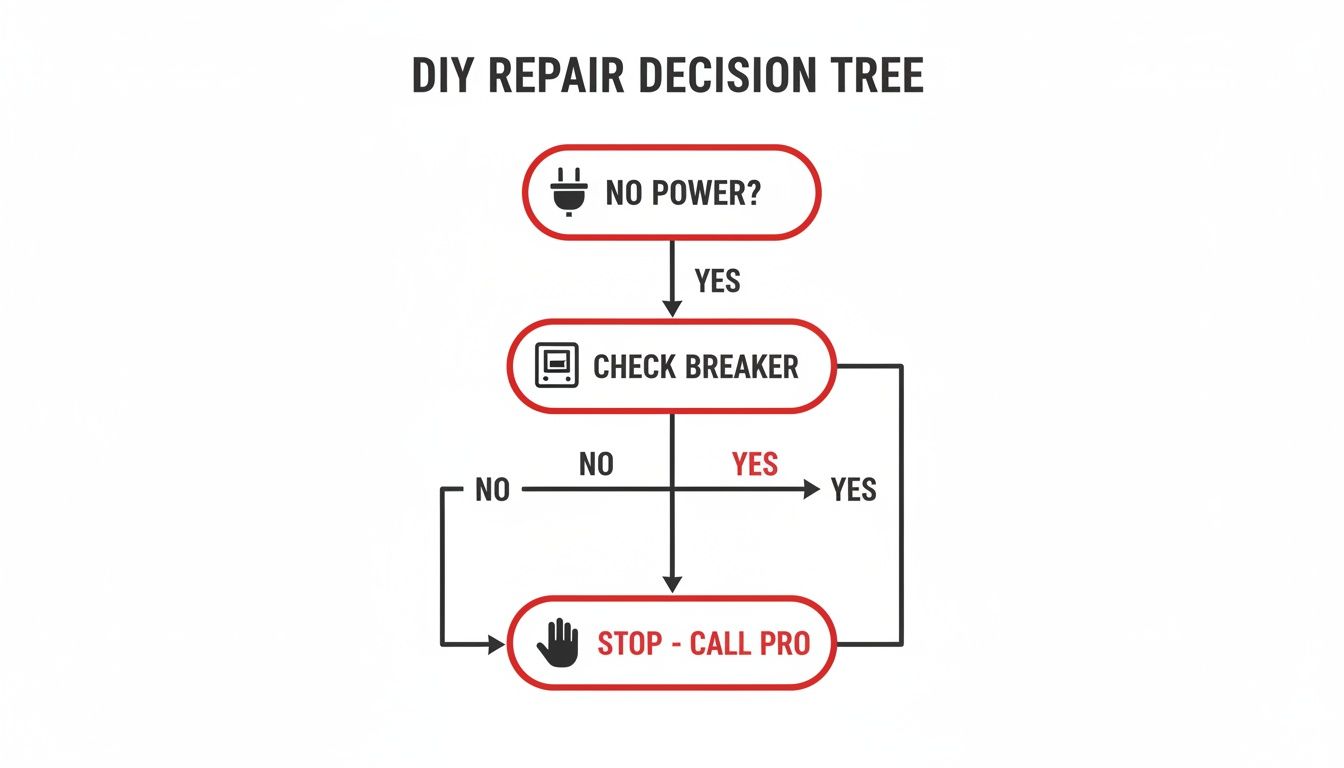
Crucial Safety Warning: Always disconnect the appliance from its power source before attempting any inspection or troubleshooting. For built-in models, go to your home's electrical panel and flip the corresponding circuit breaker to the "OFF" position. This is non-negotiable to prevent the risk of electric shock.
- Check the Circuit Breaker: Go to your electrical panel. If the breaker for your appliance has tripped (it will be in the middle position), turn it fully to "OFF" and then back to "ON" to reset it. This can often resolve power issues caused by a minor surge.
- Inspect Filters and Vents: For a dishwasher, remove and clean the filter at the bottom of the tub to remove any food debris causing a drainage issue. For a refrigerator, ensure that the air vents inside are not blocked by grocery items, as this restricts airflow and affects cooling.
- Perform a Hard Reset: Turn the circuit breaker off and leave it off for at least five minutes. This allows the appliance's internal computer (control board) to fully discharge and reboot, which can clear minor electronic glitches.
- Clean Condenser Coils (Refrigerators): If you can safely access the coils at the back or bottom of your refrigerator, use a vacuum with a brush attachment to gently clean away dust and pet hair. This simple maintenance can significantly improve cooling efficiency.
- Test the Door Seal: For ovens and refrigerators, close the door on a piece of paper or a dollar bill. If you can pull it out easily without any resistance, the door gasket may be worn and needs replacing.
- Confirm Settings: Double-check the appliance settings. It's easy to accidentally engage a "Control Lock" or "Sabbath Mode," which can make it seem like the appliance is not responding.
If these steps don't resolve the issue, it's time to stop. Further investigation requires specialized tools and knowledge of electrical and mechanical systems. Do not attempt to disassemble panels or test components yourself. For your safety and to avoid causing more damage, call a certified technician.
KitchenAid Repair Cost Breakdown in Alberta
Understanding potential repair costs helps you make an informed decision. For homeowners in Edmonton, Calgary, and Red Deer, a typical repair bill consists of three main parts: a diagnostic fee, the cost of parts, and labour. At Advance Appliance Ltd, we waive the diagnostic fee if you proceed with the recommended repair, rolling it into the total cost.
| Repair Type | Typical Cost | Notes |
|---|---|---|
| Diagnostic Fee | $120–$150 | Waived with any completed repair. Covers technician's travel and troubleshooting time. |
| Common Parts | $150–$650 | Price varies widely by component, from a simple door latch to a complex control board or compressor. |
| Labour | $150–$260/hr | Rate is based on the complexity of the job and the time required by a certified technician. |
Note: Prices are estimates and do not include GST. Final costs may vary based on your location (Edmonton, Calgary, Red Deer) and the specific nature of the repair. For a deeper dive, see our average appliance repair cost breakdown.
Failure Rate & Repair Cost Chart
Chart Description: The following chart compares the failure rate and average repair cost for key KitchenAid components over the last two years. Gray bars represent last year's data, while light blue bars represent the current year's data. This visual helps identify trends in component reliability and repair expenses in Alberta. (Visual to be generated by AI).
- Component Failure Rates: The chart shows a slight increase in control board failures this year, likely due to power grid fluctuations. However, bake element and igniter failures remain consistent.
- Average Repair Costs: Repair costs for defrost systems have risen modestly due to increased part costs, while labour for drain pump replacements has remained stable.
Repair vs. Replace: Making the Smart Choice
Deciding whether to repair or replace your KitchenAid appliance comes down to a simple cost-benefit analysis. We recommend using the "50% Rule" to guide your decision.
- Replace if: The estimated repair cost is more than 50% of the price of a new, comparable appliance.
- Repair if: The repair cost is well under 50% of the replacement cost, especially if the appliance is less than 10 years old.
KitchenAid built-in appliances have an expected lifespan of 12-15 years. If your appliance is only halfway through its life, a repair is almost always the more economical and sustainable choice. High-end brands like KitchenAid and Sub-Zero are designed to be serviced, unlike some Samsung or LG models where parts can be harder to source. You can find more details in our guide on appliances that are worth repairing versus replacing.
Preventive Maintenance Tips to Extend Appliance Life
Proper care can prevent many common issues and prolong the life of your KitchenAid appliances. Incorporate these simple habits into your routine:
- Clean Oven Interiors Regularly: Wipe up spills promptly to prevent them from burning on, which can damage the enamel and interfere with heating elements.
- Check and Clean Dishwasher Filters: Clean the filter at the bottom of your dishwasher monthly to ensure proper drainage and cleaning performance.
- Clean Refrigerator Coils: Every six months, vacuum the condenser coils to improve efficiency and reduce strain on the compressor.
- Inspect Door Gaskets: Regularly check the seals on your oven and refrigerator doors for cracks or wear. A tight seal is crucial for temperature regulation.
- Don't Overload Your Dishwasher: Overcrowding blocks water jets, leading to poor cleaning and putting extra stress on the wash motor.
- Use the Self-Clean Feature Sparingly: The high heat of a self-clean cycle can be hard on electronic components. Use it only when necessary.
- Ensure Proper Ventilation: Make sure built-in appliances have adequate clearance around them as specified by the manufacturer to prevent overheating.
- Schedule Annual Professional Inspections: A certified technician can spot potential issues before they become major, expensive repairs.
Brand-Specific Notes for Common Appliances
While we specialize in KitchenAid, our technicians are certified to service all major brands. Here are some common issues and characteristics we see.
Samsung
- Known Issues: Ice maker failures in French door refrigerators are extremely common. Control board issues on various appliances.
- Parts Availability: Can be inconsistent, with delays for certain electronic components.
- Difficulty: Medium to High. Complex electronics often require specialized diagnostics.
LG
- Known Issues: Linear compressor failures in refrigerators are a well-documented problem. Drainage issues in front-load washing machines.
- Parts Availability: Generally good, but compressor replacements are a major job.
- Difficulty: High. Compressor repairs are complex and should only be done by certified technicians.
Whirlpool
- Known Issues: Thermal fuse failures in dryers, actuator problems in washing machines. Generally reliable appliances.
- Parts Availability: Excellent. As a parent company to KitchenAid and Maytag, parts are widely available.
- Difficulty: Low to Medium. Many repairs are straightforward for a trained technician.
GE
- Known Issues: Water valve issues in dishwashers, faulty igniters in gas ranges.
- Parts Availability: Very good. Parts are readily accessible throughout North America.
- Difficulty: Low to Medium. GE appliances are typically designed for serviceability.
Bosch
- Known Issues: Drainage and pump issues in their famously quiet dishwashers. Control panel glitches.
- Parts Availability: Good, but can be more expensive than domestic brands.
- Difficulty: Medium. German engineering means precise but sometimes complex disassembly.
Maytag
- Known Issues: Drive belt and motor issues in older washers and dryers. Similar to Whirlpool in reliability.
- Parts Availability: Excellent. Shares many components with the Whirlpool family of brands.
- Difficulty: Low to Medium. Known for being durable and relatively easy to service.
Frequently Asked Questions (FAQs)
Here are answers to common questions we receive from homeowners in Edmonton, Calgary, and Red Deer about KitchenAid built-in appliance repair.
When should I call a technician immediately?
Call a professional right away if you smell gas, see sparks, have a significant water leak, or if the appliance is completely unresponsive after you've checked the circuit breaker. Your safety is the top priority. Don't take unnecessary risks. Our guide on whether it's safe to repair your own appliances has more info.
Is it worth repairing an older KitchenAid appliance?
Yes, often it is. KitchenAid appliances are built to last 12-15 years or more. If your 8 or 10-year-old appliance has a repairable issue, it is almost always more cost-effective to fix it than to replace it with a new model of similar quality.
How long will the repair take?
Most common repairs are completed in 1-2 hours during the first visit. Our service vehicles are stocked with genuine KitchenAid parts to ensure a fast and efficient fix. If a special-order part is needed, we can typically source it within 3-5 business days.
Does your repair come with a warranty?
Yes. We stand behind our work with a comprehensive 90-day warranty on all parts and labour. If the same issue reoccurs within that period, we will come back and fix it at no charge.
Will a repair affect my manufacturer's warranty?
Using a certified technician and genuine manufacturer parts, as we do, helps protect any remaining warranty. DIY repairs or using third-party parts can void your warranty coverage entirely.
How much does a typical KitchenAid repair cost in Alberta?
The total cost depends on the issue, but most repairs fall between $250 and $800, including the service call, parts, and labour. We always provide a detailed, upfront quote before any work begins, so there are no surprises.
Final Summary
When your KitchenAid built-in appliance fails, a timely and professional repair is the most effective solution to protect your investment and restore your kitchen's functionality. While simple troubleshooting steps like resetting the circuit breaker or cleaning a filter can sometimes resolve minor issues, most problems require the expertise of a certified technician. Attempting complex DIY repairs on high-end appliances can lead to further damage, safety hazards, and voided warranties. For a reliable and lasting fix, the safest choice is to seek a professional diagnosis from a trusted expert. For more information, read why you should hire a professional repair service.
Book Your KitchenAid Repair Today
Don't let a broken appliance disrupt your life. Our certified technicians are ready to provide fast, reliable KitchenAid built-in appliance repair across Alberta.
Edmonton Customers
📅 Book Online: https://advanceappliance.ca/scheduler/
📞 Call Us: 587-882-3225
Calgary & Red Deer Customers
📅 Book Online: https://www.advanceapplianceltd.com/
Same-day or next-day appointments available. Certified technicians. Warranty on parts and labour.