

Mon–Fri 7:30–11PM • Sat–Sun 7:30–7PM
Internal training reference for Advance Appliance Ltd technicians. This guide explains how VCC (Variable Capacity) compressors work, how speed is controlled, and how to safely diagnose compressor, inverter, and control faults.
For additional field safety requirements, see our safety tools and procedures guide .
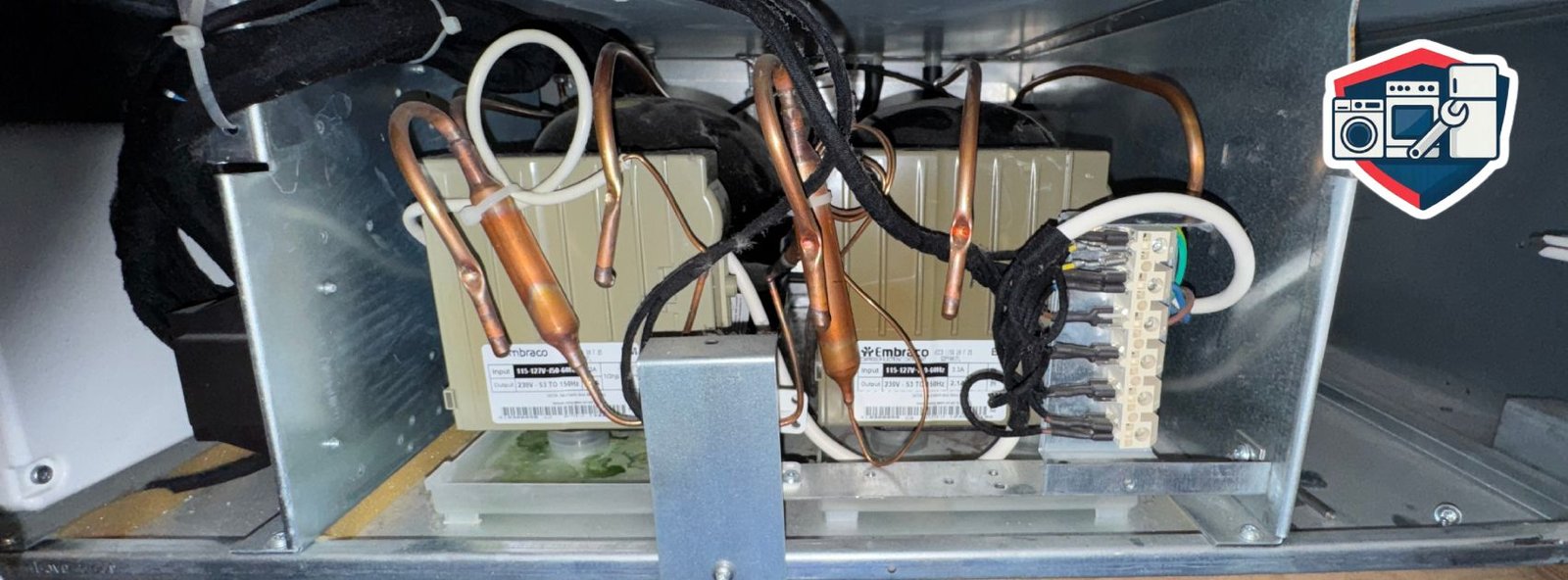
A VCC (Variable Capacity Compressor) is controlled by a frequency (inverter) control board mounted next to and wired to the compressor. The VCC runs at various speeds depending on the thermal load in the refrigerator and the ambient temperature.
The starting speed and subsequent speed increases depend on the ambient temperature registered by the NTC and the total compressor runtime.
First speed increase: after ~80 minutes of continuous operation (or ~60 minutes after defrost) the compressor increases by ~600 rpm. Second increase: after a further ~30 minutes, another ~800 rpm. Speed is not reduced while the compressor is running.
The power electronic (inverter) uses discrete output frequencies to control compressor speed. Each frequency corresponds to a specific rpm and cooling capacity.
| Frequency (Hz) | Speed (rpm) | Typical Use |
|---|---|---|
| 53.3 Hz | 1600 rpm | Low cooling demand / energy-saving mode |
| 73.3 Hz | 3600 rpm | High cooling demand / Super mode |
| 100.0 Hz | 3000 rpm | Normal operation at warmer ambient |
| 116.7 Hz | 3500 rpm | High ambient / heavy load |
Higher frequency = higher rpm = more cooling. The system may also default to ~3000 rpm if the ambient air NTC is defective (failsafe behavior).
These tests are done with power off. They confirm if the three-phase compressor motor windings are electrically healthy before further control or inverter diagnosis.
1. Coil-to-Coil Resistance
Small variations due to temperature are acceptable as long as all three readings are equal. If one reading is significantly higher or lower than the others, the winding is likely defective.
2. Coil-to-Ground Test
| Test Result | Interpretation | Action |
|---|---|---|
| All three readings ≈16 Ω, equal | Healthy windings | Proceed to wiring & control tests |
| One reading much lower | Shorted turn / short-circuited coil | Replace compressor (sealed-system repair) |
| One reading much higher | Open winding / interruption | Replace compressor (sealed-system repair) |
| Any coil to ground continuity | Grounded compressor | Replace compressor (sealed-system repair) |
If the measured resistance values deviate significantly (short circuit, interruption, or short-circuited coil), the winding is defective and the compressor must be replaced via a sealed-system repair.
If the compressor windings test correctly, the next steps are to verify wiring from the control to the compressor, test alternate control modules, and determine if the compressor is seized.
If correct resistance values are measured on the compressor, check for continuity in the leads from the VCC2 control module to the compressor.
If all leads and connectors are in order and the compressor still does not run, remove the VCC2 control and replace it temporarily with a VCC3 control.
| VCC3 Test Result | Interpretation | Next Step |
|---|---|---|
| Compressor starts after ~90 s | Compressor & wiring OK, VCC2/control signal suspect | Proceed to VCC Control Testing (speed-signal voltage) |
| Compressor does not start | Possible seized compressor or inverter fault | Evaluate inverter output; likely sealed-system compressor replacement |
If the compressor does not start after approximately 2 minutes of receiving a valid start command and correct inverter output, the compressor is considered seized.
These tests confirm that the VCC control is powered correctly and that the power electronic is sending the correct DC speed-control signal.
Step A – Check at Terminal Block
Step B – Check at VCC Control Input
| Test Location | Reading | Diagnosis |
|---|---|---|
| Terminal block | ~120VAC | Household supply OK |
| Terminal block | 0VAC | Outlet / breaker / supply issue |
| VCC control input | 0VAC but 120VAC at block | Wiring / harness fault to VCC control |
| VCC control input | 120VAC but no operation | Faulty VCC control module |
With the VCC3 control still in the appliance, check the voltage at the speed-control connector while the appliance is turned ON.
| Measured DC Voltage | Interpretation | Action |
|---|---|---|
| Between 1 and 10 VDC | Power electronic is sending a valid speed-control signal. | Install a new VCC2 control (with speed-control connection). |
| 0 VDC | No speed-control signal being sent. | Replace the power electronic and reinstall the original VCC2 control. |
| Above 10 VDC | Invalid / out-of-range signal from power electronic. | Replace the power electronic and reinstall the original VCC2 control. |
Summary: If the speed-signal voltage is 1–10 VDC, the inverter is good and the VCC2 control is suspect. If the speed-signal voltage is 0 VDC or >10 VDC, the inverter (power electronic) is faulty and must be replaced.
Training reference for Advance Appliance Ltd. Explains which brands commonly use inverter technology and the key pros and cons for both customers and technicians. For deeper sealed-system diagnostics, see our internal VCC / inverter compressor guide .
Many newer mid- to high-end appliances now use inverter or variable-speed compressors/motors:
In customer language: most newer mid- to high-end fridges, washers, dryers, and ductless systems now use inverter/variable-speed motors instead of basic ON/OFF designs.
An inverter system uses electronics to control the speed of the compressor or motor instead of simply turning it fully ON or fully OFF.
This is the same concept as VCC (Variable Capacity Compressor) in your sealed system and VCC training modules.
Key benefits you can highlight to customers, plus performance advantages your technicians should know.
Explains why inverter repairs can be more complex and costly, and where Advance Appliance Ltd can stand out.
This justifies premium diagnostic and sealed-system rates for inverter/VCC jobs.